

On November 21, 2017, a letter arrived at the office of the martyred Leader of the Islamic Revolution, Ayatollah Seyyed Ali Khamenei. It was sent by Martyr General Qassem Soleimani, then-commander of the IRGC Quds Force, writing from the battlefields of Syria.
Abu Kamal, the Daesh Takfiri terrorist group’s last major stronghold in the country, had been liberated. The black flag that had come to symbolise the terrorist organisation's reign of brutality had been lowered, and the Syrian national flag raised in its place.
There was no lengthy military assessment in the letter's central declaration. General Soleimani, describing himself as a soldier entrusted with a mission, announced that the territorial rule of Daesh in Iraq and Syria had been brought to an end.
Behind those words lay years of fighting, thousands of lives and a regional campaign against a terrorist organisation that had seized cities, massacred civilians, displaced millions and threatened to redraw the political map of West Asia.
General Soleimani paid tribute to the fighters who had confronted the terrorist group, acknowledged the sacrifices of those who had fallen and identified the foreign interventions and political calculations that had enabled the terrorist organisation to emerge and expand.
Nine years later, as Iran marks National Hero Day, the letter remains a significant record of the top anti-terror general’s role in one of the region's most consequential military campaigns.
Summer 2014 in Iraq and Syria
To understand its significance, it is necessary to return to the summer of 2014, when Daesh appeared capable of remaking the map of West Asia.
The Takfiri terrorist organisation had grown out of al-Qaeda in Iraq, whose networks flourished in the aftermath of the US-led invasion and the dismantling of Iraq's state and security institutions.
In October 2006, Abu Omar al-Baghdadi announced the formation of the so-called Islamic State of Iraq. Abu Bakr al-Baghdadi assumed its leadership in 2010, and the organisation expanded into Syria as the war there intensified.
In 2013, it declared itself the “Islamic State of Iraq and Syria”.Then came Mosul.
In June 2014, the Daesh Takfiri group captured Iraq's second-largest city. Iraqi military positions collapsed and the group acquired the resources to advance further.
Baghdad itself faced a growing threat. Erbil, the capital of the Kurdistan Region, was also in danger.
Across the border, Daesh was consolidating its control over large areas of Syria. Its fighters carried out mass executions, enslaved women, destroyed religious and historical sites and subjected entire communities to violence. Christians, Yazidis, Muslims and other minorities were among those targeted.
The Takfiri terrorist organisation was no longer an insurgent group operating in isolated areas. Now it had an army, territory, financial resources and an ambition to establish a permanent political order through terror.
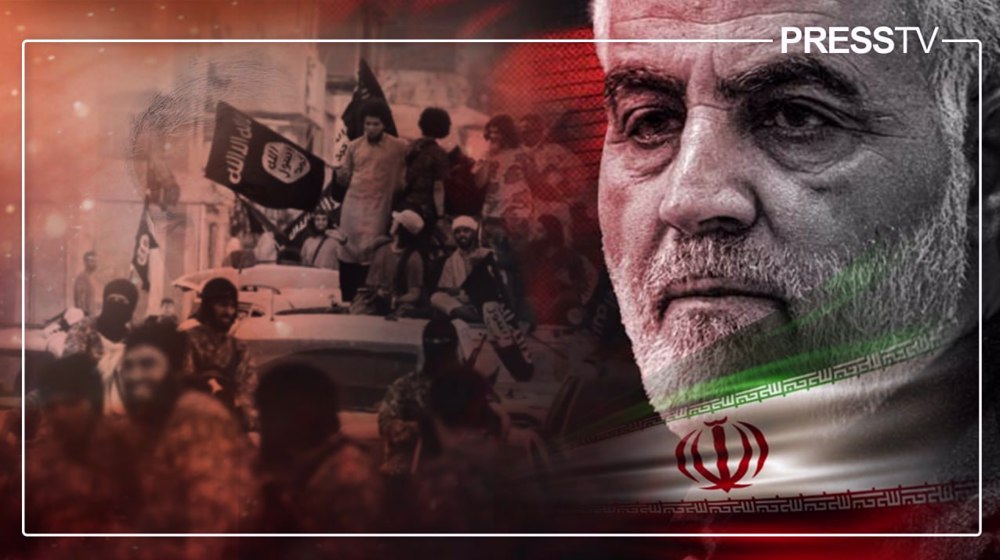
The commander who went to the front lines
One episode from the summer of 2014 illustrates the urgency of the situation and the role General Soleimani came to play.
As the Daesh terrorists advanced towards Erbil in August 2014, Kurdistan Region president Masoud Barzani contacted the United States, Turkey, Britain, France and Saudi Arabia, seeking urgent assistance.
According to Barzani's account, none could provide the immediate support he needed. He then turned to Iran and contacted General Soleimani. General Soleimani promised to arrive by the following morning and asked Barzani to hold the city through the night.
According to Barzani, the Iranian anti-terror commander arrived at Erbil airport with roughly 50 personnel, went to the front lines and helped reorganise the Peshmerga forces.
Iran's involvement in Iraq and Syria was not limited to this episode. Following requests from the governments in Baghdad and Damascus, Tehran provided military advisers and support to forces fighting the Daesh terrorist group.
In Iraq, the Popular Mobilisation Forces (PMU) became a major component of the campaign. In Syria, Iranian advisers worked alongside the Syrian army and allied formations.
General Soleimani became one of the central figures in coordinating this regional effort. He moved between battlefronts, maintained contact with local commanders and helped coordinate forces confronting Daesh across two countries. His presence among fighters was a defining feature of his military leadership.
The campaign brought together forces from several countries and communities. Iraqi and Syrian troops, Iranian advisers, Hezbollah fighters and volunteers from Afghanistan and Pakistan all contributed to the confrontation with the Takfiri terrorist group.
In his November 2017 letter, General Soleimani specifically acknowledged the contribution of these fighters, paying tribute to those who had been killed or wounded.
Powers behind the rise of the Daesh Takfiri group
The Takfiri terrorist group did not emerge in a political vacuum, nor did it build its military strength in isolation. Its rise was inseparable from the foreign interventions, proxy wars and regional strategies pursued by Washington and Tel Aviv and their allies.
The 2003 US invasion of Iraq dismantled the country's state institutions, disbanded its army and unleashed the instability from which al-Qaeda in Iraq emerged.
That organisation would eventually evolve into Daesh. Washington then pursued government-toppling policies in Syria, supporting an armed opposition in a conflict increasingly dominated by extremist and sectarian forces.
A declassified US Defence Intelligence Agency assessment, dated August 2012, provided particularly revealing evidence of what Washington knew. The document identified al-Qaeda in Iraq, the Muslim Brotherhood and Salafist groups as the "major forces driving the insurgency in Syria."
It also recorded that Western countries, Persian Gulf states and Turkey were supporting the opposition's efforts to seize territory in eastern Syria.
Most strikingly, the assessment envisaged the establishment of a "Salafist principality" in eastern Syria and warned that al-Qaeda in Iraq could declare an “Islamic State” through its merger with other terrorist organisations operating in Syria and Iraq.
It described such a development as being in accordance with the objectives of the powers supporting the opposition, which sought to isolate the Syrian government.
In August 2012, almost two years before the Takfiri group declared its so-called caliphate, Washington's own intelligence apparatus had already identified the extremist forces driving the insurgency and the possibility of an “Islamic State” emerging across the Iraqi-Syrian border.
Israeli regime and the rise of Daesh
Israel's role in the Syrian war adds another dimension to this picture. Its support for armed mercenary groups fighting the Syrian government was not merely an allegation made by Damascus. In January 2019, outgoing Israeli military chief Gadi Eisenkot acknowledged that Israel had supplied weapons to Syrian terrorist groups.
Investigative reporting had previously documented Israeli financial and military assistance to terrorist factions in southern Syria, including weapons, ammunition and payments to fighters. Israeli occupation forces also treated wounded members of the al-Qaeda-affiliated al-Nusra Front, as the regime’s media reported at the time.
Reports suggest it was an Israeli strategy to cultivate terrorist groups along the Syrian border, weaken the Syrian government's control and prevent the consolidation of forces allied with Iran and the resistance.
The military arsenal Daesh deployed across Iraq and Syria offered another indication of the external networks and regional policies that shaped the war.
Its fighters operated US-made Humvees and possessed ammunition, explosive weaponry and military supplies, including rations reportedly originating from the United States, Turkey and Saudi Arabia. Israeli-origin ammunition was also reported among the supplies.
The issue of external backing came into sharper focus following Daesh's takeover of the historic Syrian city of Palmyra.
Writing about the aftermath of the city's capture, political analyst Dr Tim Anderson cited the account of a Syrian general who described Washington and its close regional allies, Turkey, Saudi Arabia, Qatar and Israel, as backers of the offensive that brought Palmyra under Daesh control.
For Iran, these developments were part of a wider pattern. The leadership has repeatedly stated that Washington and Tel Aviv were exploiting Takfiri extremism as an instrument of regional policy: weakening independent governments, deepening divisions among Muslim communities and undermining the resistance against Israel.
The martyred Leader of the Islamic Revolution, Ayatollah Seyyed Ali Khamenei, made this assessment explicit in his response to Martyr General Qassem Soleimani's 2017 letter.
He described Daesh as an instrument of a project aimed at provoking civil war among Muslims, destroying the resistance against Israel and weakening independent governments across the region.
Washington presented itself as the leading force in the international campaign against Daesh, while Iran maintained that the takfiriorganisation's rise could not be separated from the foreign interventions and regional power struggles that had enabled its expansion.
Abu Kamal and the meaning of victory
By November 2017, Daesh had lost Mosul and other major strongholds in Iraq. In Syria, the campaign had pushed the terrorist organisation towards Abu Kamal, near the Iraqi border. The city's liberation dealt a death blow to its territorial project.
In his letter, General Soleimani described the devastation left behind: destroyed infrastructure, displaced populations, ruined religious and historical sites and the suffering inflicted on ordinary people.
He announced that Abu Kamal had been liberated, the group's flag lowered and the Syrian flag raised. The project that the Takfiri group had built across Iraq and Syria had collapsed.
Ayatollah Khamenei, in his response, congratulated General Soleimani and the forces involved, describing their achievement as the uprooting of an evil tree planted by the tyrants of the world. However, he warned that Daesh’s territorial defeat would not end the forces and policies behind its rise.
Three years later, on January 3, 2020, the United States assassinated General Soleimani in a drone strike near Baghdad airport, on President Donald Trump’s orders.
The irony was stark: the United States assassinated the top anti-terror commander who had played a leading role in defeating the very terrorist organisation Washington claimed to fight.
 This makes it easy to access the Press TV website