

By Mohammad Ali Haqshenas
Gianni Infantino is looking to get another four-year term as FIFA president (until 2031), but that bid is being made against a backdrop of increasing criticism of his leadership, a very divided European football establishment and the unresolved question of whether he is in fact legally entitled to stand again.
The election—to be held on March 18, 2027, at the 77th FIFA Congress in Rabat, Morocco—will be the one that decides whether Infantino can go on to a fourth term as the football governing body’s president (his first term having started in 2016).
Despite the controversy, the incumbent clearly has the backing of a large number of the 211 member associations. The opposition is in a very tricky position in that they have to turn the criticism of his leadership into a credible coalition.
How does the FIFA presidential election work?
FIFA Congress elects the president, with each of the 211 member associations entitled to one vote, irrespective of the footballing or financial position of the country in question.
The six continental confederations don’t actually elect the president, though their political influence and ability to rally support can have a massive bearing on the outcome.
UEFA (Europe) has 55 votes, CAF (Africa) 54 and AFC (Asia) 46. CONCACAF (North & Central America and the Caribbean) has 35, OFC (Oceania) 11 and CONMEBOL (South America) 10.
Africa and Asia together have 100 votes, which is a huge proportion of the total (211), so those two confederations are going to be very important to any candidate looking to build a winning coalition.
Europe is the largest in terms of numbers, but it’s not going to be enough for UEFA to simply decide the outcome.
If more than two candidates are still in the running, then a two-thirds majority is required in the first round. If no one gets that, then the candidate with the fewest votes is eliminated and it moves to a second ballot. Once only two candidates are left, a simple majority is enough.
A candidate must have been actively involved in association football for at least two of the previous five years, be nominated by a member association and have the support of at least five associations. They must also pass FIFA’s eligibility and integrity checks.
The nomination deadline was November 18, and the four men currently in the running are Infantino, Philippe Diallo (president of the French Football Federation), Kozo Tashima (honorary president of the Japan Football Association) and Ramon Vega (former Switzerland international).
Who are Infantino’s challengers?
Diallo is clearly the most serious contender, having got the backing of the 21-member UEFA Executive Committee.
The French football chief has been critical of Infantino’s centralised approach to leadership and has questioned a number of his decisions, including the award of the FIFA Peace Prize to Trump.
However, UEFA’s endorsement in no way gives him 55 votes. The individual associations still have their votes, and it’s not at all clear how many will go along with the executive committee. Diallo’s ability to get support outside of Europe will be key to his chances.
Tashima (former Japan international and coach, FIFA Council member since 2015) is also in the running for the coveted post. He has been very much focused on governance and transparency and has confirmed that his nomination was submitted with the backing of at least five associations, though he hasn’t named them.
⚽️ Former Japan Football Association president Kozo Tashima is reportedly considering a FIFA presidency bid, potentially challenging incumbent Gianni Infantino in the upcoming election, with his chances estimated at 30 percent.@presstvsports pic.twitter.com/l1iQ43LEP7
— Press TV Sports (@presstvsports) November 15, 2026
His chances are further complicated by the AFC’s endorsement of Infantino.
Vega was a former Switzerland captain and has the business experience to be a candidate. He has stood for president of FIFA on several occasions (2015, 2019 and 2023), and all of those attempts have so far been unsuccessful.
The fact that he has lost on three occasions is in itself a bit of a question mark in terms of his ability to put together a broad enough electoral base.
Former Arsenal manager Arsène Wenger was also discussed as a possible alternative but declined to run, while CONCACAF president Victor Montagliani has opted to pursue a leadership position within his own confederation.
Why is it hard to beat Infantino?
Infantino’s principal advantage is not simply that he is the incumbent but that he has the apparent backing of the majority of the member associations.
A number of confederation leaders (particularly in Asia and Africa) have backed his leadership. He has also stated that the overwhelming majority of the national associations are in his camp.
That support is in part a reflection of the value of FIFA’s development programmes and funding to the smaller associations, as well as the commercial expansion and increased global footprint of his presidency.
His supporters can point to the expansion of the international competitions and the increased commercial opportunities available to the member associations as proof of progress.
The critics would argue that the commercial side of the game has not been matched by an equivalent level of transparency, accountability and institutional independence in the football body.
This is a major hurdle for the opposition: the discontent of a number of senior European figures is not necessarily indicative of the views of the wider FIFA membership.
For Diallo or any other challenger to win, the criticism of Infantino would have to be backed up by a properly coordinated campaign which could pull support from a number of confederations. With multiple challengers in the field, you could end up splitting the opposition’s own vote.
What is the FFE controversy?
One of the most serious governance issues of Infantino’s tenure is the proposed commercial venture of FIFA Forward Enterprise (FFE).
Introduced in July 2026, the proposal was to bring the major commercial operations (broadcasting, sponsorship, licensing, ticketing, hospitality, etc.) together into a single entity. FIFA also looked at the possibility of attracting private investors via the sale of a minority stake whilst maintaining control.
The plan was for an investment of up to $4.2bn on the back of an estimated enterprise value of $20bn.
The plan was criticised for the lack of consultation and transparency and the prospect of private capital taking a significant slice of FIFA’s business. The scheme also raised eyebrows for its links to the brother of Jared Kushner (Trump’s son-in-law).
The proposal was withdrawn on July 31, and Infantino duly apologised to the members of the FIFA Council amid the backlash.
The matter then took on a legal complexion, with UEFA moving to obtain evidence via US court proceedings as part of its investigation into whether the project warranted a criminal complaint against the relevant FIFA officials in Switzerland.
FIFA’s US subsidiaries sought to get involved in the process of gathering the evidence, but that was denied by the judge.
How did Trump’s Peace Prize raise questions about FIFA’s political independence?
Infantino’s intimate relationship with Trump has become yet another point of criticism.
The FIFA boss has been seen on numerous occasions with the US president at political and public events, including at Trump’s inauguration in January 2025.
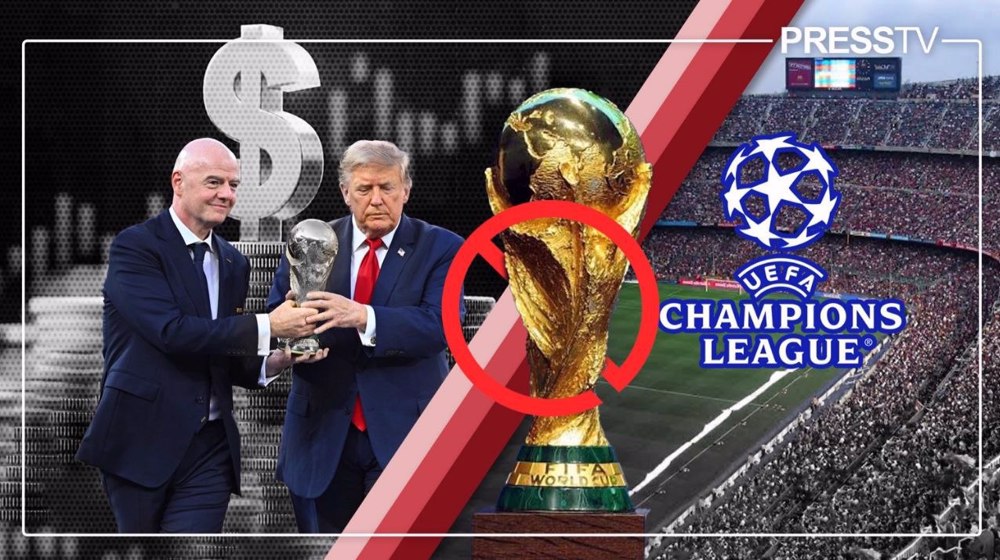
The relationship was under the microscope when FIFA launched its so-called Peace Prize and awarded the first such prize to Trump at the 2026 World Cup draw in Washington in December 2025.
The decision raised questions about the award’s criteria, its transparency and its consistency with FIFA’s stated commitment to political neutrality. There has also been internal criticism, with members of the Council reportedly calling for the prize to be scrapped or depoliticised.

The controversy flared up during the 2026 World Cup when Trump got in touch with Infantino regarding Balogun’s red card suspension after the US game against Bosnia and Herzegovina.
Although the red card itself stayed in place, FIFA’s Disciplinary Committee suspended the implementation of the one-match ban that would have followed for a period of one year on probation. That therefore allowed the forward to play against Belgium.
Could US lawmakers force Infantino to give evidence?
FIFA’s relationship with the Trump administration has also come in for criticism in Washington.
In July, Democratic Congressman Jamie Raskin asked for records of the communications between FIFA and Trump, his administration and the Trump Organisation.
Raskin also wanted information as to any gifts, payments or other benefits given to Trump, his family or any of the entities associated with him and also wanted the visitor logs for FIFA’s office in the Trump Tower office in New York.
He asked for an interview with Infantino to be transcribed and asked FIFA to keep the relevant correspondence. His concerns were that FIFA had been seeking political favours in the course of its commercial and World Cup activities.
With Democrats back in control of the House, Raskin is in a position to become chairman of the Judiciary Committee and thus would have the power to push the inquiry forward.

Can Infantino legally serve a fourth term?
Beyond the political contest, the big issue is whether Infantino is eligible to run again.
According to the FIFA Statute, no person shall be elected president for more than three terms (consecutive or otherwise). Previous service as vice president or member of the FIFA Council shall not count towards this limit.
Infantino was first elected in February 2016 to complete the remainder of Sepp Blatter’s term of office (which was due to end in 2019). He was re-elected in 2019 and again in 2023.
In December 2022, the FIFA Council agreed unanimously that Infantino’s first term should not count towards the term limit, on the basis that he had in fact completed the mandate of his predecessor, which had been broken off.
Under that interpretation, his 2019–23 and 2023–27 terms are his first two countable terms. A win in 2027 would therefore give him a fourth term, taking his presidency to 2031.
However, former FIFA governance committee chairman Miguel Maduro has challenged that interpretation.
“Article 33, paragraph two of the FIFA statutes is very clear when it says no person may serve as president for more than three terms,” Maduro told reporters earlier this month.
“Gianni Infantino has been elected three times, he’s been president of FIFA for three terms. So, in my view, there’s no way to reconcile another presidency of Infantino.”
What’s at stake in 2027?
Infantino is in a strong position to win the election, having the institutional advantages of the game at his disposal. He is, however, under criticism over commercial transparency, the nature of his political relationships and the way FIFA is governed.
His challengers will have to show that opposition to his leadership goes beyond the prominent football officials and can in fact command the support of a majority of the national associations.
The election therefore represents two very different tests. On the political front, it will be a test of whether the opposition can put together a coalition capable of unseating Infantino.
Legally, it will be a test of the interpretation of FIFA’s three-term limit and whether his 2016–19 term should count.
The controversies have put the FIFA leadership under the microscope, but that doesn’t in itself mean Infantino will be voted out.
 This makes it easy to access the Press TV website