

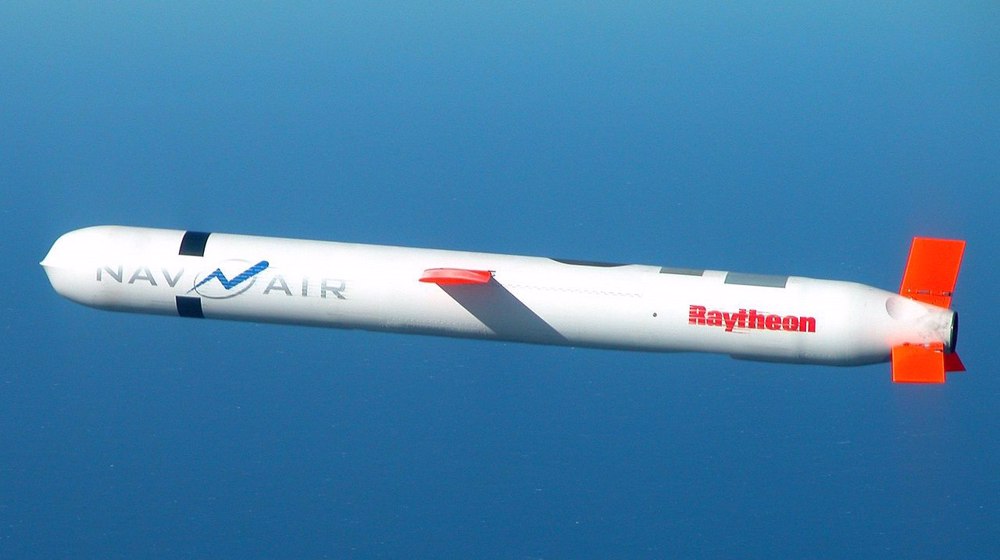
The US Navy has resorted to using expired Tomahawk missiles amid a shortage of critical munitions caused by the war on Iran, US President Donald Trump’s pick for Navy secretary reveals.
During his confirmation hearing on Tuesday, Acting Navy Secretary Hung Cao admitted that the eight-month-old conflict between the United State and the Islamic Republic placed considerable pressure on naval resources, as senators from both parties grilled him on the costs of the war, depleted weapons stockpiles and prolonged deployments.
Cao, who retired from active duty in 2021, said that when he “was in uniform, we only produced 125 Tomahawks a year. Right now we’re well above 60 every month”, adding that production of naval missile interceptors was also being expanded.
He also said that, due to concerns over dwindling missile supplies, Tomahawk production increased substantially, admitting, however, that the Navy is using expired munitions.
“For some of these munitions, we recoded them. And so we’re able to shoot off the expired munitions,” the acting Navy secretary noted.
Each Tomahawk missile costs between $2 million and $4 million, depending on the variant, with some estimates placing the cost as high as $3.5 million per unit.
Senator Elizabeth Warren, a Democrat from Massachusetts, stressed that independent estimates as well as media reports confirm that the naval blockade on Iranian shipping costs about $32.5 million a day and Iranian strikes on the Navy’s regional headquarters in Bahrain did at least $400 million in damage.
Cao, in response, confirmed that maintaining the naval blockade of Iranian shipping costs approximately $32.5 million daily, however, he said that he cannot provide a full assessment of damage to the Navy’s headquarters in Bahrain because “it’s a nonpermissive area for us to go.”
This is while, according to Associated Press, Cao admitted in speaking with a reporter months ago that Iran “blew the hell out of Bahrain.”
Back in August, Reuters, citing sources, reported that the US Army exhausted much of its stockpile of precision long-range missiles - including the Army Tactical Missile System (ATACMS) and the newer Precision Strike Missile (PrSM), two key surface-to-surface systems in the US arsenal - during its months-long war of aggression against Iran.
The strain on US arsenals comes as the Trump administration seeks to expand weapons production. The Center for Strategic and International Studies (CSIS) has already warned, however, that efforts to rapidly replenish “exquisite-class” weapons will take years to bear fruit.
Earlier this year, the White House reached agreements with arms manufacturers aimed at quadrupling production of advanced weapons.
The scale of the depletion was already anticipated. Before the war, senior US military leaders, including Joint Chiefs Chairman General Dan Caine, warned Trump that a prolonged war could severely strain American weapons stocks.
The US, along with Israel, launched an unprovoked war of aggression against Iran – codenamed Operation Epic Fury - in late February 2026, prompting the Islamic Republic to retaliate with waves of missile and drone strikes against the Israeli-occupied territories and US bases and interests across the region.
Tehran has also restricted US and allied vessels from passing through the strategic Strait of Hormuz, in response to Washington's imposition of an illegal blockade against Iran’s southern ports and the country’s shipping.
The move disrupted global energy supplies, sending oil and fuel prices soaring, particularly in the US. Washington and the International Energy Agency (IEA) have since released strategic oil reserves several times in an effort to ease supply pressures.
This is while American officials continue to threaten to resume strikes on Iran, keeping tensions high in recent weeks.
American lawmakers on Tuesday also warned that the months-long conflict with Iran has weakened US military readiness and diverted resources from countering China.
Senate Armed Services Committee ranking Democrat Jack Reed warned that “the munitions expended and damage sustained from Operation Epic Fury alone will take years to recover.”
Cao, however, claimed that the conflict had boosted America's strategic position, saying “it’s really set China back on their heels” by demonstrating cooperation among the military services.
The US acting Navy secretary, a combat veteran and Trump loyalist, is seeking Senate confirmation for the permanent position and must also secure a congressional waiver because he left active-duty service less than seven years ago.
His hearing comes amid mounting political pressure over the war on Iran and recent dismissals of US Navy officials.
Following their midterm election massive losses, Republicans are set to relinquish control of both chambers of Congress to Democrats in January.
 This makes it easy to access the Press TV website