

By Press TV Website Staff
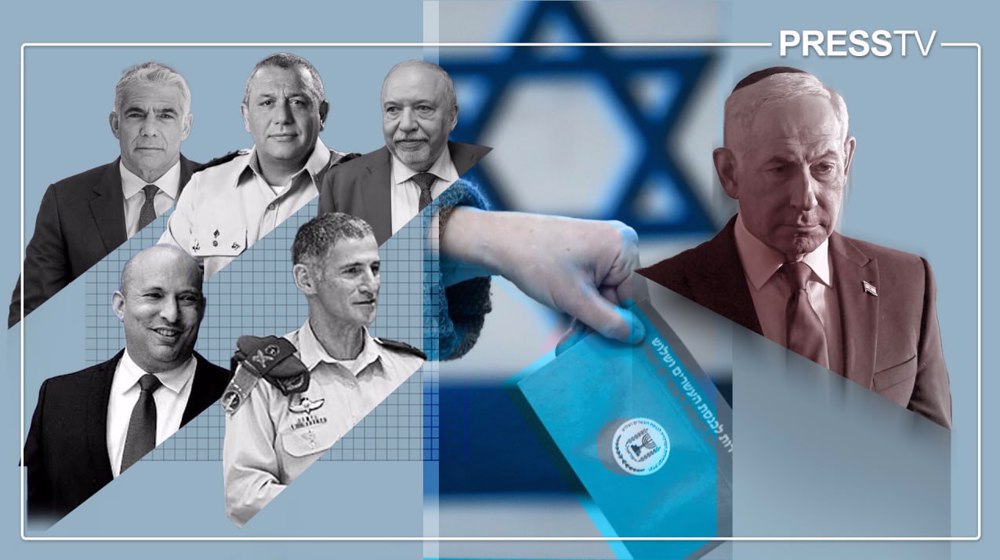
Even if Benjamin Netanyahu leaves office, Israel’s hawkish policies toward Palestinians and its increasingly aggressive military posture across the region are unlikely to change under a new regime led by opposition parties, says a Boston University professor.
Speaking to the Press TV website, Assaf Kfoury noted that no fundamental changes are expected to happen in Israeli aggressive policies with a probable change of cabinet.
“The opposition is no less hawkish or hostile toward Palestinians than Netanyahu’s bloc,” said Kfoury, a professor in Boston University’s Computer Science Department.
Kfoury noted that replacing Netanyahu would not necessarily bring a meaningful change in Israel’s aggressive approach to Gaza, the occupied West Bank, Lebanon, Iran and Syria.
He pointed out that the destruction of Gaza and the continued occupation of the West Bank were largely absent as subjects of disagreement during the election campaign.
Gadi Eisenkot, the leading opposition figure seeking to replace Netanyahu, has himself demanded recognition of Israel as a “Jewish state” and pledged to destroy Hamas’s military and political power in Gaza.
According to Kfoury, Eisenkot’s political program offers no clear change in policy toward the occupation or Israel’s genocidal conduct in Gaza and said little about the wars against Iran, Lebanon and Syria.
The analyst stressed that the rival political blocs share a rejection of Palestinian rights and an increasingly aggressive regional posture.
The significance of those positions extends beyond the election. Israel's genocidal war on Gaza, launched after the October 7, 2023 Hamas operation, has involved extensive airstrikes, artillery bombardment and ground operations, causing widespread destruction and displacement.
The regime has killed more than 74,300 Palestinians and injured more than 175,000 others, with the UN confirming that the attacks as an act of genocide.

In the occupied West Bank, Israeli military raids, arrests and airstrikes have continued, particularly in Jenin, Tulkarm and Nablus.
Attacks by violent Israeli settlers, protected by Israeli soldiers, have also targeted Palestinian communities. At least 1,216 Palestinians, including 263 children, had been killed by Israeli forces or settlers since October 7, 2023, according to UN figures through September 2026.
Israel's regional military offensives have also extended into Lebanon, Syria and Iran. Its war on Hezbollah escalated into extensive airstrikes and a ground invasion of Lebanon in September 2024.
Despite a ceasefire in November that year, Israeli attacks have continued. In Syria, the regime intensified airstrikes and expanded its ground presence in the south following the collapse of Bashar al-Assad's government in December 2024. Israel also directly launched unprovoked and illegal military aggression against Iran in June 2025 and joined another unlawful attack against the country with the United States in February 2026.
Kfoury noted that Eisenkot had served in Israel’s 2023–24 war cabinet and could potentially join Netanyahu in a so-called “unity government,” particularly if war against Iran resumed.
A different cabinet, he acknowledged, might moderate certain decisions or prove more responsive to international pressure, but he saw no basis for expecting it to end the occupation, adopt a just policy toward Palestinians or abandon military adventurism in the region.
“A change of prime minister should not be confused with a change of political consensus,” he said.
A divided electorate
Kfoury also cautioned against interpreting the October 27 election as an unequivocal rejection of Netanyahu among Israelis.
Likud remains the largest party, winning 27 seats in the 120-member Knesset. Eisenkot’s Yashar secured 21 seats, while Naftali Bennett’s B’Yachad won 12. The Joint List and Ra’am, the two Arab-led political groupings, collectively secured 19 seats.
Netanyahu’s bloc won 53 seats, compared with 48 for the opposition bloc. Neither secured the 61 seats needed for a parliamentary majority. Turnout reached 77.9%, the highest in decades, according to Israeli reporting.

Kfoury said Netanyahu’s bloc had received more votes than the rival Zionist bloc, demonstrating that the outgoing prime minister retains substantial political support despite his genocide in Gaza and failed war against Iran.
“At the same time, his camp failed to win a parliamentary majority, and the parties campaigning to remove him collectively had enough seats to block his return to office,” he noted.
He also highlighted that a majority of voters, by more than half a million votes, had voted against the outgoing cabinet, although the margin among Zionist parties was narrow.
The unusually strong turnout among what has become known as Arab-Israelis was another important factor. Their parties won 19 seats and helped deny either bloc a working majority.
The election represented a “rebuke to Netanyahu” in one sense, but “it did not demonstrate a broad rejection of his politics or of the hard-line consensus on Palestinians,” added the professor.
Coalition deadlock and the prospect of another election
The absence of a parliamentary majority has left several possible routes to cabinet formation, but Kfoury said none was straightforward.
The clearest numerical option for Eisenkot would be a minority regime supported from outside by the Palestinian-led parties, which together hold 19 seats. Such an arrangement could help remove Netanyahu without requiring those parties to formally join a government whose conditions they oppose.
However, Eisenkot’s stated principles, particularly his insistence on recognition of Israel as a so-called “Jewish state” and his commitment to destroying Hamas’s military and political power, make cooperation especially difficult for the Joint List, added the analyst.

Another possibility would be to win the support of ultra-Orthodox parties through concessions, he said, adding, yet their demands, along with objections from Eisenkot’s potential coalition partners, could complicate negotiations.
Another election remains a genuine possibility if the parties fail to reach an agreement. Such a contest could benefit Netanyahu, he added, meaning that the eventual outcome would depend on political bargaining rather than simply the arithmetic of the election results.
Netanyahu's struggle for political survival
Beyond the struggle for political survival, Netanyahu also faces an ongoing trial on charges of fraud, bribery and breach of trust.
“It is clear to most people, inside and outside Israel, that his personal interest in remaining in power is one reason he has an incentive to prolong the wars and crises around him,” he said, adding that the ongoing wars had also provided a pretext for repeated postponements of court hearings.
Losing the premiership, the professor said, would deprive Netanyahu of political authority and influence and could weaken his ability to shape the political environment surrounding his case.
“It might therefore leave him more exposed to political pressure and allow legal proceedings to proceed without the same advantages of incumbency.”
However, Kfoury cautioned against predicting the legal consequences with certainty. Israeli commentators, he said, had not reached a common position on the specific protections Netanyahu might lose, the procedural implications of leaving office or the likely timetable of the trial.
Nor have they established the probability of a conviction or whether imprisonment was likely, added the analyst.
He therefore distinguished between the political consequences of losing office and the separate question of the trial’s outcome.
“His legal jeopardy is real, but we should not conclude that conviction or imprisonment is inevitable.”
 This makes it easy to access the Press TV website