

By Press TV Website Staff
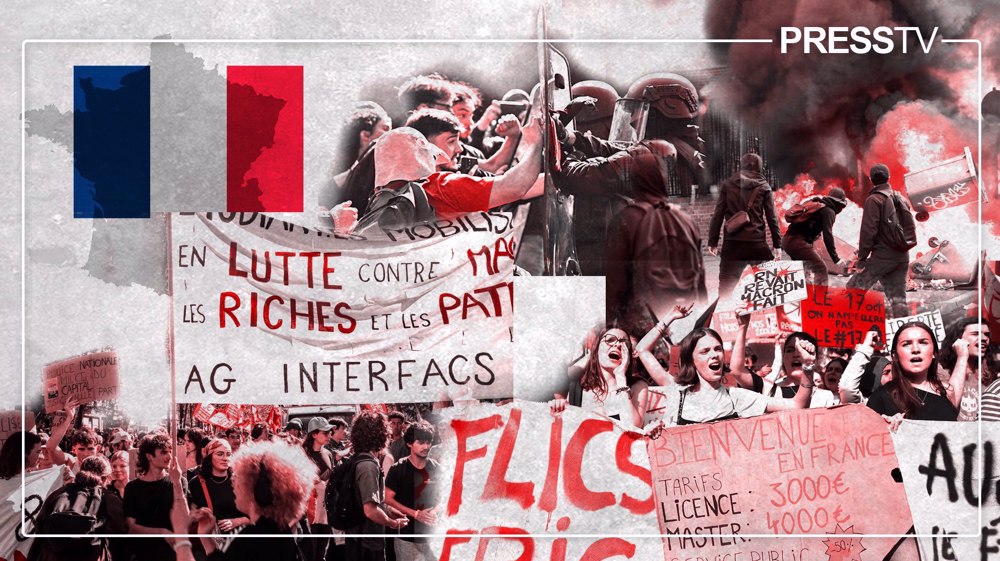
As hundreds of thousands took to the streets across France on Saturday, with protests continuing across Europe, a Belgian economist says the “disastrous war against Russia” and European countries’ continued alignment with Washington are fueling public anger over the rising cost of living.
Speaking to the Press TV website, Belgian economist Xavier Dupret outlined the underlying causes of growing protests across Europe, as high inflation and the escalating cost-of-living crisis fuel public discontent across the continent.
"This resurgence of inflation is stirring up social movements all across the continent," Dupret said.
He said rising inflation across Europe is closely linked to higher gas and oil prices. In France, energy prices rose 21.3% year-on-year in September, contributing to inflation of 3.1%. Italy’s inflation rate reached 4.2%, exceeding the eurozone average of 3.8%.
Dupret further noted that the situation continues to be worse still in France because of how unpopular President Emmanuel Macron has become.
"A French president has never been so unpopular in the past," he said. "It's very unusual."
The public mood is reflected in the polls. An Ipsos BVA-CESI survey for La Tribune Dimanche, published on October 10, put Macron’s approval rating at 15%, its lowest level since he took office in 2017.
With Macron in the final months of his term ahead of France’s presidential election in May, Dupret said the protests point to a broader problem extending beyond France’s borders.
He described it as “the symptom of a generation, the Z generation as we say, which has lost access to a stable situation on the labor markets.”

The French protest movement began with a protest over staff shortages at one high school before students and workers joined. In Italy, 110 of the 371 people briefly detained on Saturday were minors.
Dupret said unemployment was at the heart of the crisis, describing it as “really a plague for European youth” amid very weak GDP growth across the continent.
He also highlighted the gap between young people’s qualifications and their job prospects, noting that nearly 50% of young Europeans hold a college degree.
"We are facing a very, very tough situation, a very polarized political situation," he told the Press TV website, expecting the social movements to grow in the near future.
In France, the far-right National Rally has urged people to turn their anger into votes.
The warning signs were already visible, he said, pointing to unrest in Milan and Belgium. Italy prepared to send 500 troops to Milan after looting, and police in Belgium clashed with demonstrators in Brussels and Liège last week.
Dupret placed the blame on governments. "Those responsible for this terrible situation are our governments," Dupret said. "They have led a disastrous war against Russia."
"The price of gas in Europe is really, really high," he added, calling it "a huge burden for our economy."
Europe’s close ties with the United States were adding to the economic strain, he said, adding that European countries had never chosen to distance themselves from Washington and were now paying the price for that continued alignment.
“We are suffering from the war that [US President] Donald Trump is leading against Iran,” he said, referring to the war of aggression that was jointly launched by the US and the Israeli regime against Iran on February 28, which led to disruptions in oil transfer from the Strait of Hormuz and caused a steep fuel price hike across the world.
He gave Belgium as an example. A liter of oil there now costs more than 2 euros, he said, up 30% in one year. "It's an enormous shock for the standard of living of Belgian citizens."
In that context, Dupret said "insurrectional movements" against European governments would keep happening and keep contesting power.
Organizers show no sign of backing down. Italy's new "Oct. 17 Movement" plans protests every Saturday, and French yellow-vest organizers have called new rallies for Oct. 31.
"We are living in very tense situations," the analyst stated, adding that they made him think of the 1930s and the French Revolution.
Dupret said European societies are marked by deep inequalities, despite the longstanding expectation that each generation would enjoy better living standards than the one before.
“This growth model is broken today,” he said, warning that younger Europeans faced declining living standards and eroding purchasing power, adding that “this structural crisis is transforming into a political crisis, and it is deepening day after day.”
"I would like to remind you that French history has seen a huge revolution that transformed the world, and we cannot exclude that from political phenomena in the future of Europe," he noted.
 This makes it easy to access the Press TV website