

Never-before-published photos and videos have confirmed damage to US military facilities across West Asia during Iran’s retaliatory attacks, with US military personnel slamming their country for mismanagement and inadequate preparations and for “abandoning” them during the recent war on Iran.
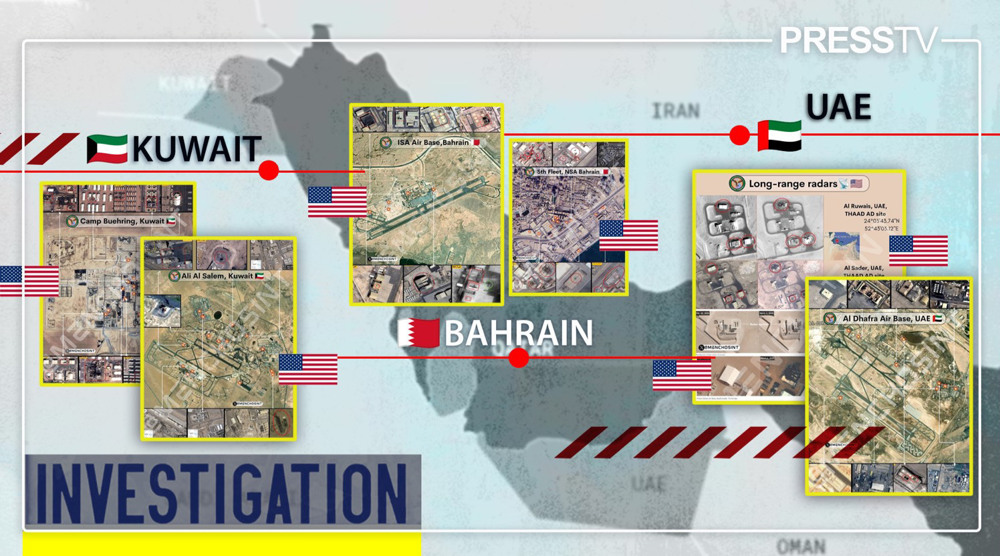
MeidasTouch, in coordination with VALOR Media Network, obtained tens of never-before-seen photos and videos showing damage to US military installations in Saudi Arabia, Jordan, Kuwait, United Arab Emirates, and Bahrain.
As the US censors information about the casualties and damage caused by the retaliatory Iranian strikes, the report also cited firsthand accounts from sources, including service members and civilian contractors, describing destroyed aircraft, bombed-out barracks and mess halls, troops digging their own foxholes, and parking garages turned to shelters.
"It's so much worse than people realize," one source said.
The sources asked not to be named because, they said, they have been repeatedly threatened with disciplinary action under the Uniform Code of Military Justice for speaking out or sharing images.
The sources said their experience was unlike anything they had encountered in other war zones where they had been deployed.
"This is not a normal deployment," multiple sources said, citing a level of mismanagement they had never seen before.
As the US expected to achieve the war’s objectives within few days, one service member described being called up in mid-February and asked to ship out immediately on what was supposed to be a three-week assignment.
However, they ended up staying more than seven months.
Several, even though some of them were directly involved in the war, said they had no advance knowledge of the US-Israeli aggression against Iran, and learned that it had begun from the news. "We are sitting ducks," one said.
They noted that the attacks came almost entirely from the sky: drones, rockets, and ballistic missiles, unlike past wars.
Describing the Iranian drones that targeted their base, one of the troops said, "You can't see them at night. They have no lights and are GPS navigated via coordinates. It sounds exactly like a small Cessna. Looks like a large falcon if it's about 400 feet up. We had no defense against the drones."
Saudi Arabia: Extensive damage at Prince Sultan Air Base
Among the images published by the report were those supplied by US service members and contractors that have showed extensive damage at Prince Sultan Air Base in Saudi Arabia between March and July.
The photos show destroyed dining facilities and workspaces, and damaged dorms where military personnel were living back then, as well as unfinished bunkers.
Other images show aircraft burning on the tarmac after missile attacks.
One photo shows a damaged US Air Force E-3 Sentry AWACS surveillance plane, tail number 81-005. According to the sources, it was hit in an attack that injured between 10 and 12 troops, and left multiple other aircraft, including two KC-135 refueling tankers, damaged.
A source also provided an image they say shows a fully destroyed C-17 cargo aircraft. They noted that it was piled up to speed cleanup and limit knowledge of the loss. That’s while the Pentagon has not confirmed the loss of a C-17.
Jordan: ‘Alarms couldn't keep up’
In Jordan, troops reported roughly three months of near-constant incoming fire beginning in March at Muwaffaq Salti Air Base.
"They were taking incoming fire so frequently that the alarms couldn't keep up," according to one account.
According to the sources, command-and-control facilities and critical infrastructure, as well as multiple US Air Force aircraft were damaged during the strikes, including F-15 fighters, F-35s, MQ-9 Reaper drones, and helicopters.
Citing an attack on the night of July 17 into July 18, sources said Iranian ballistic missiles and drones got past the base's defenses and struck US military barracks.
While three military personnel were reportedly killed, sources said those on the ground were surprised no more deaths were reported as the base was overcrowded at the time of the attack. They said deaths occurred when troops couldn't make it to shelters in time.
Multiple sources said they could hear troops calling for help from inside the flames following the attack, but they could not reach them because of inadequate emergency response and a lack of preparation.
The report said the continued strikes left troops ran out of basic supplies, especially personal hygiene items, and suffering from deteriorated living conditions.
Kuwait: Scattered personnel, abandoned camp
In Kuwait, sources said that after the initial attacks, some US military personnel scattered into the desert and lived out of a van for three months before they could be sent home.
According to sources and images taken in September at Camp Buehring, months after the last attack, a base was almost completely abandoned by the US military.
Multiple sources said no one is allowed in parts of the camp at night.

UAE: Personnel dug their hideouts
In the United Arab Emirates, troops said they had no shelters or protection when the US aggression began.
Some personnel fled to hotels, while others dug their own foxholes.
Troops described leadership as "rudderless," caught off guard by a war no one had prepared them for.
Bahrain: US troops hid in residential buildings
In Bahrain, the report said, Iranian drones or missiles inflicted damage to the US Navy's Fifth Fleet.
Military families say the Pentagon refused to allow the evacuation, despite the existence of evacuation plans and the presence of planes at the Bahrain airport, in order not to "make the situation look bad at home."
Sources say some senior leaders were evacuated under what was presented as a training exercise.
Military families were left to find their own way out.
According to the report, US troops were moved into residential buildings and hotels that were then struck by Iranian drones and missiles within hours.
"We were used as pawns in the war. There were many opportunities to get us out BEFORE things broke bad,” the spouse of a US service member, who was living in Bahrain in March, said.
"The planes were sitting, waiting for the call to be made, but the powers that be didn't make the call to evacuate dependents, and then the Bahrain Airport was damaged and we were trapped."
The wife of a US contractor said she and her husband were living near the US military base when the war began on February 28.
"The US government did absolutely nothing to help me evacuate," she said, adding "As an American citizen, I felt completely abandoned by my own government."
The sources also pointed to the absence of embedded journalists, which have been standard in past American wars.
The accounts paint a picture of collapsing morale, with troops saying they have no idea what they are fighting for.
Many described feeling that "no one was coming to help" and that they were on their own.
"The whole idea of the military caring about service members' mental health is bullshit," one stressed.
"As a service member, you lose rights as an American citizen; you are bound to your contract," said another. "You just have to ride it out and hope you survive."
The US and Israel launched another round of aggression against Iran on February 28, some eight months after carrying out unprovoked attacks on the country.
Iran swiftly retaliated by launching barrages of missiles and drones at the Israeli-occupied territories, as well as US bases and interests across the region.
Following 40 days of war, a memorandum of understanding was signed remotely in June by Iranian President Masoud Pezeshkian and US President Donald Trump under the mediation of Pakistan.
The 14-point memorandum committed both sides to ending military operations "on all fronts" and provided for the suspension of wartime restrictions placed by Iran on the Strait of Hormuz, the lifting of the US naval blockade, and the release of frozen Iranian assets.
However, the US has repeatedly violated the agreement, including through military strikes, the revocation of oil sale licenses, and continued Israeli attacks against Lebanon.
 This makes it easy to access the Press TV website