

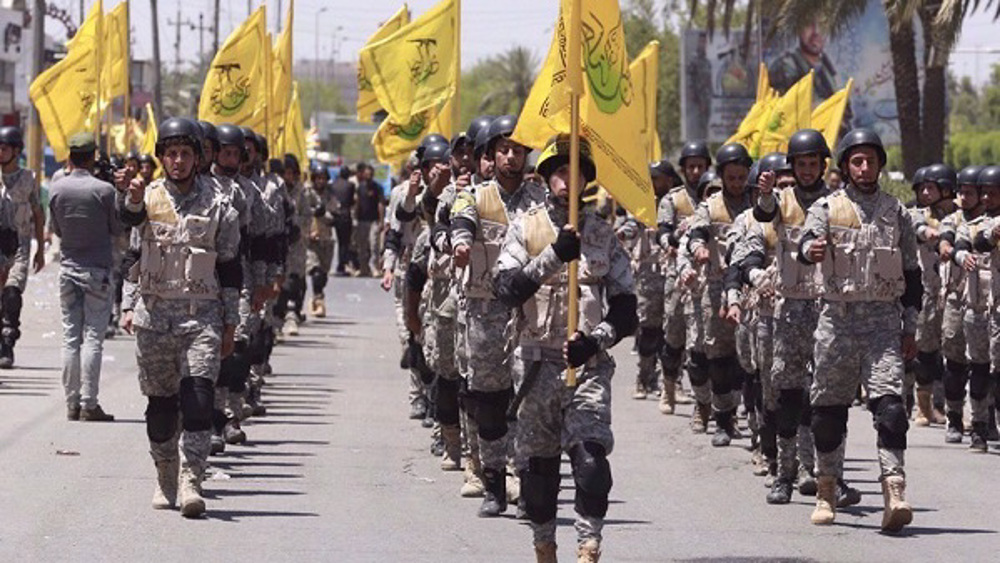
An Iraqi resistance group has rejected disarmament, declaring that its “sacred weapons of the Resistance” will never be surrendered as the government presses ahead with plans to bring all arms under state control.
Abdul Qader al-Karbalaei, military deputy of the Harakat Hezbollah al-Nujaba movement, said on Wednesday that terms such as “disarmament,” “handover” and “restriction” had no place in the Resistance’s vocabulary.
He also dismissed media reports suggesting a change in the movement’s position on Iraq’s political process, stressing that its decision to remain outside it was firm and unchanged.
"Nujaba will remain “among Iraqis, share their hardships and concerns, and advocate for their rights, while expressing hope for a prosperous, fully sovereign Iraq free from corruption,” he noted.
The movement’s rejection comes as Prime Minister Ali Al-Zaidi pursues a plan to place all weapons under exclusive state control.
On August 11, Al-Zaidi instructed officials to draft a bill to that effect during a meeting in Baghdad with Khalid al-Obeidi, head of the Iraqi Parliament’s Security and Defense Committee.
On June 3, Sabah al-Numan, spokesperson for the commander-in-chief of Iraq’s armed forces, announced the formation of a committee to bring all weapons under state control, saying it had already begun its work.
While several Iraqi resistance groups, such as Kata’ib al-Imam Ali, Saraya al-Salam, and Asa’ib Ahl al-Haq, have agreed to integrate into the state’s armed forces, Harakat Hezbollah has pledged to retain “resistance weapons” and further develop its arsenal.
On October 5, Zaidi said three Iraqi armed factions had handed over their weapons, and two others had agreed to do so. He noted that negotiations over arrangements aimed at bringing weapons under state control were underway.
Iraqi resistance groups have maintained that their weapons are essential to safeguarding the country, protecting its people from potential threats and countering destructive plots against the nation.
 This makes it easy to access the Press TV website