

By Yalda Amrouni
French people are angry and rightly so. On Saturday, October 17, they gave vent to that anger to make their voice heard loud and clear. Nearly one million people took to the streets across the country to express their anger over the sordid situation and official indifference.
Ultimately, despite the spectacular turnout, the movement itself is barely being discussed. The date of October 17 had not been chosen randomly. It was the first day of the school holidays and a Saturday, a day when a large part of the population does not work. All the conditions seemed to be in place for a strong and significant mobilization.
Yet, from the very first hours of the demonstration, at around 2 p.m., things quickly spiraled out of control. The official reasons put forward to explain these events remain extremely vague.
Eden, 14: double jaw fracture. Evan, 15: he lost the use of his hand, which was reportedly amputated. Maël, 16: he lost sight in his right eye.
Three young people, three destinies, three tragedies.
How can such violence against young demonstrators who came to express their demands be explained? These are demands that deserve to be heard, particularly in light of the state of disrepair reported in public high schools across the country.
These events took place in France, a country that projects itself as the land of human rights. Where is the respect for fundamental freedoms, the proportionality of the use of force, and the protection of minors during demonstrations?
These questions are compounded by particularly troubling accounts. Lawyers say they were subjected to pressure from police officers in an attempt to discourage victims from filing complaints. This constitutes a serious violation of victims’ rights and raises fundamental questions about the independence of legal proceedings and the transparency of investigations.
The demonstrators are all unanimous. How can it be explained that a mobilization of such magnitude, driven by citizens who came to express their genuine and legitimate anger, concerns, and utter frustration, should so quickly be overshadowed by the incidents that marked the first hours of the movement?
Thousands of people mobilize, families take to the streets, and citizens who no longer feel heard try to make their voices heard. And yet, instead of initiating a debate about the underlying reasons for this mobilization, attention shifts to the unrest, the clashes, and the responsibility that everyone rushes to attribute to their adversary.
The demands take a back seat. Everyday difficulties, purchasing power, the feeling of being abandoned, distrust of institutions, and anxiety about the future disappear behind a succession of official statements and contradictory commentaries.
October 17 should have been a symbolic date, one demonstrating that the French people are not asleep, that their youth is engaged, and that, whatever happens, France belongs to the French. This date should have served as a reminder that France’s long tradition of protest and popular mobilization has not died out.
From the French Revolution of 1789 to Victor Hugo’s struggles for social justice and freedom, from the great workers’ struggles to the May 1968 demonstrations, and up to today’s mobilizations, the same aspiration runs throughout French history: that of a people who mobilize to defend their rights, challenge injustices, and make their voices heard.
This is the historical continuity that October 17 should have embodied: that of a people who, from one generation to the next, refuse to give up their rights and remind everyone that democracy is not limited to the ballot box, but also rests on freedom of expression, the right to demonstrate, and the ability to challenge those in power.
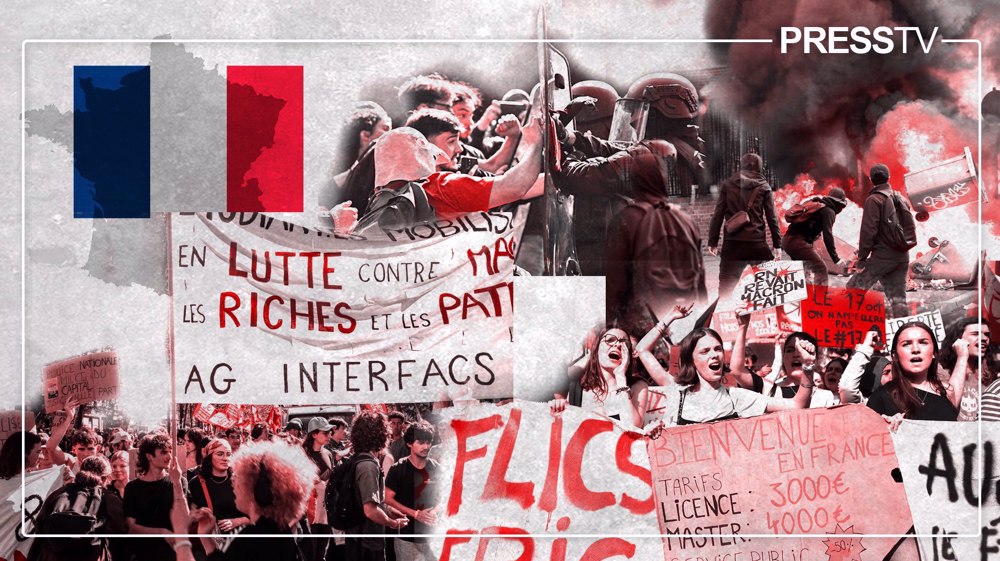
Yet that is not what happened. Just minutes before the authorized processions were due to set off, the police changed their routes, disrupting the planned organization of the demonstration. These last-minute changes quickly created confusion among participants.
Then, from the very beginning of the demonstration, police violence heightened tensions and triggered significant crowd movements. In this situation, panic spread, leading to grievous injuries and fueling the demonstrators’ frustration. Thus, instead of allowing the gathering to proceed under the planned conditions, the sequence of these events contributed to escalating tensions from the very first minutes.
The police terror was carried out using batons and tear gas. Facing the police, equipped with armor and shields, the demonstrators, by contrast, appeared defenseless, with no means of protecting themselves other than using their arms to try to avoid the blows. For many, the demonstration then turned into an ordeal marked by injuries, bruises, and fear.
The police did not arrive empty-handed on October 17. Their arsenal included tear gas, crowd-control grenades – particularly EF-SON grenades, explicitly mentioned by the minister – as well as various types of grenades: tear-gas grenades, encirclement-breaking grenades, intended to allow the police to free themselves from a surrounded position, and stun grenades, which produce a loud explosion that can cause disorientation. Numerous accounts described genuine panic among demonstrators of all ages when the latter were used.
This arsenal also included lanceurs de balles de défense (LBDs), which fire projectiles capable of causing serious injuries, particularly when they strike the head or face, as well as batons, close-contact weapons used during interventions at very close range to demonstrators.
While a large turnout was expected, bringing together firefighters, healthcare workers, farmers, teachers, university students, high school students, and many other citizens, one of the issues that raised the most questions the day after the demonstrations was the police deployment.
The authorities expected to see more than 100,000 demonstrators. Yet in Paris alone, approximately 5,000 police officers and gendarmes were deployed. This figure raises an essential question: were the resources committed sufficient to manage a mobilization of such magnitude, prevent unrest, and protect both people and property?
In a context already marked by severe tensions between demonstrators and police, reports of police violence further fueled the anger of part of the population.
The day after this day of mobilization, many voices are calling for the resignation of the Minister of the Interior. According to these protesters, the mobilization did not bring together 100,000 people, as the authorities had anticipated, but instead came close to one million participants.
Testimony of Océan, 21, demonstrator (student at the University of Reims Champagne-Ardenne): “I'm still in shock, because, basically, they started charging at us. Someone told me, ‘Be careful, your cardio, you're going to die.”
“Basically, we were there, we were campaigning, demanding our rights, we were peaceful, we weren't looking for trouble, we weren't looking for problems. We were just there to express our anger, demand our rights, and so on. And at one point, while running, I fell, and I was really close to the police officers. So I genuinely thought they were going to take me away, to be honest,” she added.
This student is not the only one to give such testimony. Numerous demonstrators present at the scene reported similar events on October 17, also describing police violence directed against them.

Arié Alimi, a French lawyer and member of the Human Rights League, who represents three high school students involved in the student mobilizations, accused Laurent Nuñez of seeking to provoke a human tragedy that would, in his view, exhaust and weaken the social movement.
To support his analysis, he referred to a historical event that took place in 1977, during the environmental protest against the Superphénix nuclear power plant project in Creys-Malville, in Isère. On July 31, 1977, Vital Michalon, an environmental activist, was killed after being struck by an OF F1 offensive grenade during a demonstration marked by police violence. This tragic event became a symbol of the repression of environmental mobilizations at the time.
For Alimi, this episode illustrates the consequences that a murder can have on a collective mobilization. He believes that political power is aware of the effects of such a tragedy: the death of a student, a young person, or an activist can cause considerable shock, exhaust the movement's forces, and ultimately weaken or even bring the mobilization to a halt.
He thus refers to the persistence of an “administrative DNA,” a way of describing the institutional memory of the state and its knowledge of the mechanisms through which repression and human tragedies can affect social movements.
In the aftermath of this day of mobilization, many voices are denouncing premeditated police violence. The demonstrators are challenging the methods employed by law enforcement. For them, these interventions were not simply isolated incidents of disorder, but rather a strategy of repression capable of intimidating demonstrators and exhausting the social movement.
The demonstration, which should have been a moment of popular expression allowing citizens to make their genuine demands heard, appears once again to have been overshadowed by other debates. Instead of focusing on the reasons for the mobilization, part of the media's attention turned to recurring subjects in French public debate, particularly immigration and Islam, often discussed in terms of tensions and political divisions.
In the face of the violence denounced by demonstrators, the state appears to be turning a deaf ear, favoring a repressive response rather than genuinely taking the demands expressed in the streets into account.
Faced with the police violence denounced by demonstrators and the political silence that rejects their demands outright, part of the population is expressing growing anger and seeking to make itself heard. When citizens feel that their rights are being violated, that their testimonies are being ignored, and that their demands remain unanswered, distrust of institutions can only intensify.
Should citizens not be able to demonstrate, express their anger, and defend their rights without fearing that they will be brutalized or intimidated? When avenues for dialogue are closed and institutions don’t listen, frustration turns into deep-seated distrust. Defending one's rights should not force the population to choose between silence and confrontation.
November 20 is approaching. Since this date was set before the October 17 demonstrations, the movement planned for that occasion is part of a broader dynamic. Its distinctive feature is that it invites citizens from all across Europe to join the action launched in France.
The demands concern issues that extend beyond France's borders: purchasing power, the ability to afford food and live with dignity, government debt, armed conflicts, and European regulations considered increasingly restrictive. Many European citizens express similar concerns and ask their leaders to take their living conditions and concerns more fully into account.
This anger is fueled by fear of a more difficult future, economic uncertainty, and the feeling that political decisions do not reflect the views of part of the population. Positions adopted on the war in Ukraine and West Asia, particularly the genocide in Palestine and the US-Israeli war of aggression against Iran, are also fueling debates and disagreements.
Yalda Amrouni is a France-born, Tehran-based writer and analyst.
(The views expressed in this article do not necessarily reflect those of Press TV)
 This makes it easy to access the Press TV website