
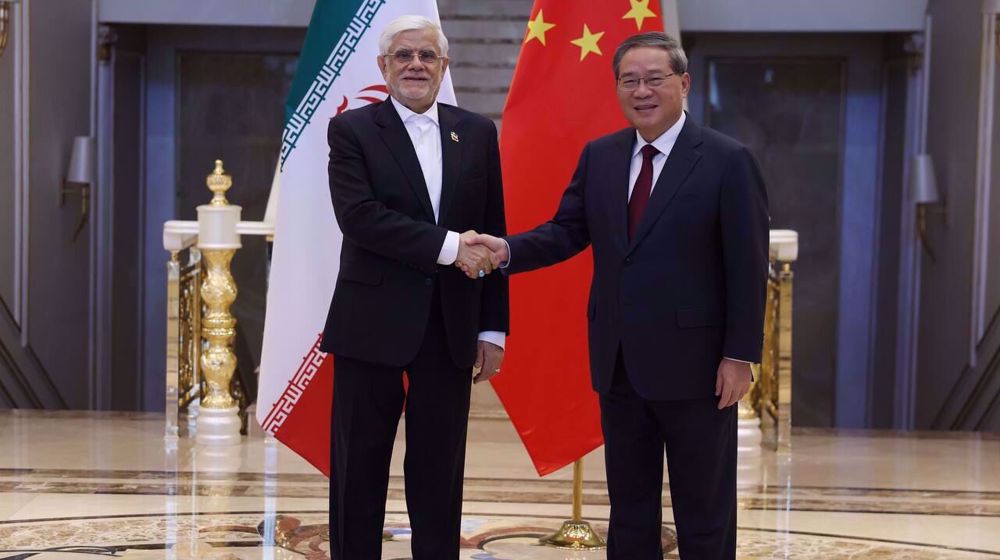
Chinese Premier Li Qiang has described the US-Israeli military offensive against Iran as “blatant aggression,” reaffirming Beijing’s firm opposition to the illegal assault launched in the midst of negotiations and without United Nations Security Council authorization.
The remarks were made during a meeting with Iranian First Vice President Mohammad Reza Aref on the sidelines of the 25th meeting of the Council of Heads of Government (Prime Ministers) of the Shanghai Cooperation Organization (SCO) in the Tajik capital of Dushanbe on Monday.
Li explicitly termed the February 28 US and Israeli regime actions against the Islamic Republic “blatant aggression” carried out during ongoing talks and without UN Security Council consultation.
He underscored Beijing’s clear and resolute stance against Washington and Tel Aviv, its opposition to unilateral American sanctions, the necessity of restoring the Islamabad Memorandum of Understanding, and China’s full support for Iran’s legitimate rights in international bodies.
Chinese state media Xinhua reported that Li stressed the sovereignty and security of all countries must be respected.
He called on all parties concerned to choose peace, resume dialogue and negotiations at an early date, and resolve differences through political and diplomatic means to restore regional tranquility.
Li noted that China has been making every effort to encourage peace and promote dialogue, in keeping with the spirit of major initiatives and proposals put forward by President Xi Jinping, including four-point proposals on Middle East peace, stability, and common security that have resonated widely.
Aref, for his part, said Iran attaches great importance to its relations with China and stands ready to maintain close exchanges at all levels, strengthen mutually beneficial cooperation, and enhance coordination within multilateral frameworks such as the SCO and BRICS in order to further deepen the comprehensive strategic partnership.
He appreciated China’s consistent support for multilateralism and the common interests of Global South countries, thanked Beijing for its persistent efforts to promote peace and end conflicts, and expressed hope for an early return to the Islamabad Memorandum of Understanding and the restoration of regional peace and stability.
The high-level meeting comes amid the continuing fallout from the US-Israeli war of aggression that began on February 28, 2026, an unprovoked aggression widely condemned as a violation of international law and the UN Charter.

The Islamabad MoU, reached earlier this year with Pakistani mediation, had provided for an immediate and permanent end to military operations across all fronts, a commitment to refrain from the threat or use of force, and a framework for broader negotiations. Iranian officials have stated that the agreement was subsequently violated by the aggressors.
This year also marks the 10th anniversary of the Iran-China comprehensive strategic partnership, with relations remaining steady and resilient despite international pressures.
The SCO, of which Iran is a full member, previously issued a statement expressing serious concern over the military strikes on Iran, declaring the use of force unacceptable, and calling for respect for the country’s sovereignty, security, and territorial integrity.
 This makes it easy to access the Press TV website