
By Arman Shariati
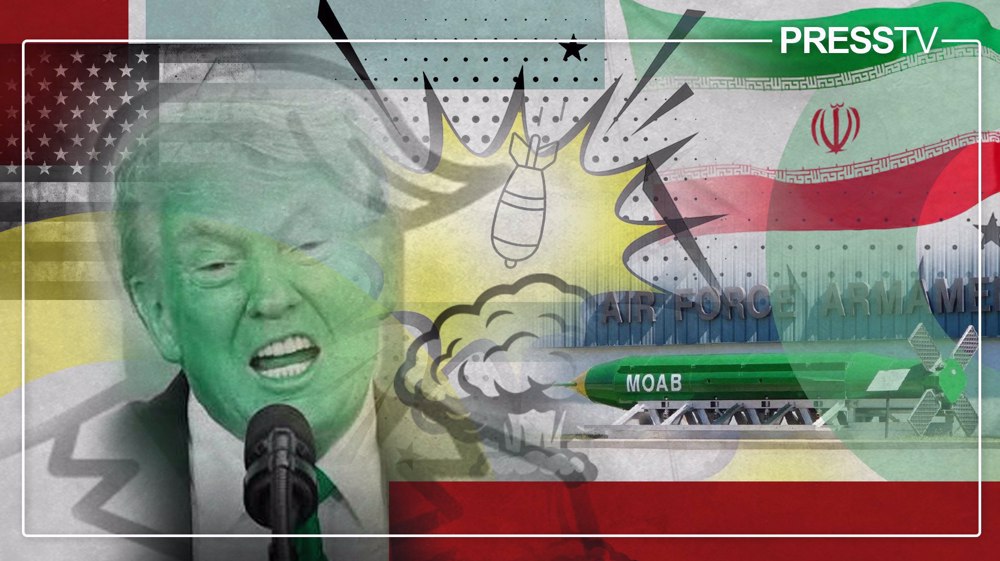
American media this week began circulating a carefully placed story, claiming that the US military has drafted strike options against Iran that include deployment of the GBU-43/B Massive Ordnance Air Blast Bomb, the weapon branded as the “Mother of All Bombs.”
CNN was the first to report it on October 15, followed immediately by a wave of amplification across the mainstream American and European media.
US President Donald Trump, appearing later on Newsmax in an interview, did not deny the story. He offered instead a characteristically garbled endorsement, describing the MOAB as “like a tiny nuclear bomb, but it’s not nuclear,” and adding that the US may have to “take a shot” at Pickaxe Mountain in Iran’s Karkas mountain range.
The narrative was set, and it deserves to be taken apart with facts.
The GBU-43/B is an enormous munition by conventional standards. It carries approximately 8,500 kilograms of high explosive in a casing that brings its total weight to around 9,800 kilograms, just under 10 tons. Stretched end to end, it measures just over nine meters.
It is GPS-guided and essentially designed to detonate above the ground.
The MOAB is a thermobaric, or fuel-air, weapon. This description explains precisely why the weapon is irrelevant to the current discussion. A thermobaric weapon does not carry all of its oxidizer within its casing the way a conventional explosive does.
Instead, on detonation, it disperses a fine aerosol of fuel particles or reactive material into the surrounding atmosphere. A secondary ignition then detonates this cloud together with the ambient oxygen in the air itself, producing a pressure wave of exceptional duration and reach.
The fireball essentially consumes the atmosphere around it. The result is a weapon optimized for destroying things on or just above the surface, such as personnel in the open, light structures, and cave mouths, across a wide area. What the MOAB does not and cannot do is drive energy downward through hundreds of meters of solid rock.
Trump’s description, “like a tiny nuclear bomb,” is not merely imprecise. It is exactly the kind of rhetorical inflation that makes the current hostile military campaign against the Islamic Republic of Iran intelligible as communication strategy rather than military planning.
The MOAB has been used in combat once. On April 13, 2017, during Trump’s first term, a single GBU-43/B was dropped on a tunnel complex in Nangarhar province in eastern Afghanistan, claiming to target the ISIS (Daesh) Khorasan infrastructure.
The US administration at the time announced that the strike had killed approximately 90 ISIS-K militants. The actual battle damage assessment remained classified. What was confirmed is that a very large explosion occurred in a mountainous area of eastern Afghanistan.
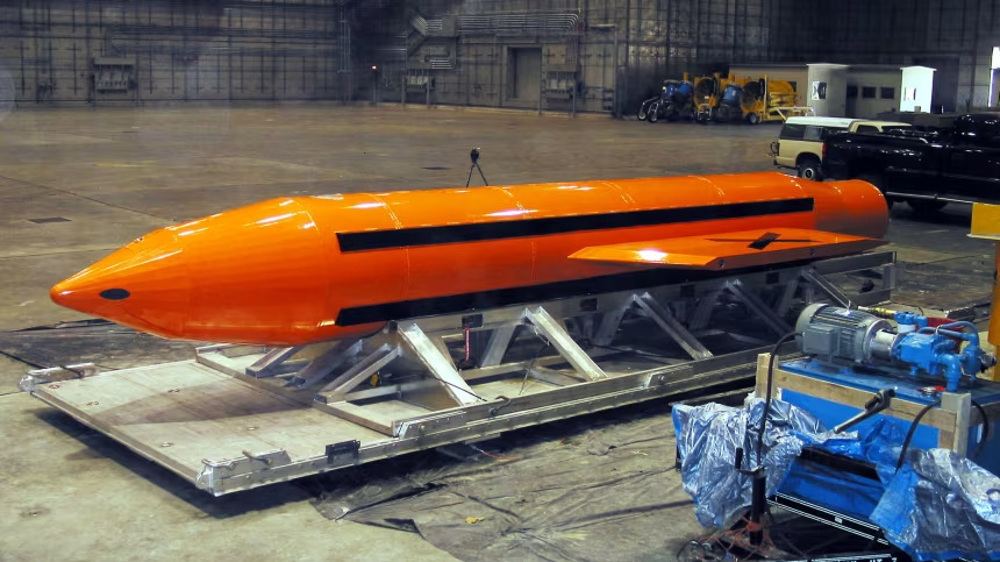
The strategic effect on ISIS-K’s operational capacity in the region was, at best, ambiguous. The organization has continued to carry out attacks in the months and years that followed. That one strike, against an unprotected tunnel network in soft ground, in an area with no air defense, delivered by a slow cargo aircraft operating in uncontested airspace, is the entire operational history of this weapon.
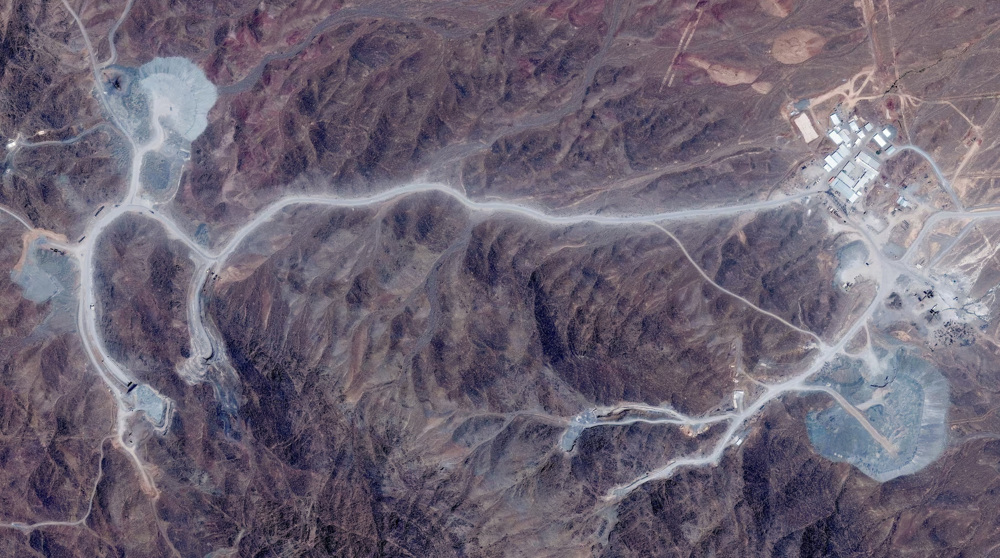
The target reportedly under consideration is Kuh-e Kolang Gaz La, internationally known as the Pickaxe Mountain, in the Karkas range of central Iran. The facility buried beneath it reportedly sits under more than 100 meters of hard granite.
To suggest that an air-burst weapon, however large, could threaten such a target is to misunderstand the physics of the problem at the most elementary level.
The United States possesses a weapon actually designed for this task, namely the GBU-57/B Massive Ordnance Penetrator; a 13,600-kilogram bomb built specifically to drive through reinforced concrete and hardened rock before detonating.
The MOP was used against Iranian nuclear sites on June 22, 2025, during the 12-day imposed war. Its effectiveness against the deepest and most hardened of those facilities, particularly the Fordow Fuel Enrichment Plant, remains a matter of genuine debate.
If the weapon engineered for penetration cannot be confirmed to have neutralized Fordow, a target much less protected than Pickaxe Mountain, then the notion that an air-burst weapon detonating above the mountain surface would accomplish anything beyond scorching rock is not a serious military proposition.
Even setting aside hardened underground targets, the MOAB offers no material advantage against any conventional surface target that cannot be achieved more efficiently and with far less operational risk by using multiple precision-guided JDAMs delivered from fighter aircraft operating at standoff ranges.
The MOAB does not expand the target set. It does not add capability. It adds spectacle.
There is a further operational reality that receives almost no attention in the current American media narrative. The GBU-43/B is confirmed to be deliverable only by the C-130 family of cargo aircraft. Flying such a platform into contested Iranian airspace is not a minor planning consideration and introduces significant operational difficulties.
The United States lost two MC-130J Commando IIs during its wars of aggression against Iran. The idea of routing another slow cargo aircraft into that same environment in order to drop a weapon that cannot reach the target it is supposedly meant to destroy compounds the absurdity.
What the current MOAB narrative resembles most closely is not a serious military planning process. It resembles the late-war German doctrine of the Wunderwaffe, the wonder weapon.
Under mounting pressure, facing an unwinnable strategic position, Nazi Germany’s leadership turned to announcements of extraordinary new weapons that would change the course of the war. The V-1 and V-2 generated genuine fear and caused real casualties.
They did not alter the strategic outcome by a single day. The function of the wonder weapon is not primarily military. It is political. It tells a domestic audience and a wavering alliance that there are still options, that new instruments of power remain available, that the situation is not as bad as it looks.When strategy fails, spectacle fills the gap.
The Trump administration is conducting a war that did not emerge from American strategic interests. It entered the war of aggression to further Israeli goals and expansionist ambitions, has absorbed significant losses and embarrassments, and now approaches midterm elections with a public that has not been offered a clear account of what victory looks like.
In that very context, the MOAB story makes complete sense as an information management campaign, to paint a picture of a strong American military, when the truth is something else.
There is one more thing worth stating plainly. Even if the MOAB is used, even if a C-130 penetrates Iranian airspace, releases the weapon over Pickaxe Mountain, and produces the largest conventional explosion seen in the region, Iran will be compelled to respond.
Not because the strike will have damaged anything of military significance. A major attack that fails to achieve its stated objective does not end a war. It resets the escalation clock. Tehran’s hand will be forced, and it will answer with something commensurate in visibility, and Iran has demonstrated repeatedly that it possesses the means and the will to do exactly that.
The MOAB is a very large bomb, but it is particularly good at the thing it is now being asked to symbolize. What it is, in the current context, is a prop, useful for an interview, useful for a news campaign, and essentially useless for anything happening 100 meters below the surface of a granite mountain in central Iran.
Arman Shariati is a Tehran-based military analyst and researcher.
(The views expressed in this article do not necessarily reflect those of Press TV.)
 This makes it easy to access the Press TV website