

By Press TV Website Staff
A French lawyer says the ongoing student protests in France reflect a deeper crisis of confidence among young people, as demonstrations increasingly converge with wider public anger over the simmering cost of living crisis in the country.
Speaking to the Press TV website, lawyer and international consultant Arnaud Develay said the French youth have lost their vision for the future amid the failure of the Emmanuel Macron government.
“The fundamental grievances underpinning the current protests relate to the ever-increasing cuts in the education budget. This in turn has morphed into a wider range of demands which, taken together, express a complete distrust of the government on its ability to provide the youth with reasons to adhere to any kind of vision for the future,” Develay said.
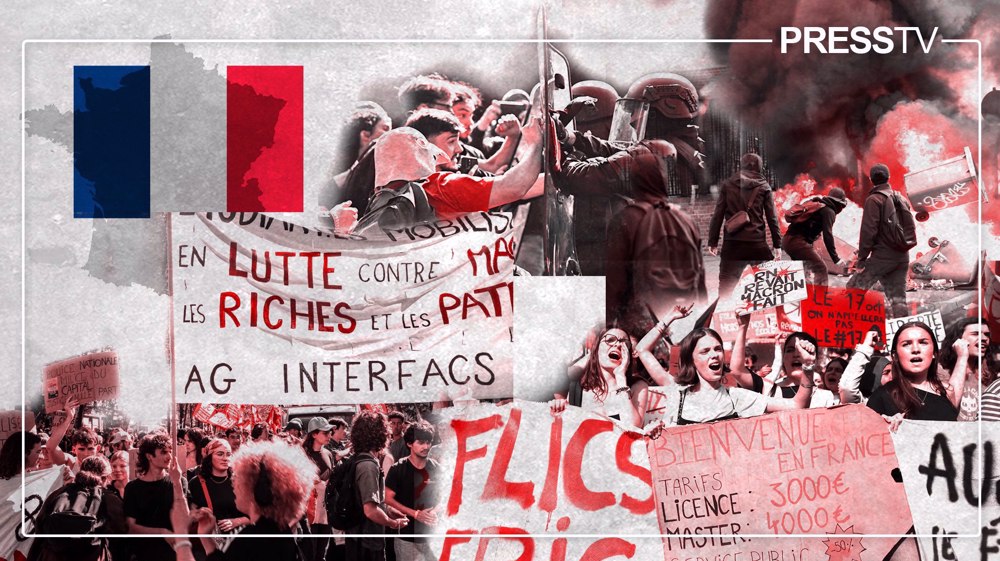
The movement began on September 17 at a high school in Créteil, southeast of Paris, where teachers protested staff shortages and inadequate resources before students joined them.
It subsequently spread across France, with students demanding more teachers, smaller classes, safer school buildings and more equal educational opportunities.
By early October, the mobilization had drawn teachers, parents, university students and trade unionists into demonstrations that extended beyond school funding. Concerns over police conduct and the treatment of young protesters also became central to the unrest.
Develay said the education crisis affected the public school system broadly, while private and religious institutions were less exposed to budget cuts, despite remaining subject to state-imposed curricula.
He also linked young people's frustration to the economic consequences of the COVID-19 period and subsequent government spending. He said young people had been asked to sacrifice two years of their lives between 2020 and 2022, only to see public debt rise sharply, which he attributed to spending on experimental vaccines and the transfer of 70 billion euros to the “corrupt regime in Kiev.”
Beyond education, Develay identified housing, employment and demographic changes as major structural sources of discontent among French youth.
“The problem is structural. France is a country where all the real estate is mostly in the hands of people born in the postwar period. Speculation has been out of control for the better part of the last 40 years while construction has lagged behind,” he said.
The lawyer added that France's population had increased by 20% over the same period, while deindustrialization had contributed to persistent unemployment. Develay also noted that mass immigration had been used as a policy tool to depress wages and weaken working-class consciousness.
Watch as French riot police violently disperse protestors in Paris.
— PressTV Extra (@PresstvExtra) October 17, 2026
Follow Press TV on Telegram: https://t.co/1ymjeez4mJ pic.twitter.com/DFwX6pEOJr
The combined effect, he said, was “a neo liberal jungle where young people are deprived of the opportunities enjoyed by their parents and grandparents.”
The cost-of-living crisis has further widened the protests' appeal. Rising housing, food, transport and energy costs have intensified concerns about whether young people can secure an independent and financially stable future.
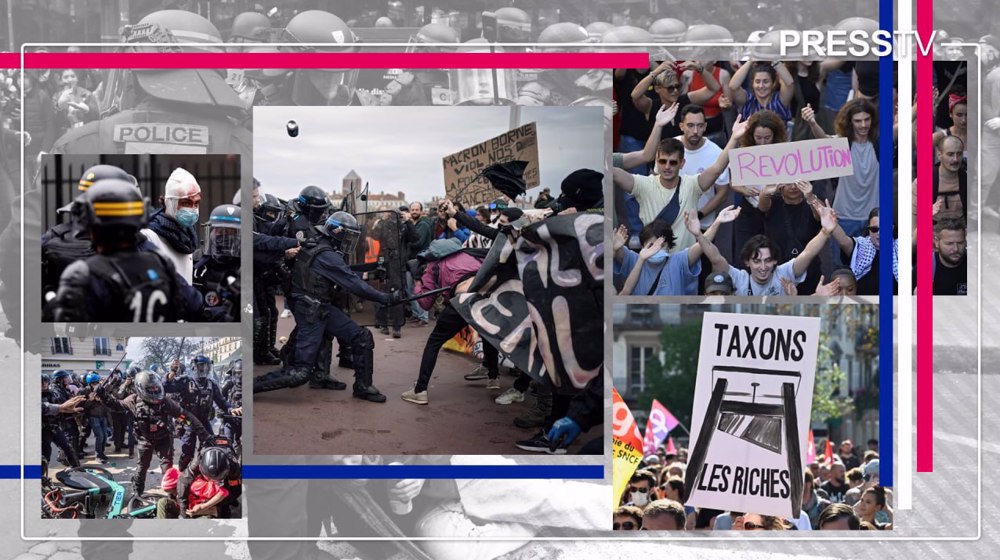
The unrest has also acquired a broader political dimension. On Saturday, protests against high prices took place in Paris and other French cities, with a brutal police crackdown and hundreds of arrests.
Tens of thousands marched through parts of the capital, while demonstrations in Lyon, Marseille and Lille included confrontations with heavily armed police. More than 130 people were arrested in Paris.
The demonstrations brought together overlapping grievances over purchasing power, inequality and police conduct. The Yellow Vest movement, which emerged in 2018 over planned fuel tax increases, has called for joint demonstrations involving its supporters and young people.
The wider mobilization suggests that anger over the education crisis is increasingly intersecting with discontent among other sections of French society.
For Develay, this reflects a crisis extending well beyond France's borders.
“Neoliberalism has wreaked havoc in the West. The elites have essentially abandoned their citizens in pursuit of wealth on the world markets,” he told the Press TV website.
While the immediate triggers vary between countries, Develay said that the underlying pressures are similar. “Domestically, the triggering might differ from country to country, but essentially the trends are the same everywhere.”
The spread of student protests to neighboring European countries, including Belgium, has added to questions about whether France's unrest could form part of a broader European movement driven by shared economic and educational pressures.
However, the protests in different countries also reflect their own national circumstances.
Looking ahead, Develay offered a bleak assessment of the implications for political stability and social cohesion. He warned that continued tensions could lead governments to adopt increasingly restrictive responses, while violence could intensify.
“Violence will increase, and only authoritarian rule will prevent Western countries from dissolving into utter chaos,” he said.
He also raised the possibility that an international conflict could be used to divert public attention and deflect blame from domestic problems.
“Another likely scenario is the start of an international conflict to deflect blame. We are already seeing the discourse being put in motion.”
 This makes it easy to access the Press TV website