

Iranian Foreign Minister Abbas Araghchi says Tehran has presented a concrete seven-day plan to reopen the Strait of Hormuz, warning that the United States cannot expect maritime security to return to normal while continuing to exert military pressure on Iran.
Speaking at the 52nd Council of Foreign Ministers of the Organization of Islamic Cooperation (OIC) in Baghdad on Saturday, Araghchi said Tehran had conveyed the proposal through Qatar and is prepared to restore passage through the strategic waterway if the necessary conditions were met.
“Through Qatar, we have conveyed a concrete seven-day plan: if the necessary conditions are met, the Strait can be reopened and normal maritime passage restored within seven days,” he said. “The choice now rests with the United States.”
Araghchi went on to say that Iran remained committed to safe and secure navigation through the waterway, adding that the disruption to maritime traffic resulted from US and Israeli military aggression and subsequent US restrictions.
“Security cannot be restored by more of the same,” he said. “One cannot bomb a country, threaten its annihilation and impose a blockade, and then expect the security of navigation to return to normal.”
Araghchi also pointed to previous diplomatic efforts, saying Iran and the United States signed a memorandum of understanding in Islamabad on June 17, with Pakistan facilitating the process and Qatar providing support.
He said Iran had subsequently begun technical discussions with Oman to facilitate the safe passage of vessels.
According to the Iranian foreign minister, maritime traffic had recovered to approximately 60 percent of its pre-war level within two weeks, before subsequent US measures and military action obstructed implementation of the agreement.
Araghchi further noted that Tehran had repeatedly pursued negotiations in good faith but had been met with military action, creating deep distrust in the prospects for renewed talks without credible guarantees against a recurrence.
Despite those concerns, he said Iran had kept the door to diplomacy open.
Addressing representatives of OIC member states, Araghchi pointed out that Iran’s military actions were measures to protect its people, sovereignty and legitimate interests. He denied that defending the country’s rights conflicted with pursuing peace.
“We know the cost of war, and that is precisely why we value peace,” he said.
He also called on the OIC to uphold the principles of sovereignty, territorial integrity, non-interference and the peaceful settlement of disputes, arguing that these principles must be applied equally to all countries.
“The problems of our region are best resolved within the region, by its own states, before they become a pretext for the wars of distant powers,” he said, urging regional countries to cooperate on security rather than allow their territory or infrastructure to be used for attacks on their neighbors.
Araghchi concluded that Iran remained open to dialogue based on mutual respect and credible guarantees but would not relinquish its sovereign rights under pressure.
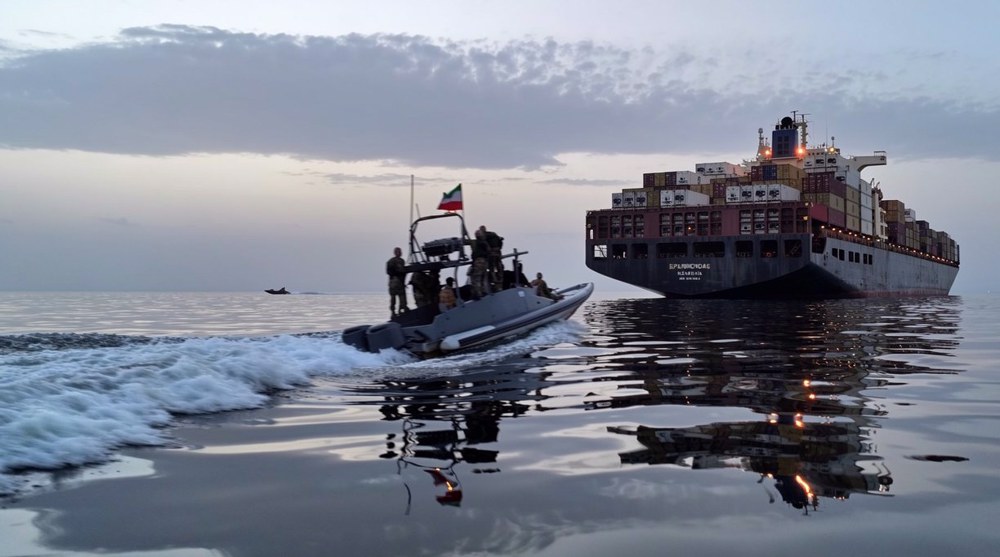
Iranian security forces have maintained control over the strategic Strait of Hormuz since the early days of the US-Israeli aggression against the country in late February.
The Islamic Revolution Guards Corps (IRGC) has repeatedly warned that vessels violating the waterway’s security regulations will face serious consequences.
 This makes it easy to access the Press TV website