

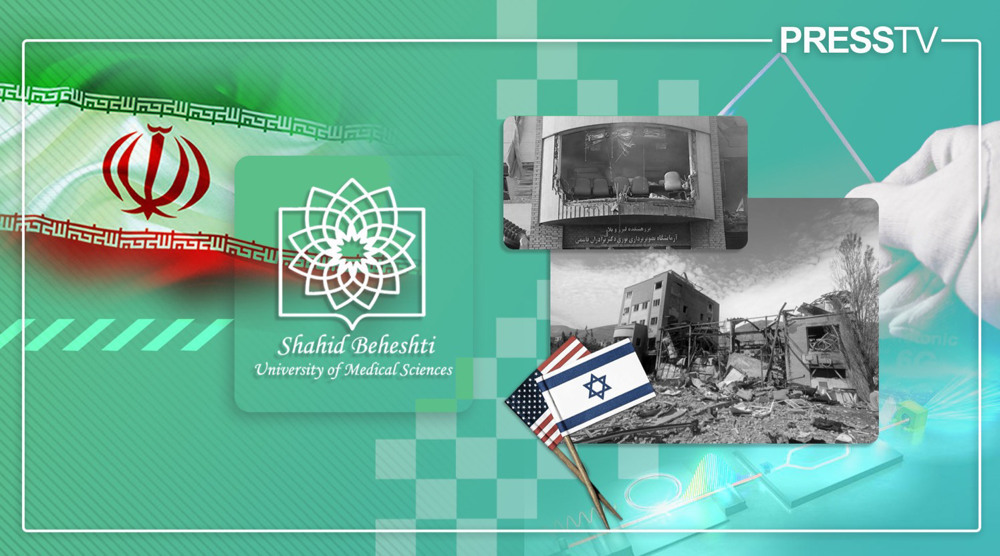
I see the ruins of two buildings in northwestern Tehran whenever I pass by, their battered remains standing across from Press TV’s headquarters.
They are a stark reminder of a night when the American-Israeli war against Iran reached a site associated with the country’s scientific and pharmaceutical capabilities.
One of those buildings housed a knowledge-based company producing plasma-derived pharmaceutical products, transforming a precious biological resource into medicines essential for modern healthcare.
A service attendant told me he had watched barrels of blood being unloaded and carried inside, an apparently routine operation concealing a sophisticated pharmaceutical process connecting biological materials, scientific expertise, industrial technology and patients requiring specialized treatments.
Then, one night, the building was bombed, with an adjacent residential building struck first, apparently by mistake, before the plasma-related premises were attacked.
The ruins remain, a daily reminder of the destruction of infrastructure associated with Iran’s scientific and pharmaceutical development.
The facility’s proximity to Shahid Beheshti University and being apparently the only reason for being located there adds another dimension to the story.
It connects pharmaceutical manufacturing with a broader scientific environment where researchers have developed expertise in advanced technologies, including lasers, plasma applications, and specialized engineering.
On April 3, 2026, US-Israeli strikes destroyed Shahid Beheshti University’s Laser and Plasma Research Institute, a center dedicated to advanced scientific research, bringing the consequences of the war into sharp focus for Iran’s scientific community.
Labs, pharmaceutical facilities and research institutes represent years of investment, accumulated expertise and training, forming the foundations upon which countries develop sophisticated medical technologies and improve access to essential medicines.
Plasma fractionation is among the most technically demanding areas of pharmaceutical manufacturing.
Through specialized processes, manufacturers separate and purify proteins in blood plasma to produce medicines including albumin, intravenous immunoglobulin (IVIG) and certain clotting factors.
These products have distinct medical applications. Albumin is used in selected clinical circumstances, IVIG treats several immune deficiencies and immune-mediated conditions, while specific clotting factors are essential for patients with particular bleeding disorders.
Producing such medicines requires carefully screened plasma, specialized processing equipment, validated manufacturing procedures, rigorous quality control, and highly trained personnel.
The achievement lies in integrating these capabilities into a reliable production system that delivers safe, consistent medicines.
Iran’s experience in this field predates the current terrorist war.
A peer-reviewed study examining the country’s national contract-fractionation program reported that, in 2011, it supplied the domestic market’s entire recorded requirement for IVIG and factor IX, alongside 40 percent of albumin and 15 percent of factor VIII.
The historical figures, documented in research published in DARU, demonstrate that Iran had already established experience in coordinating plasma collection, processing and pharmaceutical supply.
The subsequent ambition to expand domestic manufacturing represents a further step: converting accumulated scientific knowledge into industrial capacity, specialized employment and greater resilience in supplying medicines essential to patients.
The economic significance of plasma technology extends far beyond a single factory. Its value chain encompasses blood collection, specialized transportation, laboratory testing, pharmaceutical engineering, production equipment, quality assurance and medicine distribution.
Each component creates demand for technical expertise, offering opportunities for biotechnology companies, equipment suppliers, laboratory professionals, university researchers and graduates in pharmacy, chemistry and engineering.
This is how scientific advancement translates into economic development as research becomes productive capacity, specialized knowledge creates skilled employment, and domestic manufacturing retains a greater share of value within the national economy.
For Iran, these capabilities are particularly important in a pharmaceutical environment shaped by financial restrictions and difficulties accessing some international markets.
Producing specialized medicines domestically can reduce exposure to external supply disruptions, although self-sufficiency also requires dependable access to equipment, raw materials, and production technologies.
The objective is therefore not simply to manufacture more products, but to develop a connected scientific and industrial ecosystem capable of sustaining increasingly sophisticated pharmaceutical production.
Mohammad Hossein Motavalli, chief executive of Novzhin Zist Pharmed, describes plasma-derived medicines as an opportunity to strengthen domestic pharmaceutical production, create specialized employment and reduce dependence on imports.
The company supplies approximately 50 percent of Iran’s domestic plasma-products market and plans to increase its production capacity by more than twofold through a new development phase.
He outlined an ambition to meet the country’s full requirements for albumin and IVIG during the following year, subject to the successful expansion of manufacturing capacity and the conditions necessary for sustained production.
The company is pursuing additional products, including plasma-derived factor VIII, used in treating haemophilia A, and fibrinogen, which is used in selected circumstances involving bleeding and coagulation disorders.
These products require specialized manufacturing, comprehensive quality evaluation and regulatory authorization before commercial availability.
Their development nevertheless illustrates the technological direction of Iran’s pharmaceutical industry and its ambition to expand domestic production into increasingly specialized treatments.
For patients, the ultimate measure of progress is dependable access to clinically appropriate medicines. For the economy, it is the creation of productive capacity, skilled employment and expertise that can support further scientific development.
The bombing of Shahid Beheshti University’s Laser and Plasma Research Institute underscores the vulnerability of research infrastructure during the war.
The institute’s scientific activities formed part of a wider research environment supporting advanced technologies and the training of specialists.
The Pasteur Institute of Iran, established in 1920, also suffered significant damage during the war, according to reporting on attacks affecting the country’s medical infrastructure.
Its work encompasses infectious-disease research, biological products and public-health services, making the disruption consequential beyond the immediate physical damage.
The World Health Organization has documented attacks affecting Iranian healthcare facilities during the war, highlighting the pressures placed on medical services and infrastructure.
Scientific facilities are productive national assets. Their destruction can interrupt research, damage specialized equipment, delay industrial development and disrupt the training of personnel whose expertise may take years to acquire.
The consequences also reach beyond individual institutions because research centers, pharmaceutical manufacturers, hospitals and public-health laboratories depend on one another.
Disrupting one part of this network can affect the broader system supporting medicine production and patient care.
The destruction of these facilities makes the importance of domestic scientific capacity unmistakable.
Countries capable of developing specialized medicines, training researchers and sustaining advanced manufacturing possess valuable foundations for protecting public health when international supply chains become uncertain.
The historical achievements of the country’s plasma-fractionation program, the expansion ambitions of Novzhin Zist Pharmed and the research conducted at Shahid Beheshti University represent different dimensions of this effort.
The ruins I see whenever I pass across from Press TV headquarters are a physical reminder of what has been destroyed. Yet the knowledge accumulated by scientists, engineers, pharmaceutical workers and researchers cannot be reduced to the buildings in which they work.
Iran’s scientific future will depend on its ability to preserve and extend these capabilities despite extraordinary pressure.
The development of plasma-derived medicines demonstrates what becomes possible when scientific knowledge is translated into industrial expertise and practical healthcare.
The ruins remain, but the scientific achievement they represent is not confined to the buildings that once housed it.
 This makes it easy to access the Press TV website