
By Ivan Kesic
- Arak was founded in 1808 as Sultanabad, a planned military fortress designed by a French engineer on a grid layout inspired by the city of Nice, making it one of the few Iranian cities built according to a deliberate urban plan.
- The city's historic bazaar, constructed from 1813 onward, remains a living commercial center whose caravanserais and covered passageways once connected the agricultural wealth of the Farahan plain to the great trading houses all around Iran.
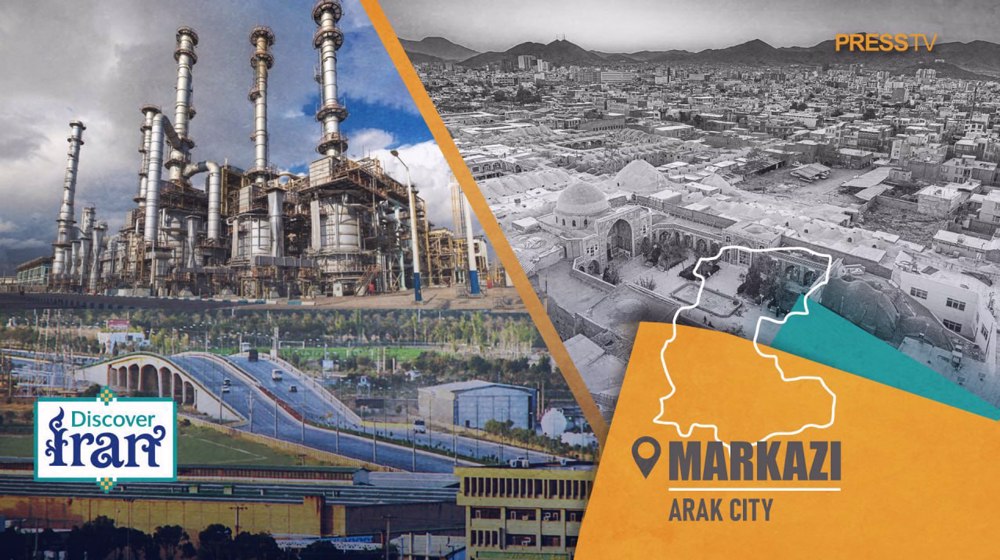
- Arak's industrial base, anchored by the country's first aluminum plant, first locomotive and wagon factory, and first combine plant, has earned it recognition as the fourth industrial pole of Iran and the informal title of the country's industrial capital.
Few Iranian cities can trace their origins as precisely as Arak. Founded in 1808 on the orders of a Georgian-born general serving the Qajar crown, this city was designed from the outset as a military fortress and administrative center, laid out on a grid plan inspired by French urban design.
Over the following two centuries, Arak transformed from a walled garrison town into one of Iran's most important industrial centers, a journey shaped by geography, trade routes, and the national drive toward modernization.
At the heart of this story lies the city's historic bazaar, a network of covered passageways, caravanserais, and shops that connected the agricultural wealth of the surrounding plain to the great commercial houses of Tabriz and beyond.
Through its evolution, Arak offers a window into how Iran itself moved from a traditional economy toward industrial modernity.
Geographical features and natural landmarks
Arak sits at an altitude of roughly 1,800 meters, positioned on the southwestern edge of the Farahan plain where the Zagros mountain range meets the vast expanse of the central plateau.
To the northeast of the city stretches the Miqan Lake, an extensive salt flat that has long shaped the region's hydrology and climate.
The climate is characterized by long, harsh winters that may extend from four to six months, with frost occurring on anywhere from 65 to 120 days each year depending on the season.
Spring and autumn are brief transitional periods, while summer arrives in July and August. Annual rainfall fluctuates considerably, ranging between 230 and 638 millimeters, with an average of approximately 300 millimeters.
The surrounding landscape offers several natural attractions. Gerdu Valley, a 100-hectare area south of the city, has become a popular promenade for residents, known for its pleasant climate, walnut trees, and proximity to the urban center.
Miqan Lake, situated northeast of Arak, covers between 100 and 110 square kilometers and serves as the final drainage point for the city's seasonal floodwaters.
The lake's moderately warm winters attract large numbers of migratory birds from colder regions, making it an important destination for nature lovers, particularly in autumn.
Sefidkhani Cave, located about 18 kilometers southwest near Khan Miran village, requires a three-hour hike to reach and rewards visitors with tent-like rock formations and stalactites.
Anjedan Cave, roughly 40 kilometers southeast near the village of the same name, offers a more accessible excursion, with the surrounding district noted for its natural beauty, hunting grounds, and artifacts.
Historical background
The area around present-day Arak holds traces of settlement dating back to the Median and Sassanid periods.
During the Seleucid era, a city called Kore existed in the broader Median region, and the modern village of Kore-rud on the city's southern side preserves this ancient name.
The site of contemporary Arak, however, belongs to a much more recent chapter of Iranian history. Two factors drove the city's creation during the reign of Fath Ali Shah.
The first was political: the region of Iraqi Ajam, as the area between Hamedan and Rey was known, suffered from persistent insecurity and local disputes, with neighboring tribes occasionally disrupting the security of central Iran.
The absence of a permanent military garrison and the distance from the center of government required a central army base. A corps called the Iraqi Army was formed, placed under the command of Yusuf Khan Gorji, a Georgian-born general.
With the shah's approval, a fortress was built to serve as the army's headquarters, and the chosen location proved suitable for both military and logistical purposes.
The second factor was economic: the fertile and populous plains of the region required a central market town where villagers could exchange their agricultural and industrial products rather than traveling long distances on foot or horseback to neighboring cities.
Construction of the Sultanabad fortress began in the early nineteenth century and was completed by 1808. The design reflected the ambition of the Qajar authorities to impose order on a turbulent frontier.
A French engineer, Trezer, who had accompanied General Gardane's mission to Iran during the Napoleonic era, drew up the plans, and the layout was modeled on the French city of Nice.
The town within the walls followed a strict checkerboard pattern, with a bazaar placed close to the central crossroads and defensive walls punctuated by numerous towers.
The name evolved over time from Sultanabad to Iraq-e Ajam, and finally to Arak. The term Arak derives from an old Persian word meaning "smooth land," while the earlier designation, Iraq, came from an Arabic root signifying "edge."
The city's fortunes changed dramatically in the late nineteenth century with the expansion of the carpet industry, and again in 1938 with the completion of the Trans-Iranian Railway, which gave Arak a station of major importance where the line emerged from the Zagros ranges.
Architectural monuments
The historic bazaar of Arak stands as the city's defining architectural monument and its most important historical complex.
Built by Yusuf Khan Gorji beginning in 1813, the bazaar occupies the central heart of the old city, connecting in four directions to the ancient gates that once punctured the defensive walls.
Its north-south and east-west axes intersect at the Chaarsough, the crossroads that served as the most strategic point in the old urban fabric.
The complex includes not only shops and warehouses but also a bathroom, a mosque, a school, a water reservoir, and several caravanserais.
Among these caravanserais, Saraye Mehr represents one of the oldest and rarest examples of its kind. Designed with a certain elegance that predates the intrusion of machine-age architecture, it rises to three floors beneath a domed roof, with interconnected porches that once sheltered merchants and their goods.
In the center of its courtyard glows an eight-sided blue pool, a feature that, like a hand-painted pottery bowl by an elderly artisan, presents its beauty to visitors.
Today the caravanserai has been repurposed as a craft museum and gathering place for local artisans, its coppersmiths combining the architectural heritage of the past with the living artistry of the present.
Near the bazaar stands the Sepahdari Madrasa, one of the historical buildings remaining from the Qajar era.
Built simultaneously with the bazaar on the orders of Yusuf Khan Gorji, it was the first school established in Arak and was adapted from Safavid-era school styles, adorned with delicate and elegant tile work of the Qajar period.
The seminary comprised a mosque, water reservoir, and other facilities, and its comparatively large courtyard centers on a pool. It was converted into the city's first school of religious sciences, and among its students were Imam Khomeini and Ayatollah Golpayegani.
The Chahar Fasl Hammam, also known as the Four Seasons Hammam, represents one of the most beautiful architectural and tile works in Iran from recent centuries.
Built in the late Qajar period, it is considered a unique monument in Iranian architecture for its special decorations, and it is the only bathhouse in the country that contains a specific section for religious minorities.
After restoration, it reopened as the museum of archaeology and anthropology in Arak, displaying anthropological effects of the province.
Arak's religious diversity is reflected in the Saint Mesrop Church, a Qajar-era Armenian place of worship built in 1941. The church has a rectangular plan, with several lightwells and two entrances in the south and west.
Its bell tower stands opposite the western entrance, and the complex includes a clergy house, prayer hall, and congregation hall.
The favorable economic conditions in Arak and the proximity of Armenian villages such as Lilian, Mohajeran, and Shazand were among the factors that led to the church's construction.
The building's exterior facade is decorated with brick, its roof supported by four octagonal columns connected by arches, and within its sanctuary images of the Holy Mary and Jesus Christ are beautifully rendered, with the crucifix visible above the painting.
A large chapel on the southwest side of the yard commemorates Armenian martyrs throughout history, particularly those of the Imposed war.
Industry
Arak's transformation into one of Iran's major industrial centers represents one of the most consequential urban developments in modern Iranian history.
The city's position as a transportation hub, reinforced by the Trans-Iranian Railway, made it a natural site for industrial investment.
During the early 20th century, modern factories were established, including a beet sugar refinery, vegetable oil and soap works, and wool industries. These enterprises drew workers from surrounding rural areas and set the pattern for the city's future.
The 1970s marked a decisive turning point. Two state-owned enterprises of national significance opened in 1972.
The aluminum smelter, built under the Regional Cooperation for Development program of the Central Treaty Organization, was the country's first aluminum production plant, known today as IRALCO.
A heavy engineering plant, constructed with Soviet equipment and technical advice, established Arak as a center for machinery and industrial equipment.
These were followed by the country's first wagon and locomotive manufacturing plant, Wagon Pars, and the first combine plant, Combine Sazi-e Iran.
The scope of Arak's industrial base has continued to expand. The city hosts the largest manufacturer of power transmission racks in West Asia and the first testing station of power transmission racks in the wider region and Asia.
Arak Petrochemical Company has become a significant player in the petrochemical sector.
Because of this remarkable diversity of key industries, Arak is ranked first in Iran in terms of variety of industrial products, second in terms of the presence of strategic industries, and is generally considered the fourth industrial pole of the country.
The completion of gas supply plans has also made Arak known as the first provincial green area in the country.
The presence of various factories and industries, combined with its status as the center of Markazi Province, has attracted industrial and service activities that reinforce the city's economic importance.
This industrial concentration has earned Arak the informal title of the industrial capital of Iran.
The historical bazaar, meanwhile, remains a living commercial center. Its shops offer clothing, fabrics, jewelry, shoes, accessories, books, food ingredients, and home furniture, while cafés and restaurants serve the surrounding neighborhood.
The bazaar continues to connect the traditional commerce that first gave Arak its economic purpose to the modern industrial city that grew around it.
Through its covered passageways and the caravanserais that once hosted merchants from across the region, the bazaar tells the story of a city that was built to serve the needs of a vast and fertile hinterland, and that eventually became one of the anchors of Iran's industrial economy.
 This makes it easy to access the Press TV website