

By M. Salimi
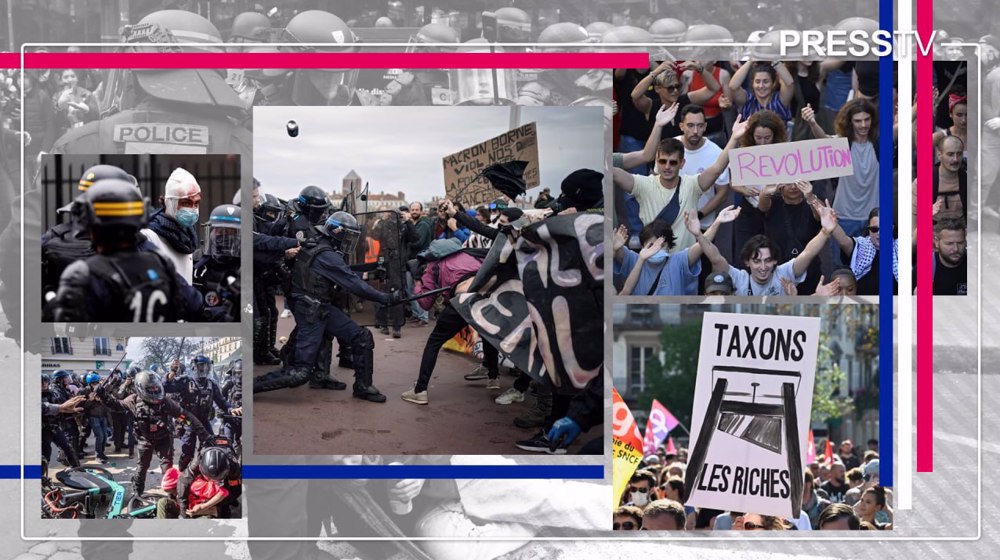
School demonstrations against conscription have spread from France to Germany, where students are also protesting rearmament, austerity and the criminalization of peaceful protest, according to a German student organizer.
Student protests that began in France earlier this month have spread across Europe, including Germany, where school strikes against conscription and rearmament have gained momentum since late 2025, according to Moritz K., a history student at the University of Hamburg and an organizer opposing arms shipments through the Port of Hamburg, particularly those destined for the Israeli-occupied territories.
Speaking to the Press TV website, Moritz said the ongoing protests in Germany have taken the form of nationwide school strikes against the army’s renewed recruitment drive.
He noted that in several major cities, students have established strike committees within schools, helping sustain the movement over time.
Students are also increasingly engaging with broader political and social issues, Moritz said, including social justice, international solidarity, antimilitarism and solidarity with Palestine.
He added that German students are now showing significant solidarity with their French counterparts and participating in joint activities with them.
Austerity and rearmament
On the protesters’ main demands and their connection to the original movement in France, Moritz said the protests began as a campaign against conscription but have since broadened to address related social and political issues in the European countries.
In Germany, he explained, austerity is closely linked to rearmament and the militarization of society. Students are therefore demanding an end to conscription, rearmament and austerity, alongside improved learning conditions in schools, universities and vocational training programs (Ausbildung).
Protesters are also opposing efforts to criminalize their movement, including measures that could bar participants from working in certain professions.
Repression and intimidation
Asked about the response of the German government and universities, Moritz said that protests in Germany remain generally smaller than those in France, and have therefore not yet faced the same level of police violence and repression.
Nevertheless, he said, authorities are repeatedly attempting to delegitimize and criminalize the popular movement led by students.
Demonstrations are accompanied by a heavy police presence, creating an atmosphere of intimidation. Students also face pressure from their schools and threats of consequences that could affect their future.
Moritz added that there have been several cases in which students were approached by Germany’s domestic intelligence service and questioned about their political activities, in what he described as attempts to intimidate and discipline them.
Meanwhile, he said, the German government is further intensifying its military recruitment plans and seeking to present students with decisions that have effectively already been made.

A European movement with national characteristics
Asked whether the protests represent a broader European movement or whether each country’s mobilization has its own distinct character and goals, Moritz said the two are not mutually exclusive.
He explained that protests in different European countries naturally reflect their own protest cultures, legal frameworks and the ways authorities respond to demonstrations.
Nevertheless, he said, the movements are increasingly connected, as demonstrated by large-scale solidarity actions in support of the protests in France.
Looking ahead, he sees considerable potential for students, who are already internationalist in outlook, to strengthen cross-border cooperation and build a more consolidated European movement.
Moritz argued that this potential stems partly from the common challenges facing students across Europe, where austerity policies are accompanied by increased militarization and preparations for a potential war with Russia.
Media and delegitimization
On the role of the media, Moritz said coverage of the protests varies considerably, but there is a broader tendency to delegitimize the movement and intimidate students.
He noted that media reports often portray the protests as having been infiltrated by violent left-wing extremists, drawing on what he described as anti-communist rhetoric, Red Scare tactics and references to Moscow.
According to Moritz, one purpose of this narrative is to stifle debate about what he characterized as NATO’s role in provoking the conflict with Russia.
He added that international media generally provide more balanced coverage, better reflecting divisions within German society, particularly over attitudes toward Russia.
Organization and international coordination
On how students have organized and coordinated with their counterparts across Europe, Moritz said social media has made it easy for students in different countries to connect and communicate.
He added that larger student delegations from various countries have repeatedly traveled to France to join demonstrations, exchange experiences, establish contacts and strengthen cooperation with French students.
Students have also organized international discussion events, providing further opportunities to share ideas, coordinate their efforts and build cross-border solidarity.

Leadership and message
Responding to critics who claim that the protests lack clear leadership or a unified message, Moritz said he would encourage them to join the demonstrations and help make the movement more organized and disciplined.
He acknowledged that the criticism had some merit, particularly given that the protests are largely led by young people, but argued that it was overstated.
In his view, the movement has a clear message: austerity and the drive toward war against Russia are unjust and run counter to the public interest. He added that this message is often diluted in media coverage.
Organizationally, Moritz said, the movement is building increasingly strong ties with trade unions and other organized political groups. While these connections need to be further developed, he believes the movement is moving in the right direction.
Connection to other social movements
On the links between the student protests and other social movements in Europe, including climate activism and anti-austerity campaigns, Moritz said protests can help raise political awareness and shape how people understand wider social issues.
He added that he is repeatedly struck by the political awareness of young protesters, who, in his view, recognize the shared underlying causes of the climate crisis, austerity, rearmament and conscription.
Moritz said these crises are being exacerbated by Western imperialism’s efforts to maintain its global dominance through intensified national oppression.
He cited the Israeli genocide in Palestine, the exploitation of Africa, Asia and Latin America, and Western involvement in wars against Iran, Yemen and Russia, as well as preparations for a potential confrontation with China.
He further noted that these international policies are linked to growing domestic repression, social discipline and support for far-right parties. He also denounced Western governments for elevating fascists and Nazi collaborators to positions of influence in Ukraine.
Pressure and consequences
Asked whether he or fellow students had faced pressure, intimidation or other consequences for participating in the protests, Moritz said authorities and institutions appeared to be trying every available means to intimidate them.
He cited a range of measures, including a heavy police presence at demonstrations, school disciplinary action over absences, threats of expulsion, attempts to criminalize strike committees and protests, hostile media coverage, and the threat of professional bans.
Moritz said several forms of repression were currently being tested in Germany. He pointed to professional bans in Hamburg, a proposed law in Hesse concerning the denial of Israel’s so-called right to exist, and the closure of the Russian House in Berlin.
He suggested that these measures could be part of an effort to develop a nationwide strategy for repression in preparation for war. At the same time, he argued that the pressure on students demonstrated that their movement posed a significant challenge to those in power and had the potential to create further political difficulties for them.
Long-term impact
On the protests’ potential long-term impact on education policy and the broader political landscape in Europe, Moritz said that, regardless of their immediate outcomes, they represent a significant source of hope.
In his view, they reflect the growing strength of social and antimilitarist movements and could lay the groundwork for increasingly large-scale political and economic protests.
To achieve this, he said, students must expand their political education efforts, sustain mobilization over the long term, strengthen ties with trade unions, establish a firmer presence in schools, universities and workplaces, and reach broader sections of society.
Moritz pointed to early successes in France, including the deployment of numerous new substitute teachers, and suggested that the government might make further concessions. However, he cautioned against interpreting these measures as evidence that the protests were over or that their demands had been met.
He argued that governments would not fully accept the movement’s central demands, including an end to austerity, the broader social crisis, rearmament, militarization and war. Any concessions, he said, should therefore be understood as attempts to contain the protests rather than resolve their underlying causes.
Moritz urged students not to let such concessions halt their movement, stressing that their future was at stake and that they must continue fighting for their demands.
“Our government is in fact planning to march against Russia for a third time, to ignite a world conflagration for a third time. And only the united people can still stop them,” he stated.
 This makes it easy to access the Press TV website