
After six years of exhausting war, hopes for a new life were rekindled. However, the end of World War II marked the beginning of a new conflict, the Cold War, a competitive battle between the two remaining superpowers, the United States of America and the Soviet Union.
“Our leadership in science and industry, our hopes for peace and security, our obligations to ourselves as well as others, all require us to make this effort, to solve these mysteries, to solve them for the good of all men.”
“We choose to go to the moon. We choose to go to the moon in this decade and do the other things, not because they are easy, but because they are hard.”
US President, John F Kennedy
In this war, there were no more bloody battles. Economy, technology, and espionage were the main axis of this conflict. Everything turned into a vast competitive arena where victory would determine the world's leading power.
The USA and the USSR cautiously watched each other as even the smallest achievement could put them ahead of their rival.
In 1959, the Soviet Union was preparing for a major mission that had caught the attention of all countries, especially the United States. The Russians were planning a significant journey, sending humans to the depths of the galaxy and landing on the moon. With success in this mission, they would achieve a substantial accomplishment in the world, strengthening the Soviet Union's position globally.
After years of hostility between the two countries, U.S. President John F. Kennedy decided to revive relations between the U.S. and the Soviet Union.
In an important diplomatic meeting with the Soviet Premier Nikita Khrushchev, he proposed a joint cooperation project between the two nations, a significant initiative aimed at reducing tensions and researching global peace issues, a joint U.S.-Soviet mission to the moon.
However, Khrushchev refused to accept the proposal.
Two years after Khrushchev's rejection, Kennedy again repeats his request and asks the Soviet Union to join forces for the moon mission project. However, Khrushchev once again rejects the request, wanting the USSR to achieve the milestone unassisted.
Russia had been planning to embark upon space travel for many years and was now ready to undertake the journey.
In 1880, Konstantin Tsiolkovsky, a self-taught Russian scientist who had begun his research on the possibility of interplanetary travel years earlier, continued his studies on aerodynamics and spacecraft design.
The scientific achievements of Tsiolkovsky marked the beginning of the country's space activities.
After him, Sergei Korolev led the country's space program. His ability to integrate designs and strategically plan set the Soviet Union on the path to great success.
The presence of these two individuals was the main reason behind the Soviet Union's ability to take this significant step.
- More... The 11th Mission - Part I
In 1957, as the chief designer of long-range missiles, Korolev began his first mission. To commemorate the centenary of Tsiolkovsky's birth, he sent the world's first artificial satellite, Sputnik, into Earth's orbit.
With this project being observed by the Americans, the space race between the two countries began in earnest.
A few months later, the United States sent its first artificial satellite, named the Explorer, into Earth's orbit.
The two countries cautiously watched each other.
Korolev prepared for the next objective, sending the first living creature to study life conditions in space.
Korolev succeeded. The first living creature in space was a dog named Laika, who made Korolev successful in this mission.
Now they could think about sending humans into space, and it was not long before Korolev achieved one of the greatest scientific accomplishments for the Soviet Union.
On April 12, 1961 the Soviet Union sent Yuri Gagarin into space. He was the first human to escape Earth's gravity and orbit around it.
This significant achievement captured the attention of people all over the world.
The United States, still one step behind the Soviets, accelerated its progress in the space program.
A few months later, they sent their first astronaut, Alan Shepard, into space. However, the success was not satisfactory for the US as the Soviet Union was still moving ahead.
Korolev's efforts had turned him into a hero for the Soviets. He could accomplish anything, and this was evident to everyone.
The ultimate goal would be landing a human on the moon in October 1967 to commemorate the 50th anniversary of the October Revolution. Sergei Korolev was preparing himself for the completion of this great mission.
Kennedy felt threatened by the Soviet Union. He assigned his vice president, Richard Nixon, to develop the American space program.
After 35 days, they presented a new space program called the Apollo Project to Congress.
“These are extraordinary times, and we face an extraordinary challenge.”
US President, John F Kennedy
Kennedy had now made both promises and set the timeline for the fulfillment. They had to act quickly. Everyone was waiting for the 50th anniversary of the October Revolution, an anniversary that would solidify the Soviet Union's power in the world.
In 1966, just as the Russians were on the verge of their goal and only one year away from their victory in this race, a tragic event destroyed the entire Soviet program, the sudden death of Sergei Korolev, the leader of the Soviet space program.
The people of the Soviet Union were unsure what would happen to their dreams now. They still hoped that the program would continue under other individuals.
Vasily Mishin, one of Korolev's students, was chosen as a successor. However, the scientific vacuum left by Korolev was disastrous.
Mishin was under pressure to land on the moon by 1968. The Soyuz-1 spacecraft was launched on April 23, 1967, with a crew member named Komarov. The launch was carried out despite project engineers reporting 203 design errors.
Komarov lost his life when the spacecraft crashed into the ground. The first launch after Korolev's death ended in the worst possible way, marking the first human casualty in space travel under the name of the Soviet Union.
The loss of the chief designer was irreparable for the Soviets, and in no time their space program fell apart.
Now the field was clear for the Americans. In 1967, exactly the year the Russians had been waiting for, the first Apollo mission was initiated.
However, as the astronauts were preparing for this mission, an accident in the Apollo cabin halted the mission.
The three crew members of Apollo 1 lost their lives in a fire-related accident. Apparently, landing a human on the moon was more challenging than previously thought. Nevertheless, NASA decided to continue with their missions.
After conducting several missions, they eventually succeeded in paving the way for sending their first astronauts to the moon.
Neil Armstrong, Buzz Aldrin, and Michael Collins were the astronauts preparing for this mission, a mission that would mark the first steps of humanity on the moon.
“That's one small step for a man, one giant leap for mankind.”
Neil Armstrong, Apollo 11
People around the world were eagerly waiting for this monumental achievement, an accomplishment for exploring the unknown and traveling to the stars.
“Oh, I think it's really a great event for a man from just our planet, not just the United States, to actually be on another world.”
Member of Public
While the Apollo space missions had concluded and their records were closed, a book was published in the U.S. that no one expected. The book questioned the most significant achievement of the United States.
Bill Kaysing, the head of the technical publications at Rocketdyne, had worked for 10 years in the laboratory producing Apollo rockets.“We Never Went to the Moon” is the title of the book that Bill Kaysing published. In this book, he presents reasons suggesting the human moon landing was nothing but a deception.
“All of the records concerning Apollo are not classified and yet they are unavailable to the public; one has to ask why?”
Bill Kaysing, Author
The title of the book garnered so much attention that it quickly captured the interest of new outlets and media worldwide.
Kaysing believed that the technology required for human travel to the moon and back did not exist at that time.
Although Kaysing had directly overseen the technical data of Apollo rockets for many years, many considered him a liar, believing that he fabricated this theory to sell his books.
Nevertheless, it didn't take long for others to join this theory.
Various theories emerged, one after another, stirring up the media landscape and adding more theorists to the media frenzy.
Many supporters and opponents entered this arena.
“Have you really thought about what it would take to fake a moon landing?”
“Hundreds of engineering hours that went behind this and the records of those designs, If you wanted to fake the moon landing, you would have to fake all these documents.”
“And it just seems to me it is way easier to just go to the moon. Has anyone considered that? Just go to the moon.”
“That’s easier than faking all of this.”
Neil deGrasse Tyson, Astrophysicist
Opponents sought to prove this deception while supporters endeavored to debunk the theory.
“A local newspaper posted a very funny story that after watching YouTube videos, Neil Armstrong himself had been convinced that the moon landings were a hoax.”
TV Host
With the spread of the theory, the situation changed in Kaysing's favor. Many television programs filled their airtime with this topic, making it difficult to easily distinguish the truth.
Old voices were willing to question missing NASA footage and other “truth-adjacent” theories, eventually making their way to respected media outlets.
“For NASA to come out and say that all the tapes were erased, I mean, it's incredible.”
Fox News
“There are a couple of questions that I do have from time to time. Who shot the footage?”
Whoopi Goldberg
“How in the world do you erase the tapes of the most historic event in 2,000 years? I mean, it's not like it was a bar mitzvah.”
TV Host
Over time, a vast amount of analysis had been conveyed to the public. They followed all the theories, and now their perspectives had changed.
The situation had become complicated. Theorists were presenting factors that questioned the possibility of traveling to the moon.
Years after the Apollo missions, with advances in technology, NASA has continued its space activities and achieved new milestones.
NASA sends several astronauts into space every year to depths of 200, 300, and even 400 kilometers. However, reaching the moon requires covering more than 1,000 times the distances traveled today.
“What the United States is claiming is that they went 1,000 times farther than they can go today with 50-year-older equipment on the very first attempt, with 1 millionth of computing power in all of NASA than is in a cell phone.”
“You would easily recognize that the previous claim was a fraud, and if it weren't for people's emotional attachment, they would see that.”
“I mean, we can only go 1,000th as far today than they did 50 years ago, even though we have 50 years of better computers and rockets.”
Despite achieving this great technology, NASA has never repeated these missions.
“I'd go to the moon in a nanosecond. The problem is we don't have the technology to do that anymore. We used to, but we destroyed that technology, and it's a painful process to build it back again.”
“It's never happened before in the history of the world that a technological achievement like the first airplane or the first car or the first nuclear reactor, that no nation on Earth could repeat it 50 years later, and it's the only time they deliberately destroyed all the hardware and the blueprints and the schematics after they were done.”
“So if they really went to the moon, they would never destroy that equipment, and there would be bases on the moon today.”
Bart Sibrel, Documentary Filmmaker
During the day, there's a significant temperature difference between sunlight and night, causing the surface temperature of the moon to range from negative 173 degrees Celsius at night to positive 127 degrees Celsius during the day.
“Somehow they would have to radiate the heat away, and that's not an easy task because the rate that heat is radiated away goes up according to the fourth power of the temperature difference between the radiator and the surrounding medium.”
“So you have to have a pretty hot radiator to radiate away a substantial amount of heat.”
Nevertheless, NASA claims that to protect against such extreme temperatures and cold, they use multi-layered suits equipped with cooling systems.
“One has to ask, how were the astronauts able to air cool or water cool or cool in any way the interior of the Lunar Excursion Module?”
“So it's obvious to almost anybody who investigates the Lunar Excursion Module that there would have been no way to keep the astronauts alive in an environment that was hot enough to bake cookies.”
Bill Kaysing, Author
The extensive dimensions of technology required for space exploration made carrying out these complex missions in the 1960s a significant challenge.
“And they're starting to figure it out. NASA has a program called Living with a Star that's a pretty name for how do we get through the Van Allen belts. They have all their top scientists working on it.”
“It's a tremendous problem because we do not have any kind of a spacecraft that we can send up that doesn't have metal in it.”
“And when these charged particles hit metal, they produce x-rays. Nothing you can do to get around that.”
“So anybody sitting around something metal in outer space in the Van Allen belts is going to be French fried.”

The existence of extremely dangerous radiation in a region called the Van Allen belts located around the Earth poses a significant obstacle for astronauts.
To travel to the moon, they would have to pass through this unsafe area. The source of this hazardous radiation is the large nuclear reactions caused by intense solar heat.
The Van Allen belts absorb harmful cosmic particles preventing them from reaching Earth.
“This radiation varies year by year. The sun has an 11-year sunspot cycle. And every 11 years, it appears to repeat.”
“And so every 11 years, there's a peak of sunspot activity, and this is associated with a peak of solar radiation. And one of the recent peaks was in 1958. And since then, the next peak was in 1969 and 1970, right when the Apollo missions were supposed to have flown through them.”
“They couldn't have picked a worse time to try to fly a manned flight through this radiation field.”
The presence of the radiation and its irreparable damage to humans has turned this theory, which has been debated in scientific circles for years, into one of the strongest conspiracy theories.
“Solar flares and other storm systems on the sun can create enormous, tremendous surges of radiation. Now that radiation is not only potentially dangerous, it could be lethal to those who are outside our atmosphere, which basically protects us.”
Despite these dangers, NASA experts consider the Apollo missions to have been perfectly executed. They did not remain silent in the face of these opinions and provided responses to address the doubts.
Using specialized protective layers in the construction of the Apollo capsule was one of NASA's reasons for ensuring the safety of the astronauts.
Furthermore, the high speed of the spacecraft passing through the Van Allen belts was another reason NASA cited for maintaining the spacecraft's safety.
“There are cosmic rays in space; you have the radiation flux that you have to deal with out there, we understood that.”
“We monitored the sun very, very carefully. We did not send expeditions to the moon at times when there was the possibility of a particle event on the sun.”
“We didn't want to subject the astronauts to any radiation that could come flying off the sun from a solar flare or a prominence or an event like that.”
“But we thought it through very carefully and we planned our way through that.”
Brian Welch, NASA Spokesperson
Weak logic or outright falsehood
“Such a claim is rather like believing that rain will wet you less if you run through it.”
“In reality, whether you move slowly or quickly through rain, you'll tend to get equally as wet.”
“And so it is with radiation, except that with radiation you cannot dry off and return to the state you were before you were irradiated.”
David S. Percy, British Television Producer
“The walls of the craft were made as thin and light as possible. The Apollo capsule itself was made unusually thin. In fact, they couldn't even initially carry enough air inside to be the equivalent to sea-level air pressure.”

The human landing on the moon had been challenged by these theories for years, making it difficult to defend the Apollo project.
However, NASA had anticipated this situation.
In 1969, a live broadcast of the first successful Apollo mission was shown to millions of people.
These images discredited all the theories against the mission, images of the launch moments, the landing of the astronauts, and the first steps of humans on the moon.
These images served as irrefutable evidence for everyone.
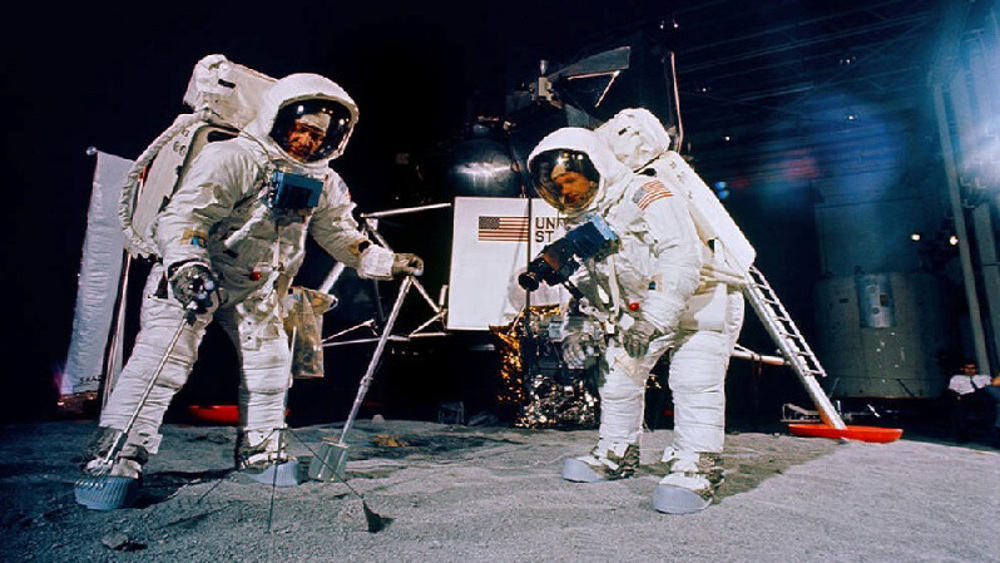
Yet theorists still sought the truth beyond these images, they viewed the footage as nothing more than a studio production.
“Taking the detail of Aldrin's right heel, you have the highlight of light on the heel. Where did that come from?”
“The highlight is produced by a point source of light, but the sun is directly behind the lander, so this whole image here is in shadow.
It is not illuminated by the sun. No additional lights were carried on Apollo 11. There were no reflectors except the lunar surface.”
“This photograph, I contend, was taken under controlled studio lighting conditions.”
“Here's a picture showing an astronaut taking a photograph and his shadow, which indicates that the sunlight, the only source of light on the moon, is directly behind him.”
“But then you look at this rock just off to his right, and the shadow is at right angles to the astronaut's shadow.”
“That can't be right.”
David S. Percy, British Television Producer
Weather issues due to radiation and extremely high temperatures affect the performance of the camera.
The presence of the camera in temperatures above 120 degrees Celsius, and the impact of radioactive materials, would have interfered with the recorded messages.
“You have an enormous amount of radiation in space and potentially it affects film, of course, and of course, as you will well know, its prime effect is on contrast.”
“We took a latent image recorded on the film of a colour test chart and exposed it to eight MUV X-rays.”
“The lowest radiation dose we applied to the film was 25 rem. The latent image, if it hadn't been subjected to radiation, would look like this. A good quality, high contrast, colour transparency. After exposure to the 25 rem radiation, the image is almost entirely obliterated.”
“This means, in my estimation, a dose as little as 5 rem would seriously undermine the transparency.”

Despite the advancements in technology and the evidence provided, conspiracy theorists continue to search for the truth.
Dr. Van Molens, a Dutch astronomer, published a theory that gained significant criticism from many cinema enthusiasts.
“According to Dr. Van Molen, who is an astronomer at Leiden University in Holland, he claims that Stan Kubrick was hired by NASA to write the scripts for Apollo 11, 12 and 13.”
The creation of these images by one of America's greatest directors, Stanley Kubrick, was one of the strangest conspiracy theories.
“Stanley Kubrick was the greatest filmmaker on the planet at the time shooting a film about going to the moon, 2001 A Space Odyssey.”
“And it's a fact Von Braun and the flight director visited the close sets of 2001 A Space Odyssey.”
“And then, I'm sure a lot of people have seen it in the movie ‘The Shining’, there's allegedly all these clues about him hinting at the moon landings being fake.”
The creation of the film, 2001 A Space Odyssey, just one year before the Apollo 11 mission, strengthened the possibility of these images being faked.
Kubrick had managed to design and execute the same space and technology in great detail before the Apollo missions. The use of cinematic equipment and techniques, as well as a similarity between this film and NASA's images, was highly controversial.
However, the mere creation of this film was not convincing evidence to support this theory until Kubrick left intriguing clues about the Apollo missions in his next film, The Shining, in a completely unrelated story.
“The greatest of which is the little Danny Redrum boy who gets up from an outline of the pad there at Cape Canaveral with a shirt on that says Apollo 11, and he walks to a door with the room 237 on it, which was changed because that represented 237,000 miles away, average distance at that time, believed, from the Earth to the moon.”
“Yes, I believe that he did it. There's no proof of that, but that's a very, very good theory, and it's very likely true.”
Despite these hypotheses, the reality of the moon landing has never been fully clarified, leaving the truth forever shrouded in the darkness of the galaxy.
And if the theorists' hypotheses were correct, what motivation would there be to fake this great achievement?
“Our leadership in science and industry, our hopes for peace and security, our obligations to ourselves as well as others all require us to make this effort to solve these mysteries, to solve them for the good of all men.”
US President, John F Kennedy
Protests and riots resulting from people's grievances had brought the United States to serious crisis.
Large crowds were taking to the streets daily to reclaim their rights.
The repeated failures in the Vietnam War and the deaths of thousands of Americans had caused immense suffering among the people.
These issues were eroding the public's trust in the United States.
“The 60s almost meant the end of the United States. We needed a psychological boost. The country needed something they could rally behind that was positive.”
“You had the civil rights riots, Martin Luther King being assassinated. We had the Cuban Missile Crisis. We had riots in the streets. We had huge racial tensions in the country and outright rioting in many cities.”
“The country was under tremendous duress.”

On the other hand, the United States was engaged in a major conflict with the Soviet Union, the Cold War, a war that had to be won at any cost.
The United States needed to prove its power to the world once again.
America decided to organize a grand show to navigate through these conditions and contain the Soviet Union in the Cold War.
“We choose to go to the moon in this decade and do the other thing, not because they are easy, but because they are hard, because that goal will serve to organize and measure the best.”
US President, John F Kennedy
With the conclusion of the moon landing mission, the U.S. had achieved its first goal, restoring public trust and delivering a significant blow to the Soviet Union in the space race, a defeat that left a heavy burden on them.
However, this was not the end of the story. The U.S. was preparing for the main act.
The move was not only aimed at containing the Soviet Union, but this time to bring about their complete downfall.
“What if free people could live secure in the knowledge that their security did not rest upon the threat of instant U.S. retaliation to deter a Soviet attack, that we could intercept and destroy strategic ballistic missiles before they reached our own soil or that of our allies?”
US President, Ronald Reagan
The Star Wars display aimed to dominate space and build destructive space weapons, a project designed to neutralize all Soviet missile power before it could reach American soil.
After their defeat in the space race to the moon, the Soviets could not bear another loss.
Seeing America's power and technology in the moon landing, they easily believed the U.S. claims about the Star Wars project.
Now, the Soviets were forced to drastically increase their military budget to counter this significant threat.
"The explanation was simple. Uncle Sam and the imperialists are making an atomic bomb. So we had to make two in order to frighten them."
"If they made two bombs, we had to produce four."
Russian Analyst
Everything was going according to plan, and once again another display from the United States reached its final act.
The Soviet Union followed the U.S. step by step and had now reached the end point. They had wasted many of the country's financial resources to compete with the United States, resources that their people needed more than anything.
The country was on the brink of complete collapse.
Instead of rebuilding their economy, the Soviet Union decided to negotiate with the U.S. for its survival. The talks were aimed at reviving their economy in exchange for surrendering their military power.
“Mr. General Secretary, though my pronunciation may give you difficulty, the maxim is: ‘Doveyei, no Proveyei’. Trust, but verify.”
US President Ronald Reagan
The result of the surrender was the signing of the Nuclear Non-Proliferation Treaty, which disarmed the Soviet Union.
Furthermore, more importantly, the Soviet Union's access to global financial resources for rebuilding and revitalizing its economy never materialized.
And after three years, in 1991, the Soviet Union's government collapsed.
“My fellow Americans, Mahalo, Donald Trump is here tonight. No one is happier, no one is prouder to put this birth certificate matter to rest than the Donald.”
“And that's because he can finally get back to focusing on the issues that matter, like, did we fake the moon landing?”
Barack Obama, Former US President
Perhaps one day, the files of the Apollo missions were on the desks of scientists worldwide.
However, what became evident over the years was their different role in American politics, which was utilized by statesmen for many years.
 This makes it easy to access the Press TV website