
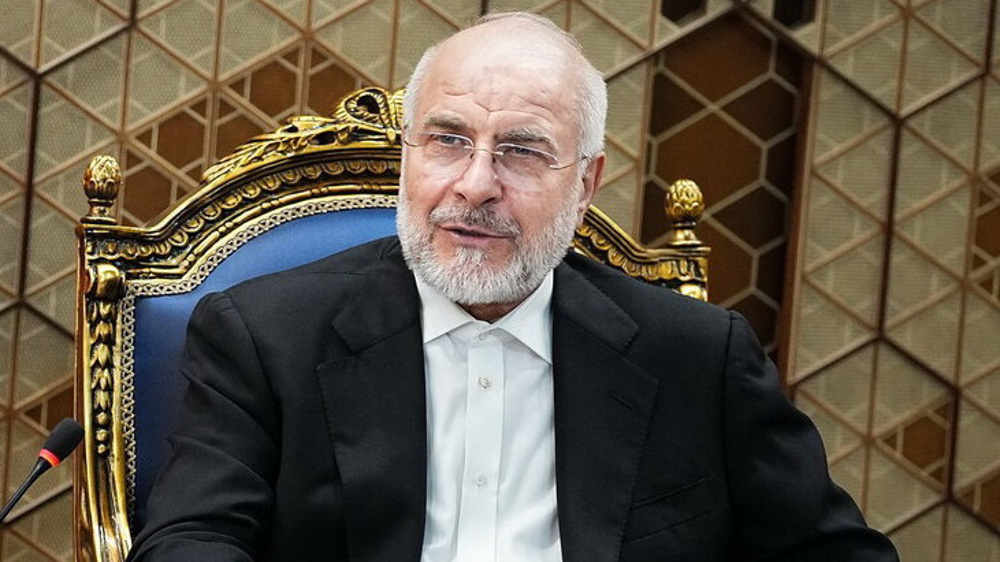
Iran’s Parliament speaker has mocked so-called American economic forecasts for the Islamic Republic, pointing to rising American inflation and Washington’s predictions about the country that had failed to materialize within their stated deadlines.
In a post on X on Thursday, Mohammad Baqer Qalibaf cited a CNN report published a day earlier showing that US annual inflation had climbed to 3.7 percent in September, up from 3.4 percent in August, with prices rising faster than economists had expected.
✍️ Feature - Mirage of capitulation: Bessent’s ‘Economic D-Day’ on Iran proves another foolhardy and failed gamble
— Press TV 🔻 (@PressTV) October 14, 2026
By Alireza Hashemihttps://t.co/8TpY6NrdHr
“Let’s ‘play the percentages.’ Not in odds, but in the % increases,” the top legislator wrote, linking to the report, which documented price pressures extending beyond gasoline to include medical care, clothing, transportation, and other consumer expenses.
He also challenged the credibility of Washington’s predictions about Iran’s economic and strategic prospects, writing, “btw, ‘They have nothing in 2 weeks,’ ‘Wells explode in 3 days,’ ‘Economic D-Day’ all passed.”
“Time’s relative; turns out it could be irrelevant. Nobel in Practical Physics for Treasury?” he added sarcastically.
The CNN report, published on Wednesday, had noted that the September Consumer Price Index rose 0.6 percent from the previous month, bringing annual inflation to 3.7 percent, above economists’ forecast of 3.6 percent.
Qalibaf: Bessent on the brink as oil reserves fall and bond yields surgehttps://t.co/ZHopyZxhnX
— Press TV 🔻 (@PressTV) September 4, 2026
Core inflation, which excludes volatile food and energy prices, increased 0.3 percent month over month and 2.6 percent year over year. Both figures exceeded economists’ expectations.
Gasoline prices rose 9.1 percent in September and accounted for more than half of the monthly increase in consumer prices, according to the report, which linked the pressure to the energy shock associated with Iran’s closure of the strategic Strait of Hormuz in retaliation for American aggression and violations.
However, price increases were not confined to energy. The report cited rising costs for used cars, air travel, medical care, apparel, housing-related expenses, and several services, indicating that inflationary pressures had spread across multiple sectors.
 This makes it easy to access the Press TV website