
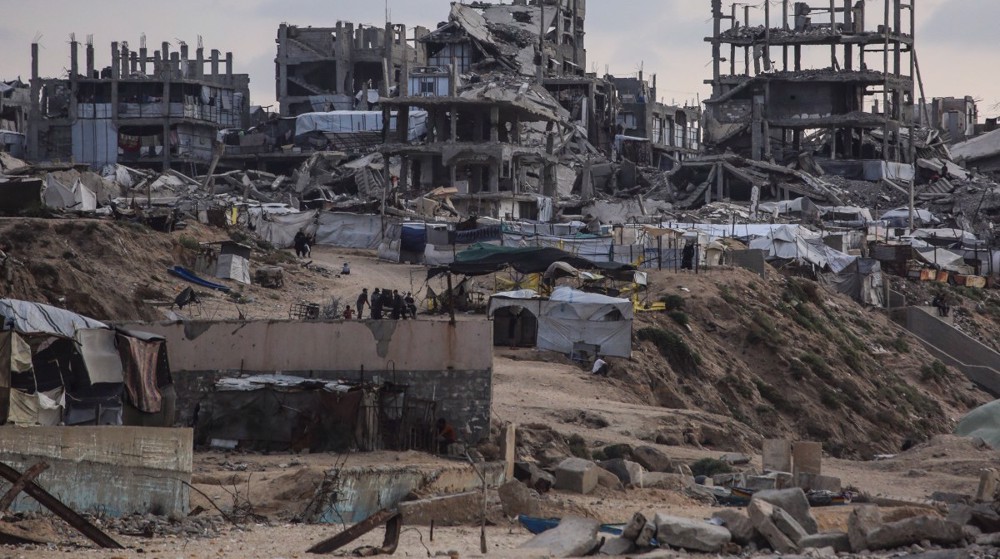
Nearly 300,000 families in Gaza face the prospect of another winter without adequate shelter, as widespread destruction, deteriorating tents and shortages of funding and humanitarian aid leave displaced Palestinians vulnerable to heavy rain and flooding amid Israel’s genocidal war.
In a statement issued on Tuesday, the Palestinian Ministry of Social Development said approximately 90 percent of tents sheltering displaced families had become torn and unfit for habitation after two years of exposure to sunlight and wind and continuous use. With many Palestinians facing a fourth consecutive winter in tents, the ministry warned that deteriorating weather conditions could trigger a humanitarian catastrophe.
The crisis is compounded by the destruction of approximately 85 percent of Gaza’s residential units by Israel, partially or completely, leaving hundreds of thousands of people with few safe alternatives. Flooding in displacement camps, damage to personal belongings and the mixing of rainwater with sewage could also create serious public health and environmental hazards.
According to the International Organization for Migration (IOM), nearly two million people in Gaza still require shelter assistance, while available and expected humanitarian supplies cover only 17 percent of winter shelter needs, according to a United Nations briefing in Geneva on October 9.
The IOM reported that approximately 8,600 emergency shelter kits remain outside Gaza after Israeli authorities repeatedly refused their entry. The kits include timber, tarpaulins and other materials needed to construct and reinforce shelters. Although some tents and tarpaulins have entered the beseiged territory, supplies remain insufficient, and restrictions continue to impede deliveries of more durable shelter materials.

A preliminary assessment cited in the UN Office for the Coordination of Humanitarian Affairs’ (OCHA) October 2 update identified more than 4,000 buildings as unsafe and requiring partial or complete demolition. More than 2,300 reportedly remain occupied by approximately 44,000 people.
Meanwhile, the Site Management Cluster identified 217 displacement sites at medium or high risk of flooding, housing around 235,000 people. Low-lying areas, coastal locations, sites near water ponds and places with blocked drainage networks face particular risks. OCHA has also warned that restrictions on access to 65 percent of Gaza’s territory limit alternative shelter options, while accessible areas remain severely overcrowded.
Funding shortages further threaten winter preparations. The Palestinian ministry estimates a $186.7 million funding gap in the shelter sector, with only 34 percent of the required budget secured. Emergency tent stocks in international organizations’ warehouses have also been exhausted.
The Norwegian Refugee Council (NRC), which leads the Shelter Cluster in Palestine, reported on October 5 that at least $283 million would be needed for a minimum winter response. Existing stocks and anticipated supplies were expected to provide only partial assistance to approximately 52,000 families, compared with nearly 300,000 families requiring support.
The NRC warned that, at the prevailing rate, bringing in at least 500 trucks carrying shelter supplies classified by Israel as “dual-use” items could take more than seven months, even under the best conditions.
The ministry has called for the immediate and unconditional entry of 200,000 weather-resistant tents and 300,000 shelter kits containing tarpaulins, reinforced plastic sheeting and insulation materials. It warned that continued shortages and delays could force displaced families to relocate again in search of safer shelter.
As the rainy season approaches, widespread destruction, restrictions on essential supplies and severe funding shortfalls are hampering preparations to shelter Gaza’s displaced population. Thousands of families remain in damaged tents or buildings at risk of collapse, leaving them vulnerable to heavy rain and flooding.
Since October 7, 2023, Israel’s genocidal war on Gaza has killed at least 74,370 Palestinians and wounded 175,371 others, according to Gaza Health Ministry figures reported on October 10.
Under the so-called ceasefire agreement brokered by the US last year, Israel was required to withdraw its forces to roughly half of Gaza, halt air and artillery attacks, release Palestinian prisoners and abductees, and allow humanitarian aid into the besieged territory.
 This makes it easy to access the Press TV website