
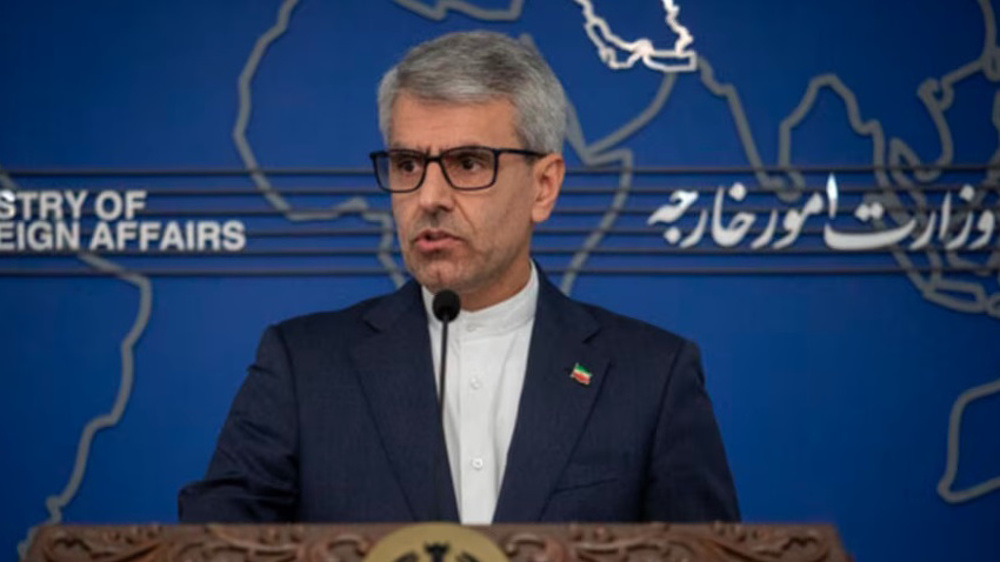
Iran's Foreign Ministry spokesperson says security would not return to the Strait of Hormuz as long as the United States continues its naval blockade and economic war against the country, rejecting US President Donald Trump’s claim that the strategic waterway has returned to normal.
“American claims bear no resemblance to what we are witnessing on the ground. They can continue to claim that the Strait of Hormuz no longer matters and that Iran has lost its leverage, but we will continue doing what we are doing,” Esmaeil Baghaei said during a press conference on Monday.
Iran closed the waterway following the launch of the latest round of unprovoked American-Israeli aggression against the Islamic Republic on February 28.
The Islamic Republic and the United States agreed on a 60-day reopening period as part of a Pakistan-mediated memorandum of understanding in June, but American violations forced Tehran to re-establish the closure.
IRGC chief: No extra-regional power has right to threaten, interfere in Strait of Hormuz, Persian Gulfhttps://t.co/SbvBJEhpte pic.twitter.com/mMAFuTgC9h
— Press TV 🔻 (@PressTV) October 9, 2026
Baghaei said – as opposed to American officials’ claims – markets and international developments reflected the realities of the situation governing the chokepoint, underlining that events in the strait since February 28 had resulted from US and Israeli aggression targeting the Islamic Republic.
He identified Iran’s closure of the strait as acting in accordance with international law in response to the use of the waterway to wage aggression against the country.
Baghaei reiterated his condemnation of the American atrocities that had afflicted the strait with insecurity. “We are not pleased with this situation, because security in the Strait of Hormuz is essential above all to us,” he said, adding that the international community needed to understand which side was responsible for the situation.
‘Iran reviewing US response to proposal’
The spokesman said exchanges of messages between Iran and the United States were continuing through mediators as the Islamic Republic was reviewing Washington’s response to a seven-point proposal Tehran has forwarded towards enabling potential conditional reopening of the waterway.
He said the proposal, discussed recently on the sidelines of the United Nations General Assembly’s latest meeting in New York and referred to as Iran’s “Seven-Day Plan,” addressed Tehran’s legitimate demands, including lifting of the naval blockade, ending the war on all fronts, and releasing frozen Iranian assets.
“These are Iran’s rights, and they will be raised in any negotiations. Circumstances have not changed in a way that would require us to show flexibility regarding our rights,” Baghaei said, adding that the new US sanctions imposed in August must also be lifted.

‘Civilizational clash narrative can fuel war’
Baghaei rejected attempts to frame relations between Iran and the West as a “clash of civilizations,” noting that Iranian civilization had developed through intellectual exchange and engagement with other cultures.
“Iranians have always been competitive, but they have combined competition with interaction. We have never sought to assert our power or sustain our existence by negating others; we have engaged even with our rivals,” he said, citing the contribution of Iranian and Muslim scholars to the translation and interpretation of Greek thought.
Rezaei fires back at US ‘civilizational war’ narrative with reminder of Rome’s defeathttps://t.co/OlHRvE9M9C
— Press TV 🔻 (@PressTV) October 9, 2026
The spokesperson warned that portraying current tensions as a confrontation between Iranian and Western civilizations could “legitimize war and aggression.”
‘Pakistan, Qatar remain mediators’
Addressing speculation about the prospect of Russian mediation between Iran and the United States, the official said, “We have always welcomed the good offices of friendly countries.”
He, however, noted that Pakistan and Qatar remained the formal mediators between Tehran and Washington.
‘Escalating tensions between Muslim countries benefit only Israel’
Baghaei also addressed a telephone conversation between the Iranian and Saudi foreign ministers amid developments in Yemen.
He expressed concern about developments on the Arabian Peninsula and reiterated Iran’s readiness to facilitate dialogue, noting that escalating tensions would benefit only the Israeli regime.
“We, therefore, do not want hostilities and war to continue between two Muslim countries. Our region is already experiencing enough tension as a result of US and Israeli actions,” he said.
Baghaei maintained that the Yemeni people had the right to live with dignity, free from pressure, sanctions, and blockade, saying that conditions in the country over the past 10 to 12 years were unjustifiable under Islamic principles or international law.
 This makes it easy to access the Press TV website