
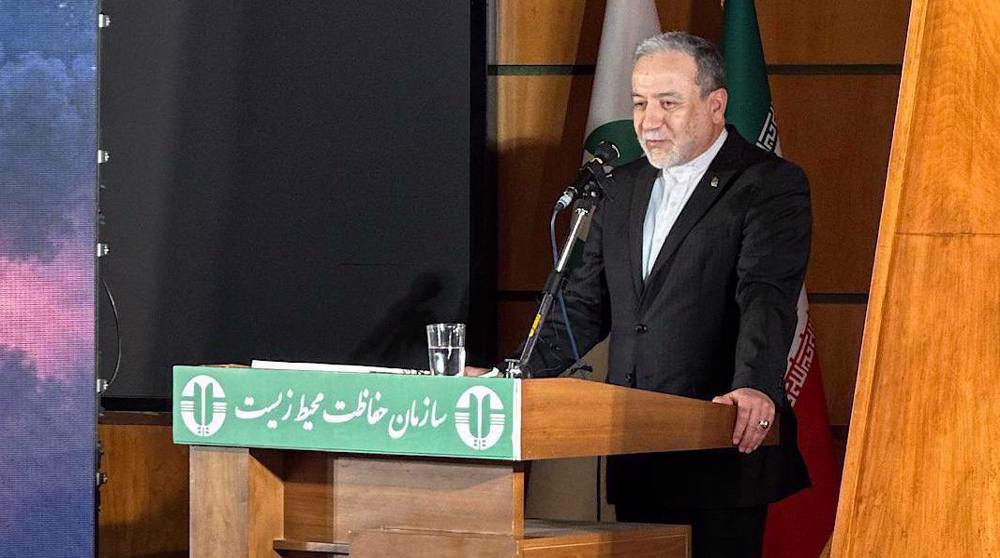
Iranian Foreign Minister Abbas Araghchi has called for international accountability for large-scale environmental destruction during armed aggression, urging stronger legal mechanisms to prevent, document, and address damage to global ecosystems.
Speaking at the international conference “Ecocide: The Silent War Crime” at Iran’s Department of Environment in Tehran on Sunday, the top diplomat said environmental protection has to move beyond political declarations and become a matter of responsibility, compensation, and effective international action. He also expressed Iran’s support for discussions on recognizing ecocide as an independent international crime.
“The environment is the common heritage of humanity. It must not become an arena for rivalry, a tool of political pressure, or a victim of short-term economic and military considerations,” he said.
Environmental damage in Gaza, Lebanon, Iran
Araghchi cited the environmental consequences of military aggression targeting the Gaza Strip, Lebanon, and Iran, warning that damage to water supplies, agricultural land, forests, and energy infrastructure could persist long after aggression ends.
In Gaza, he pointed to the destruction of water and sewage networks, contamination of water and soil, coastal pollution, accumulated rubble, and the widespread destruction of olive groves as a result of Israeli aggression. He cited the United Nations Environment Program (UNEP) as describing the environmental damage there as unprecedented.
✍️ Viewpoint -Israeli military tanks roll out of Gaza as children sing over land ravaged by ecocide
— Press TV 🔻 (@PressTV) October 13, 2025
By @AlAqsaRevolt https://t.co/6JxEojETKa pic.twitter.com/ltjzkhfexs
In Lebanon, he cited damage to forests, agricultural land, and orchards, saying reports submitted to the UN indicated that millions of square meters of land have been burned and tens of thousands of olive trees damaged still as a result of Israeli atrocities. He also cited coastal pollution following an Israeli attack on oil-storage facilities.
Turning to Iran, Araghchi denounced the United States and the Israeli regime for causing serious environmental hazards through attacks on oil facilities, refineries, energy infrastructure, and nuclear facilities.
He said the UNEP confirmed in March 2026 that oil facilities in and around Iranian urban areas, including Tehran, were targeted and that oil fires have released hazardous compounds that could contaminate soil and water and affect the food chain.
“We all remember the black rain that fell upon our people,” he said.
Iran FM Araghchi:
— Press TV 🔻 (@PressTV) March 16, 2026
Israel's bombings of fuel depots in Tehran violate international law and constitute ecocide.
Residents face long-term damage to their health and well-being. Contamination of soil and groundwater could have generational impacts. pic.twitter.com/LeU66xFzTm
Calls for legal action, end to double standards
The foreign minister said wartime environmental destruction threatened public health, food security, and future generations, stressing that international humanitarian law must be applied with due consideration for the direct and long-term environmental consequences of military strikes.
He outlined three priorities, namely strengthening international legal frameworks and criteria for identifying severe environmental destruction; establishing independent scientific mechanisms to document damage and assess its consequences; and expanding cooperation to restore ecosystems and support affected communities.
He also criticized double standards in environmental protection and called for scrutiny of unilateral coercive measures that restrict countries’ access to resources and technologies needed to address environmental crises.
Araghchi identified the pending 31st session of the United Nations climate conference, COP31, as an opportunity to draw greater international attention to the environmental consequences of military aggression.
He said Iran was prepared to contribute its scientific, legal, and diplomatic capabilities to international efforts to prevent environmental destruction and strengthen accountability.
“We must not allow aggressors to evade responsibility for their criminal actions. Through cooperation and collective engagement, we must hold them accountable,” he said.
 This makes it easy to access the Press TV website