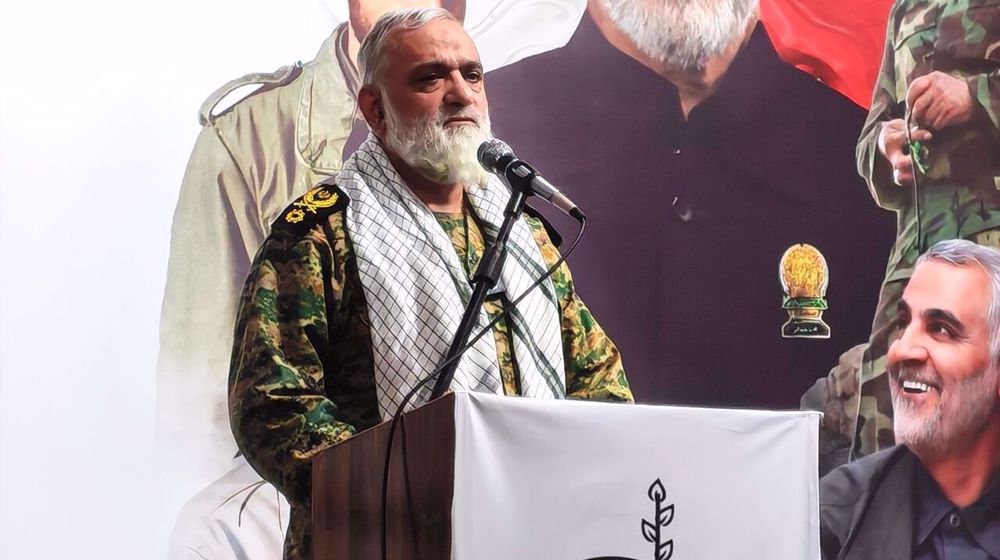
A senior advisor to the Commander-in-Chief of the Islamic Revolution Guards Corps (IRGC) has stressed that the Strait of Hormuz will remain closed until Iran’s “legitimate” demands are met, adding that a “few” illegal routes created through blasting will also be blocked soon.
Brigadier General Mohammad Reza Naqdi said on Wednesday that the Islamic Republic’s armed forces have “full control” over the Strait of Hormuz and that the situation will continue until Iran’s demands are met.
However, he noted that some individuals use small vessels to smuggle oil and transfer it to tankers.
Gen. Naqdi stressed that the volume of oil smuggled through such illegal routes is negligible, and therefore cannot be taken as evidence that the Strait of Hormuz is open. He added that Iranian authorities will address the issue.
“Soon, a small number of routes, created by violators through blasting and destroying some existing rocky passages in the Strait of Hormuz, will be blocked,” the IRGC advisor said.
His remarks come amid claims that Persian Gulf oil exports are returning to pre-war levels.
Following the recent US-Israeli war of aggression against Iran, launched on February 28, the Iranian armed forces have seized operational control of the Strait of Hormuz.
The closure of the vital waterway has sent shockwaves through the global economy, severely affecting Western energy supplies and exposing vulnerabilities in the US military’s logistical networks in the region.
Tehran has repeatedly maintained that any reopening of the Strait of Hormuz or resumption of normal maritime traffic is strictly contingent upon Washington ceasing its military aggression, lifting its illegal naval blockade, and formally recognizing Iran’s sovereign rights and strategic red lines.

'Iran ready to increase range of weapons'
Gen. Naqdi stressed that the range of Iran’s weaponry is not limited by technical constraints, but is instead determined by the country’s strategic needs and decisions made by its officials and the Leader of the Islamic Revolution.
He said Iran has the technological capability to develop weapons with longer ranges, but their range is set in accordance with the country’s requirements.
“Whenever the officials and the Leader of the Revolution grant us authorization, we will increase the range of our weapons in accordance with the needs of the battlefield,” the commander stated.
Highlighting that Iran produces its weapons domestically, Gen. Naqdi reiterated that the country can increase the range and power of its weaponry whenever required by battlefield needs.
 This makes it easy to access the Press TV website