By Press TV Website Staff
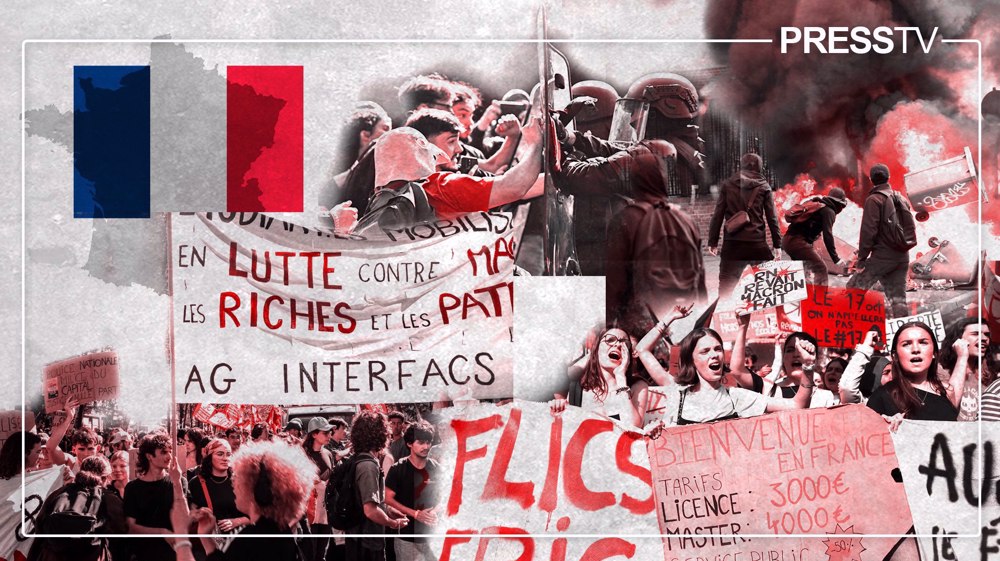
France has been gripped by a rapidly expanding student protest movement that began with a local dispute over deteriorating school conditions.
The massive protests have since grown into a nationwide student movement centered on education, inequality, and the government’s brutal response to legitimate demands.
The movement began on September 17 at the Antoine de Saint-Exupéry High School in Créteil, a southeastern suburb of Paris.
Teachers at the school had gone on strike over staff shortages and inadequate resources, and students soon joined them in peaceful protest.
What began as a local mobilization quickly developed into a broader movement. Students complained that their schools were operating with too few teachers and support staff, overcrowded classrooms, deteriorating buildings, and inadequate facilities.
In some schools, students reported broken windows, water leaks, malfunctioning toilets, excessive heat, and shortages of healthcare staff.
The movement gained momentum through social media, as videos of school blockades spread rapidly and encouraged students elsewhere to organize similar actions.
By late September, the blockades had spread beyond the Paris region.
On September 28, the mobilization began to take on a distinctly national character, with hundreds of schools reportedly affected.
As demonstrations multiplied and confrontations with police became more frequent, what had started as a dispute over school conditions evolved into a broader national political crisis.
What are the students demanding?
At the heart of the movement is a demand for better-funded public education.
Student organizations are calling for more teachers and school staff, smaller class sizes, safe and well-maintained school buildings, and an end to chronic shortages.
They have also criticized long school days and the pressure placed on young people by the French education system.
Another major point of contention is Parcoursup, the national university admissions platform. Students argue that the system adds to their stress and can reinforce existing social inequalities.
The Union syndicale lycéenne, one of the student organizations involved in the mobilization, has identified four major concerns: shortages of teachers and staff, deteriorating school buildings, overcrowded timetables and classrooms, and the stress associated with Parcoursup.
For students in poorer suburbs and vocational schools, the protests are also about equality.
Many argue that students do not have access to the same educational opportunities depending on where they live.
Some students interviewed by Le Monde described schools without functioning toilets, nurses, or substitute teachers. Others said they feared that inadequate educational conditions could limit their future prospects.
The protests have therefore evolved beyond a simple demand for more teachers.
They have become a broader call for an education system that, according to the students involved, provides equal opportunities regardless of social or geographical background.

How did a school protest become a national movement?
The movement’s expansion was remarkably rapid. By the end of September, school blockades were being reported across France. Students organized largely through social media, while teachers’ unions, parents, and later university students joined the mobilization.
On October 6, the movement reached its largest point so far as protests swelled across the country, with the participation of hundreds of thousands of students joined by teachers.
The French Interior Ministry estimated that around 266,000 people took part in demonstrations across the country, including approximately 56,000 in Paris.
Organizers gave a significantly higher figure, estimating national participation at around 450,000.
The demonstrations brought together high school and university students, teachers, parents, trade unionists, and other workers. The October 6 mobilization transformed what had begun as a high-school movement into a much broader social protest.
In several cities, protesters marched against both the deterioration of public education and violent police response to the demonstrations.
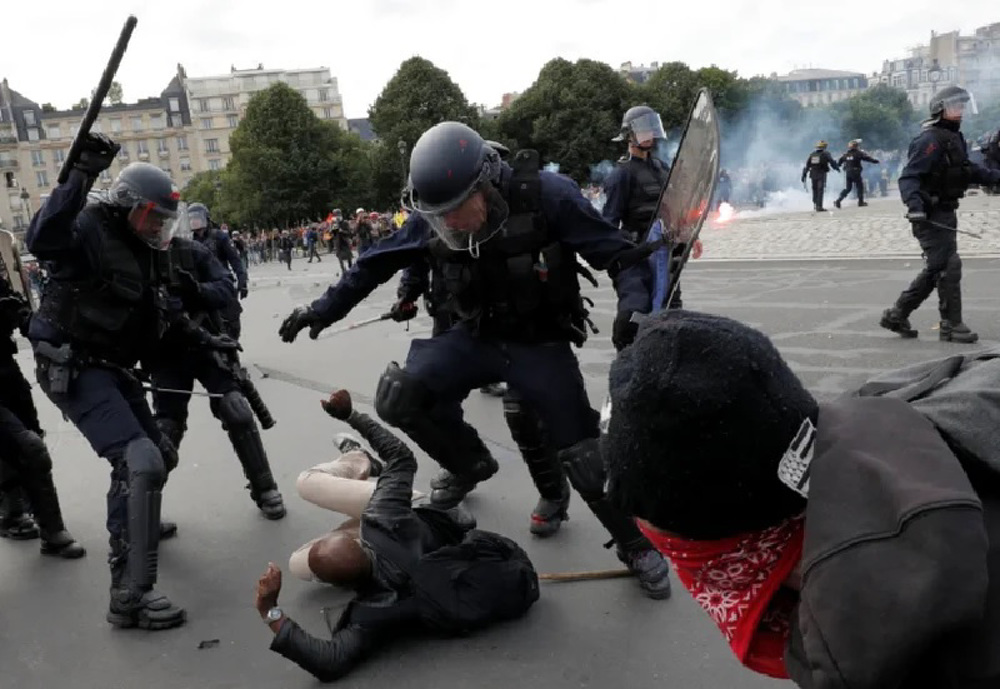
As the movement spread, police became increasingly brutal. French riot police were deployed around schools and demonstrations, particularly in areas where blockades were taking place.
Police used tear gas, batons, riot-control grenades, and rubber bullets in several incidents, and thousands of students were arrested.
How many people have been arrested and injured?
According to French authorities, more than 5,000 people had been arrested before the nationwide demonstrations on October 6.
Rights groups said that about 85 percent of those arrested were minors.
By October 6, reports put the total number of arrests since the beginning of the movement at more than 6,500, with nearly 500 arrests recorded on October 6 alone. Almost all of those arrested were reportedly minors.
The Justice Ministry said more than 1,800 people were facing prosecution, nearly 1,500 of them under the age of 18. The number and severity of injuries have also become a major source of concern for rights activists.
The French government said at least 215 teenagers and 85 education workers had been injured during the protests. Several injuries among protesters, however, were particularly serious.
On October 5, a 15-year-old boy in Lens lost his hand and part of his lower arm following an explosion involving a police grenade during clashes.
Other teenagers reportedly suffered serious injuries, including one who lost an eye and another who sustained severe facial injuries. According to the boy’s mother, his jaw and teeth were shattered, leaving him barely able to eat with a straw while in hospital.
French authorities say they have opened investigations into several cases of police misconduct.
At the same time, the government has defended the overall brutal police response, triggering an angry response from parents and human rights activists in the country.
What has been the international reaction?
The most prominent international criticism has come from human rights organizations. Several rights groups have raised serious concerns about whether the use of force by French police has been necessary and proportionate, particularly given that many of them are minors.
The organizations have called on French authorities to end “disproportionate police response,” arguing that young people peacefully demanding their right to education should be protected rather than subjected to beatings, tear gas, or arbitrary detention.
They have also expressed concern over the use of tear-gas grenades, batons, and rubber bullets, citing reports of serious injuries.
France’s National Consultative Commission on Human Rights, known by its French acronym CNCDH, issued its own warning on October 6. It denounced the disproportionate use of police force during the student protests and called for dialogue and respect for the rights of minors.
The CNCDH stressed that the response to the student mobilizations “requires, above all, restraint, listening, and strict respect for fundamental freedoms.”
Importantly, the commission also warned against treating the entire student movement as equivalent to violent acts committed by a handful of participants, arguing that such incidents should not be used to justify a broader escalation of state repression.
On the detention of minors, the commission emphasized that the rights of young people “must prevail.”
“The best interests of the child must prevail in all circumstances,” it said. “As the CNCDH has constantly reaffirmed in its work, the voices of young people must be heard and taken into account, and under no circumstances should they be criminalized.”
International trade union organizations have also expressed solidarity with the protesters.
The European regional office of the World Federation of Trade Unions issued a statement on October 3 expressing solidarity with French students and calling for an end to “brutal repression.”
“We demand an end to the brutal repression they are facing, the immediate release of those arrested and a solution to the extremely serious issues that render schools unsafe and dilapidated, lacking the resources necessary for adequate, high-quality learning,” the organization said.
The organization also linked the “dramatic crisis” to the European Union’s austerity and “warmongering” policies.
“The dramatic crisis caused by the EU’s austerity and warmongering policies, which are resulting in exorbitant rises in the cost of living, fuel, energy and basic necessities across all European countries, is the real cause of the anger sweeping across Europe amongst young people and the working class,” it said.
The protests have also attracted attention beyond France. Student protests were reported in neighboring Belgium, reflecting concerns about education and the pressures facing young people in other European countries as well.
What has Iran said?
Iran has strongly slammed the French authorities’ handling of the student protests. On October 4, Iran’s Foreign Ministry expressed concern over reports of police violence against student protesters and described the use of force as disproportionate.
The Iranian position became more explicit on October 6. In a post on X on Tuesday in French, Iranian Foreign Ministry Esmaeil Baghaeish sharply criticized the harsh response by French security forces to the student protests, drawing attention to a glaring double standard in the French government’s approach to human rights and the right to protest.
Paris, he said, had, in January 2026, during foreign-backed deadly riots across Iran, underscored the need to respect “peaceful assembly without fear of punishment” and called for government “restraint” toward protesters in Iran.
He noted that French officials had even described the events as a “peaceful uprising,” despite being aware of calls for riots and violence made from outside Iran, as well as reports of armed attacks on law enforcement centers inside the Islamic Republic.
“Now, in France, student protests are called ‘urban violence,’” Baghaei said.
He also pointed to remarks by the French interior minister, who, he said, appeared far less supportive of restraint, instead calling for decisive intervention by security forces and the use of force to restore order.
Baghaei stated that violence against police and attacks on public property could not be justified.
“Clearly, violence against police, arson and damage to public property cannot be justified, and the government has a duty to maintain security and public order,” the Iranian official said.
But he said that the central issue was not whether governments have a responsibility to maintain public order, but whether they apply the same standards when dealing with protests at home and abroad.
“The contradiction lies elsewhere: Why are the same actions and the same standards interpreted one way when the protester is in Iran and another way when the protester is in France?” he asked.
“The problem is not protest; the problem is the double standard,” Baghaei said. “If human rights and the right to protest are principles, they should not change depending on the geography of the protester.”
Iran also summoned French Ambassador Pierre Cochard in Tehran over the violent treatment of student protesters and widespread human rights violations.
Hamid Ahmadi, acting head of the Human Rights Department at Iran’s Foreign Ministry, told the ambassador that France had international obligations to respect human rights and fundamental freedoms, including the right to peaceful assembly.

Why does this matter beyond education?
The protests have become a test of France’s approach to public dissent. The scale of the arrests is particularly striking. Thousands of people have been detained in less than three weeks, with a large majority being minors.
Images of teenagers running from tear gas, heavily armed riot police surrounding schools, and reports of serious injuries have shifted the debate from school funding to civil liberties and police accountability.
As of October 6, the movement showed no clear sign of disappearing. At the same time, the movement has won support from teachers, parents, trade unions and university students.
Students and their supporters have vowed to continue demonstrating until they see concrete changes.
For the protesters, the central message is straightforward: education is a public right, and students should not have to accept deteriorating schools, absent teachers and unequal opportunities as normal.
Student and teacher organizations have called for a major emergency investment package, with demands reportedly reaching around 10 billion euros for education reforms.
The government, however, faces significant financial constraints, including high public debt and borrowing costs. The protests also come amid mounting concerns over the cost of living. Inflation reached 2.4 percent year-on-year in August, while energy prices rose sharply.
The protests have also taken on a political dimension, with France only months away from its presidential election.
 This makes it easy to access the Press TV website