
By Maryam Bashirpour
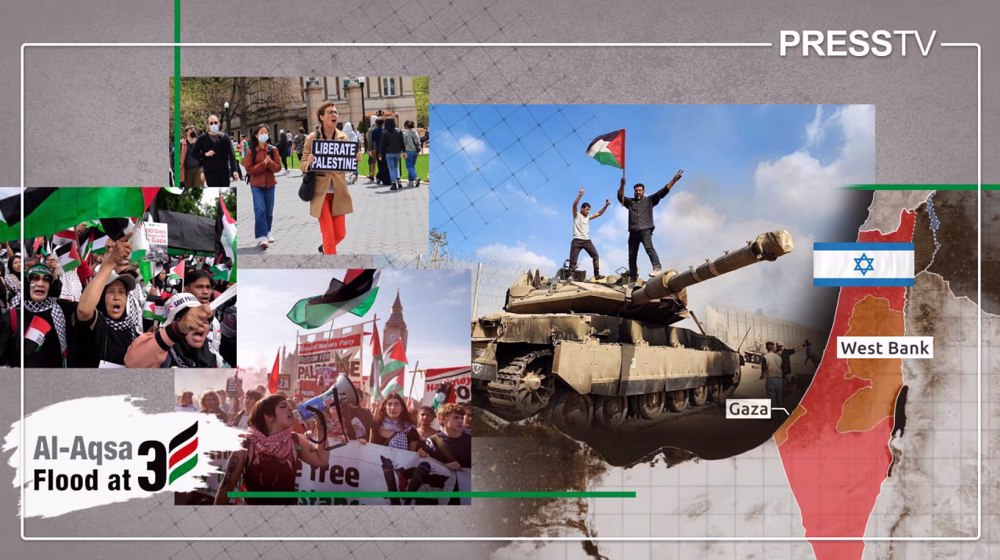
On October 7, 2023, Israel faced not merely a surprise military operation, but the fundamental collapse of the “invincibility myth” upon which the regime had built its legitimacy for decades.
But what distinguished this event from “another war” was an analysis articulated three days later by the martyred Leader of the Islamic Revolution, an analysis that, three years later, has also been reflected in reports by Western research institutions.
Ayatollah Seyyed Ali Khamenei, on October 10, 2023, made a statement that became one of the key analytical propositions of this period.
“In this incident since the 15th of Mehr, the occupying Zionist regime has suffered an irreparable defeat, both militarily and in terms of intelligence. Everyone has spoken of the defeat; my emphasis is on its ‘irreparability.’”
He continued with a description that revealed the structural nature of this defeat.
“This devastating earthquake has managed to destroy some of the main structures of the occupying regime’s rule, and rebuilding those structures will not be easily possible... Since Saturday, the 15th of Mehr, the Zionist regime is [no longer] the same Zionist regime as before,” declared the Leader.
This assessment forms the basis of all subsequent analyses. Unlike many Western analyses that viewed October 7 as an “intelligence failure” or “tactical surprise,” the Leader described it as a “devastating earthquake” at the structural level.
The difference between these two analyses is the difference between “a defeat” and “the end of a paradigm.”
A prediction that was analysis
To understand the depth of the Leader’s analysis, one must go back ten years.
On September 9, 2015, amid the nuclear negotiations and Western promises of “25 years of tranquility” for Israel, the Leader of the Islamic Revolution made a statement that many at the time regarded as a “political aspiration,” but which ten years later became one of the most significant analytical propositions in the discourse of resistance.
“After the conclusion of these nuclear negotiations, I heard that the Zionists in occupied Palestine said that, for now, with these negotiations that have taken place, we are free from concern about Iran for 25 years; after 25 years, we will think about it. In response, I say: First, you will not see the next 25 years. God willing, by 25 years from now, by the grace and favor of God, there will be no such thing as the Zionist regime in the region,” he stated.
But what distinguishes this prediction from mere “prophecy” is the mechanism the Leader immediately explained afterward: “Second, even during this period, the Islamic, militant, heroic and jihadist spirit will not let the Zionists have a moment of peace; let them know this. The nations have awakened; they know who the enemy is.”
In analyzing these statements, it must be said that the Leader did not make his prediction based on clairvoyance, but on structural analysis: a regime that builds its legitimacy on “military superiority,” if that superiority collapses, can no longer justify its survival within the very fundamental logic it has constructed.
As one Iranian newspaper wrote: “Today, even many Western and Zionist media outlets and research centers are speaking of a crisis that, more than being external, has its roots within Israeli society and the Israeli structure.”
The Israeli newspaper Haaretz has also examined factors that could potentially lead to the realization of the prediction of “the destruction of Israel by 2040.”
From “terrorism” to “legitimate defense” – A legal framework
If October 7 was the point at which Israel’s military paradigm collapsed, one year later, on October 4, 2024, the Leader of the Islamic Revolution also established the legal framework for the event. In his historic Friday prayer sermon in Tehran, in a statement that permanently altered the legal foundations of resistance.
“All these attacks, and Operation Al-Aqsa Flood, which took place around this same time last year, were a correct, logical and legally legitimate international action, and the Palestinians were in the right,” he stated.
This statement represents a legal elevation: Al-Aqsa Flood was a “lawful response” to decades of Israeli occupation and oppression. By placing it within the framework of the right to self-defense under Article 51 of the United Nations Charter, the Leader endowed it with a legitimacy beyond that of a mere “military operation.”
In the same sermon, he emphasized: “Every nation has the right to defend its land, its home, its country and its interests against an aggressor; the meaning of this is that the Palestinian people have the right to stand against an enemy that has seized their land, occupied their homes, destroyed their farms and ruined their lives.”
This legal framework responds to a fundamental contradiction in the international order – the same issue referred to in this article as the “Westphalian-colonial order”: an order that respects sovereignty for European states but disregards the right of peoples such as the Palestinians to self-determination.
By describing it as a “correct, logical and legally legitimate international action,” the Leader exposed this contradiction: if sovereignty and self-defense are universal rights, why are they not applied to Palestine?
A network that does not stop functioning through assassinations
One of the key analyses by the martyred Leader concerning the nature of resistance appears in his message following the martyrdom of Yahya Sinwar, the famed Hamas commander.
In this message, the Leader first established Sinwar’s position: “He left behind an irreparable blow in the history of this region on October 7; and then, with dignity and pride, ascended to the realm of the martyrs.”
He then added an analysis revealing the networked nature of resistance: “His loss is certainly painful for the resistance front, but this front did not stop advancing with the martyrdom of prominent figures such as Sheikh Ahmad Yassin, Fathi Shiqaqi, Rantisi and Ismail Haniyeh, and it will not pause in the slightest with the martyrdom of Sinwar either; Hamas is alive and will remain alive.”
These statements demonstrated a deep understanding of the networked logic of resistance. Unlike hierarchical organizations that collapse when their leaders are eliminated, Palestinian resistance operates as a decentralized network in which the assassination of leaders does not render it dysfunctional, but instead pushes it toward a new stage of resilience.
This analysis is also confirmed today by field reports. Following Sinwar’s martyrdom, Hamas not only did not collapse, but moved to rebuild its command structure and continued its operations against the Zionist occupation.

The prediction realized – From “25 years” to the reality of 2026
In the year 1405 (2026), in his annual Hajj message, the martyred Leader of the Islamic Revolution confirmed the realization of the prediction made ten years earlier.
“The unstable regime and the cancerous Zionist tumor are also approaching the final stages of their ominous existence and, by the grace of God and in accordance with the decisive and forward-looking statement made by the great martyred Leader ten years ago, will not see 25 years after that date, God willing,” he stated.
The phrase “in accordance with the decisive and forward-looking statement” is highly significant: it indicates that the prediction is being referred to not as a “wish,” but as an analytical proposition in the process of being realized.
The Leader himself also stated that the objective of Al-Aqsa Flood “thwarted the enemy’s major conspiracy to dominate the region and the Islamic world and placed the Zionist regime on the path to decline.”
The Palestinian Resistance Committees also stated in their declaration that the martyred Leader “regarded the Palestine issue as the first and central issue of the Islamic world, and this was not limited to moral support, but turned into direct and continuous military, logistical, financial, scientific and social support for various Palestinian resistance groups.”
In practice, this support contributed to the resilience of the Gaza front and to the emergence of turning points leading up to the historic and path-breaking Battle of Al-Aqsa Flood.
“We will not raise the white flag” — Perseverance as a paradigm
Throughout his statements, Iran’s martyred Leader emphasized perseverance until the complete elimination of occupation. In analyzing the strategic victory of resistance, he said:
“The one who is victorious is the one who struggles in the way of God; the Palestinian resistance is victorious, Hezbollah is victorious. If the evil Zionist regime had been able to defeat the fighting forces, it would not have needed to make itself appear so blackened and ugly before the world.”
This perseverance, in the Leader’s logic, replaces the dominant paradigm: it invalidated the Western paradigm – conciliation, normalization and the “Deal of the Century” – and replaced it with the paradigm of resistance. In another statement, the Leader said: “Resistance is alive and will remain alive.”
This statement is a paradigm, not a temporary tactic. Today, even Western media acknowledge that “no plan will succeed without the consent of the resistance and the people of Gaza.”
The Palestinian Resistance Committees stated: “Future generations will draw from him the meaning of perseverance, sacrifice, the demonstration of faithful dignity, and the power of the Ummah in confronting dependence, domination and Zionist and American expansionism.”

The strategic legacy — From an individual to a school of thought
Overall, it can be said that October 7 was not merely a military operation; it was the beginning of the realization of strategic predictions that Iran’s martyred Leader had articulated beginning in 2015.
Three key predictions – the irreparable defeat, the decline and fall of the Zionist regime, and the failure of colonial projects in the region – not only have been realized, but the mechanism of their realization was also explained in those very statements: “through the efforts of the peoples of the region” and “by the grace of God.”
The martyrdom of the Leader, rather than halting this process, accelerated it. The pure blood of the Leader of the Islamic Revolution will bring about the certain decline of the Zionist regime and global arrogance as he had predicted himself.
The Palestinian Resistance Committees also stated: “Future generations will draw from him the meaning of perseverance, sacrifice, the demonstration of faithful dignity, and the power of the Ummah in confronting dependence, domination and Zionist and American expansionism.”
Before his martyrdom, Iran’s martyred Leader had said: “Through the efforts of the peoples of the region, America must leave this region and will leave.”
Today, in 2026, this prediction too – like the “25-year” prediction – is on the path to realization. And the martyrdom of the Leader itself is part of the mechanism through which the divine promise is being fulfilled. To quote him, resistance is alive and will remain alive.
Maryam Bashirpour is a university researcher and writer based in Tehran.
(The views expressed in this article do not necessarily reflect those of Press TV)
 This makes it easy to access the Press TV website