
As many as 450,000 people have taken part in nationwide protests across France, according to student and youth organizations, in the biggest day yet of a growing movement over deteriorating school conditions, as police fired tear gas and used batons and water cannon to disperse protesters in several cities.
The Interior Ministry put the turnout on Tuesday at more than 250,000, including 56,000 in Paris, compared with the organizers’ estimate of 450,000 nationwide and 100,000 in the capital.
The protests, which began in September in the deprived suburbs of Paris and have since spread across the country, have brought together high school students, teachers, parents and trade unionists demanding more funding for education, additional teachers, better-maintained school buildings and improved classroom conditions.
The scale of Tuesday’s demonstrations, coupled with increasingly violent clashes between protesters and police, has intensified pressure on Prime Minister Sébastien Lecornu’s government, which has promised to address the students’ demands while defending the police response.
Lecornu told lawmakers that at least 215 teenagers and 85 school staff had been injured since the protests began, describing the toll as “the heaviest toll in decades” paid by France’s school system. His office said more than 700 police officers had also been injured.
Most of Tuesday’s demonstrations passed without serious incident, but some, including in Paris, ended in clashes with riot police. Nearly 500 people were arrested, according to Interior Ministry figures reported by French media, while the ministry said dozens of police officers were injured.
Trade unions and human rights groups have accused police of using excessive force against young protesters. Amnesty International called on French authorities to end what it described as “disproportionate police repression.”

Interior Minister Laurent Nuñez defended the police response, claiming it had been proportionate in “almost all cases” and that some demonstrations had descended into riots requiring police intervention.
In Paris, protesters held smoke flares and placards bearing slogans including “schools with no money = country with no future.”
One student, Anna, told reporters at Place de la Nation: “Our demands are simple: better study conditions, enough teachers, decent school buildings. The authorities’ response has been catastrophic. There’s enough violence already.”
Demonstrations were also held in Marseille, Nantes, Lyon, Rennes, Toulouse and other cities. In Marseille and Nantes, protesters carried signs reading “The state has killed national education”, while parents in Toulouse linked arms at the front of a march.
Students have complained of overcrowded classrooms, staff shortages and deteriorating school buildings, with some schools facing basic maintenance problems ranging from water leaks to rat infestations. They have also called for changes to university admissions and other education policies.
The Education Ministry said more than 900 of France’s 3,700 high schools were blockaded or closed for the day on Tuesday, although student organizations put the number at 1,800. Some local education authorities moved classes online.
The unrest has also been marked by serious injuries. On Monday, a 15-year-old lost a hand during clashes with riot police in northern France.
A 16-year-old in Tours lost the use of his right eye after being struck in the head during a high-school blockade, while a 14-year-old suffered severe facial injuries during a protest northwest of Paris.
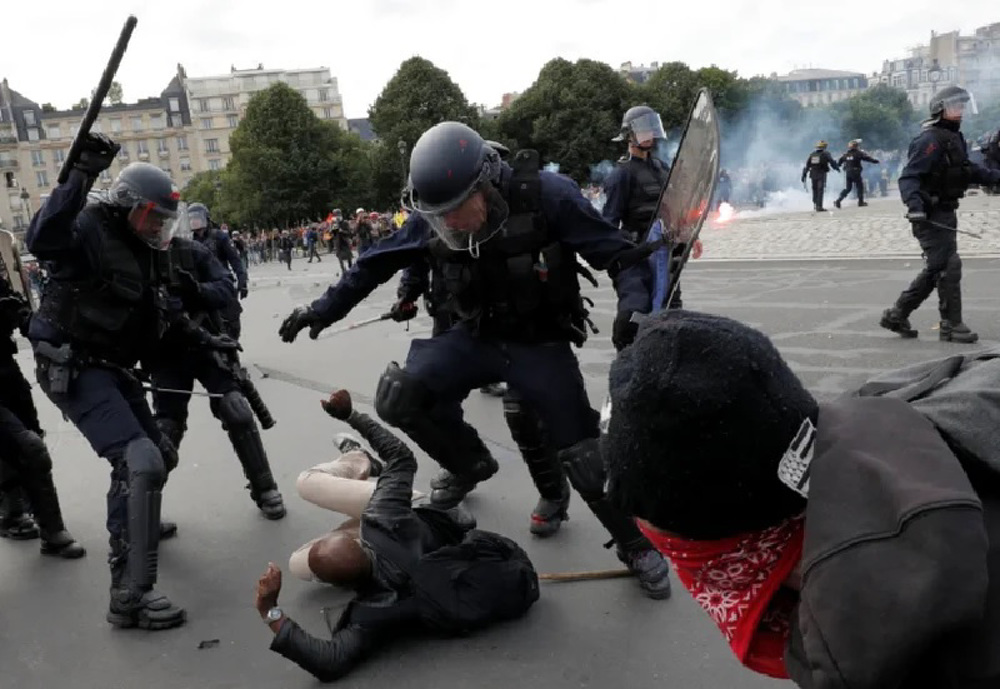
Rights groups, students and parents have accused authorities of using disproportionate force against minors.
The government has announced a temporary suspension of classes at some high schools to allow students and school authorities to hold discussions, while the Education Ministry has launched an online platform for students to report problems and suggest changes.
But the measures have done little so far to ease the pressure on the government. Parent Emilie Lhomme, speaking at a protest outside the Hélène Boucher school in Paris, said government promises were not enough to change students’ daily lives.
The protests are unfolding as the government struggles with weak economic growth, a widening budget deficit and rising borrowing costs, making additional education spending politically and financially difficult.
France’s 10-year borrowing costs recently reached their highest level in more than two decades as investors grew increasingly concerned about the country’s debt and public finances.
The pressure comes just months before a presidential election in which education, the cost of living and public services are expected to be major issues.
The government has accused the radical-left La France Insoumise party of encouraging the unrest after several of its lawmakers attended school blockades. Party leader Jean-Luc Mélenchon has backed the protests while calling for non-violence.
What began as a protest outside a single school in a low-income Paris suburb has now developed into a nationwide movement, catching the government off guard and drawing tens of thousands of students, teachers and parents into the streets.
The demonstrations have exposed deep frustration over the state of France’s public education system — and raised the question of whether the government can address those grievances before anger over schools becomes a broader political challenge.
 This makes it easy to access the Press TV website