
Iran has questioned France’s response to the nationwide student protests, noting that Paris is applying double standards to the right to protest and human rights.
In a post on X on Tuesday in French, Foreign Ministry Esmaeil Baghaei pointed to the French security forces’ harsh response to the student protests and the government’s differing approach to human rights.
Paris, he said, had in January 2026 underscored the need to respect “peaceful assembly without fear of punishment” and called for government “restraint” toward protesters in Iran.
He said French officials had even referred to a “peaceful uprising” despite being aware of calls for riots and violence outside Iran and reports of armed attacks on law enforcement centers in the Islamic Republic.
“Now, in France, student protests are called ‘urban violence,’” Baghaei said.
The French interior minister appeared less supportive of restraint and had called for swift and decisive intervention by security forces and the use of force to restore order, the Iranian official said.
En janvier 2026, la France a appelé l’Iran à garantir le « droit de manifester pacifiquement sans crainte de représailles » et à faire preuve de retenue dans sa réponse aux manifestations.
— Esmaeil Baqaei (@IRIMFA_SPOX) October 6, 2026
Malgré les appels à la révolte lancés depuis l’étranger et les informations faisant état… pic.twitter.com/7CyO9Zt7nj
He also said the French government was attributing the unrest to “political manipulation” and the involvement of far-left groups.
“Clearly, violence against police, arson and damage to public property cannot be justified, and the government has a duty to maintain security and public order,” the Iranian official said.
“But the contradiction lies elsewhere: Why are the same actions and the same standards interpreted one way when the protester is in Iran and another way when the protester is in France?” he asked.
“The problem is not protest; the problem is the double standard,” Baghaei said.
“If human rights and the right to protest are principles, they should not change depending on the geography of the protester.”
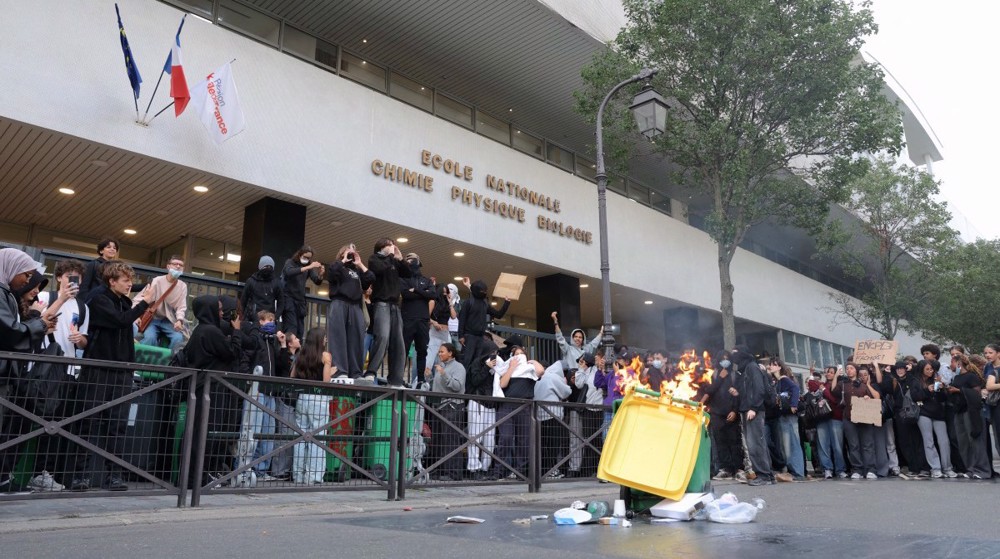
Ten investigations into possible police brutality are under way following injuries caused by the use of police weapons.
Those injured include a 15-year-old who lost his hand, another teenager who lost an eye, and a boy whose jaw and teeth were shattered, leaving him barely able to eat with a straw in hospital, according to his mother.
“The policing is catastrophic. People have been mutilated by weapons – one boy has lost an eye. It’s horrible,” said Lily, 17, whose name has been changed. A final-year social sciences student, she was protesting for greater funding for what she described as a discriminatory education system that leaves poorer children behind.
“My parents support me being on the barricades and at the protests. They’re worried about the policing, but they said they’d come and get me from the police station if I was arrested,” she said.
Nearby, teenagers held cardboard signs protesting the use of tear gas and riot police. One banner read, “A state that gases high school students is a weak state,” while another said, “Gas rapists, not children,” referring to calls for stronger laws against sexual violence. Another banner read, “Not here to riot.”
The unprecedented protest movement, which began outside a single school in a low-income Paris suburb, has spread across France, taking the government by surprise.
Hundreds of high schools have been barricaded and forced to close as students protest teacher shortages, deteriorating school buildings and overcrowded classrooms.
According to France’s Justice Ministry, 5,060 people have been arrested since the protests began, 87% of them minors. More than 1,800 people have been prosecuted, including 1,483 minors, although the ministry did not specify the alleged offenses. It said 790 cases had been dismissed.
The French government said 24 schools had been burned or ransacked.
The protests have been driven by grievances over long and overloaded timetables, overcrowded classrooms, teacher shortages and deteriorating school buildings. Students have also complained about unbearable temperatures in classrooms during heatwaves earlier this year.
The unrest is unfolding against a backdrop of mounting concerns over the cost of living. Inflation reached 2.4% year-on-year in August, while energy prices rose sharply, putting additional pressure on lower-income households.
The protests have also acquired a political dimension, with France only months away from its presidential election. The government has accused the hard-left France Unbowed party, or LFI, of encouraging the unrest.
 This makes it easy to access the Press TV website