By Humaira Ahad
Hala was a child in Gaza when the Israeli regime killed her parents. In the years that followed, she learned the language of loss before she was old enough to understand the occupation that had produced it. Yet when asked what remained, there was still something she held on to: her faith in God, and the belief that life could somehow continue beyond the ruins.
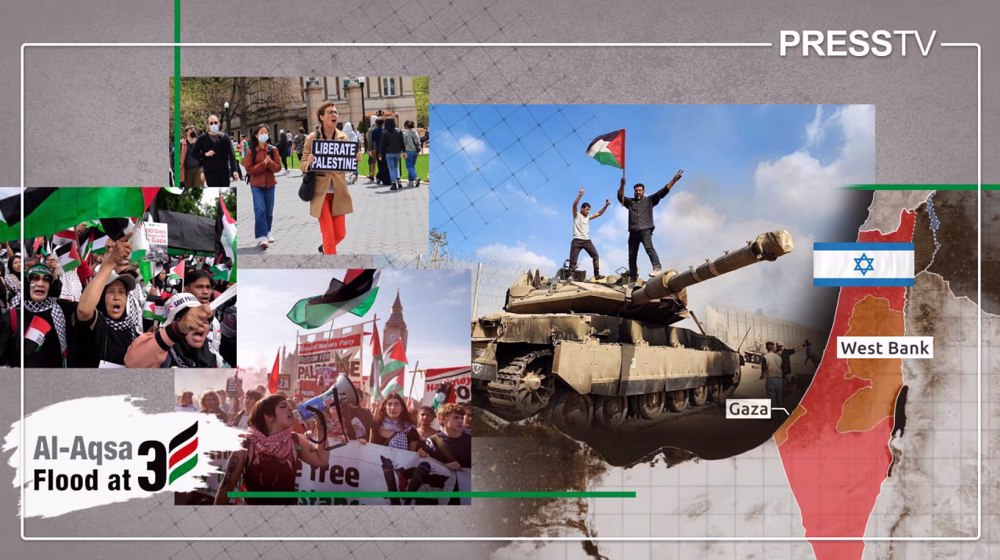
That is the paradox at the heart of the world after the Al-Aqsa Flood operation on October 7, 2023. On one side was an occupying power backed by the United States, armed with some of the most sophisticated weapons on earth and long regarded as virtually untouchable.
On the other was a population in an open-air prison whose homes could be destroyed, whose families could be shattered, and yet whose existential question refused to disappear.
October 7 tore through the false facade of Israeli invincibility. What followed in Gaza ripped the veil surrounding the political order that had allowed the Palestinian question to be postponed while the regime deepened its occupation and Washington continued to protect it.
The consequences have been enormous, from Gaza’s devastation and the growing legal and diplomatic pressure on Israel to the transformation of public opinion, the spread of global pro-Palestine protests, the disruption of regional alliances and the eventual expansion of the war to Iran, Lebanon, Yemen, the United States and the region’s critical energy routes.
There are many ways to measure how profoundly the world changed after the events of October 7. Here are ten of the most consequential.
Palestine moved closer to statehood and liberation
Before October 7, the international recognition of Palestine was already substantial. The State of Palestine, which declared independence in 1988, was recognized by roughly 139 UN member states. Then came a new wave following Israel’s genocide in Gaza.
In 2024, Barbados, Jamaica, Trinidad and Tobago and the Bahamas recognized Palestine, followed by Spain, Ireland, Norway, Slovenia and Armenia. The movement accelerated in 2025.
On September 21, the United Kingdom and Canada became the first G7 states to recognize Palestine, joining Australia and Portugal. The following day, France, Belgium, Luxembourg, Malta, Andorra and Monaco followed at a UN summit chaired by France and Saudi Arabia.
Four of the five permanent members of the Security Council, Britain, France, Russia and China, had recognized Palestine, leaving the United States as the sole holdout among the five.
The significance has not been just numerical. For decades, Western governments had maintained that recognition should come only after the so-called negotiations.
After October 7, that logic began to fracture. The Palestinian question was no longer something that could be indefinitely deferred while negotiations failed to produce a state.
Many experts have seen this recognition as a precursor to the ultimate liberation of all occupied territories from the clutches of the child-murdering apartheid regime.
Israel's crimes moved to the world's highest courts
The Gaza genocide following the Al-Aqsa Flood operation also changed where the Palestinian struggle was being fought – from the battlefield to international courts.
In December 2023, South Africa filed a genocide case against Israel at the International Court of Justice (ICJ). The ICJ ordered provisional measures in January 2024 and issued further orders in March and May.
Then, in July 2024, the top UN court stated that Israel's “abuse of its status as the occupying power" renders its “presence in the occupied Palestinian territory unlawful.” It emphasised that Israel’s continued presence is “illegal” and should be ended “as rapidly as possible.”
The ICJ even cited various policies, including the expansion of illegal Israeli settlements in the occupied West Bank and East Al-Quds, exploitation of natural resources, annexation, and discriminatory policies against Palestinians, all of which it stated violate international law.
The legal battle mattered because it shifted the language surrounding Palestine. International legal institutions were examining the conduct of Israel’s war on Gaza and the legality of the occupation itself.
The proceedings created a legal basis for sanctions, challenges to arms exports and boycott campaigns.
In September 2026, Britain, France, and Canada said that they would impose a significant set of sanctions on the Israeli regime over its settlement expansion in the occupied West Bank.

Netanyahu’s arrest warrant by the ICC
On November 21, 2024, the International Criminal Court (ICC) issued arrest warrants for Israeli prime minister Benjamin Netanyahu and his former war minister, Yoav Gallant.
The court said there were reasonable grounds to believe that both were responsible for the war crime of starvation as a method of warfare, as well as the crimes against humanity of murder, persecution and other inhumane acts. It also found reasonable grounds to believe that they bore responsibility for intentionally directing attacks against civilians.
The warrants extended the legal consequences of Israel’s genocidal war on Gaza beyond the battlefield and into the sphere of international diplomacy.
For Netanyahu in particular, the warrant complicated travel to countries that are party to the Rome Statute, the treaty that established the ICC. The Court currently has 125 States Parties, whose obligations include cooperating with the Court in cases falling within its jurisdiction.
The practical consequence is that a diplomatic visit can carry a legal question alongside its political purpose: whether the host country would be required to act on the ICC warrant if Netanyahu entered its territory.
That has placed the governments of ICC member states in a difficult position between their diplomatic relations with Israel and their obligations under the Rome Statute.
The issue has already produced different responses. The United Kingdom and Ireland have indicated that they would respect their legal obligations in relation to the warrant.
Italy has likewise acknowledged the obligations arising from its membership of the ICC. Other member states, including Belgium, Canada, Denmark, Finland, Iceland, Lithuania, the Netherlands, Norway, Slovenia, Spain, Sweden and Switzerland, are also parties to the Rome Statute.
Israel’s genocidal war on Gaza produced a second arena of confrontation. Legal filings, arrest warrants, and questions over compliance with international law have become part of the diplomatic consequences of the genocide, placing Israel under international legal scrutiny.
At the UN, the numbers became harder to ignore
The UN General Assembly became another measure of the diplomatic shift following October 7. The numbers were striking. On October 27, 2023, the Assembly called for an immediate humanitarian truce in Gaza, with 120 countries voting in favour, 14 against and 45 abstaining.
Seven months later, the divide was even more pronounced. In May 2024, 143 countries backed a resolution upgrading Palestine’s rights at the United Nations and urging the UN Security Council to reconsider its application for full membership. Only nine voted against, including Israel and the United States, while 25 abstained.
Then, in September, the UN General Assembly went further. It voted 124 to 14, with 43 abstentions, to demand that the Israeli regime end its “unlawful presence” in the occupied Palestinian territory within 12 months. The resolution followed the International Court of Justice’s July 2024 advisory opinion, which concluded that Israel’s continued presence in the occupied Palestinian territory was unlawful.
Taken together, the votes offered a clear picture of Israel’s growing diplomatic isolation at the UN General Assembly.
On questions directly tied to Gaza, the occupation and Palestinian statehood, Israel increasingly found itself isolated, with the United States frequently among the few countries voting alongside it.
The significance of these votes was political. Vote after vote showed that Israel was losing ground in the wider diplomatic arena, while support for Palestinian rights was consolidating across much of the international community.
The result was a widening gap between the Israeli regime and the majority of UN member states, a shift that made the diplomatic fallout from the genocide increasingly difficult for Israel to contain.

Israel's image collapsed completely, even in the United States
Perhaps the clearest evidence of the shift after the events of October 7 came not from world governments and leaders, but from the public – from South Asia to Africa to the United States.
For decades, Israel held a significant advantage in American public sympathy because of its intense lobbying efforts. That advantage has now completely disappeared.
In Gallup’s February 2026 poll, 41 percent of Americans said they sympathized more with Palestinians, compared with 36 percent who sympathized more with Israelis, the first time since Gallup began asking the question in 2001 that Palestinians had taken the lead.
The reversal was striking. In 2023, 54 percent of Americans sympathized more with Israelis, compared with 31 percent for Palestinians. By 2025, the gap had narrowed to 46 percent for Israel and 33 percent for Palestine. By February 2026, the numbers had crossed.
Among younger Americans, the shift was even more pronounced. Gallup found that 53 percent of Americans aged 18 to 34 sympathized more with Palestinians, compared with just 23 percent who sympathized more with Israelis. It marked a record low for Israel in that age group.
The political divide was equally stark. Some 65 percent of Democrats said they sympathized more with Palestinians, compared with 17 percent who sympathized more with Israelis.
And the shift was not limited to the United States.
A Pew Research Center survey of 36 countries, conducted between February and May 2026, found a median of 67 percent of respondents expressing an unfavorable view of Israel. In none of the countries surveyed did a majority hold a favorable view of Israel.
The American numbers were similarly stark: 60 percent of respondents expressed an unfavorable view of Israel, compared with 37 percent who viewed it favorably. Among Americans aged 18 to 34, the figure was even higher, with 74 percent expressing an unfavorable view.
The numbers suggest a profound shift in how Israel is viewed by the public, particularly among younger generations.
For a regime that for decades benefited from strong public sympathy in the United States and close political ties with Western governments, the change represents a significant loss of the international goodwill on which much of that relationship has rested.
Palestine became a mass movement on streets and campuses
The shift in public opinion was not confined to polling. It became visible in the streets, on university campuses and eventually at the ballot box across the world.
In the United States, the Crowd Counting Consortium, a project involving the University of Connecticut and Harvard’s Ash Center, recorded roughly 12,400 pro-Palestinian protests between October 7, 2023 and June 7, 2024.
The scale was remarkable, and it extended well beyond America’s largest cities. During the first five weeks after October 7, the consortium recorded more than 950 events across 48 states, drawing millions of people.
The protests soon moved into the country’s universities, turning campuses into some of the most visible sites of opposition to Israel’s genocide in Gaza. The consortium recorded more than 3,700 protest days at 525 schools across 317 localities. Encampments appeared at more than 130 institutions, and 3,645 arrests were recorded at schools.
The demonstrations were not an exclusively American phenomenon. Armed Conflict Location & Event Data (ACLED) recorded roughly 4,200 demonstrations across almost 100 countries during the first three weeks after October 7.
They accounted for 38 percent of all demonstrations recorded worldwide during that period, with about 86 percent classified as pro-Palestinian. The United States itself recorded more than 600.
What began as street protest increasingly entered formal politics. In the United States, the “Uncommitted” campaign during the 2024 Democratic primaries drew roughly 704,000 votes nationally by June 2024, signalling opposition to former president Joe Biden’s approach to the genocide among a significant section of Democratic voters.
In Britain, five independent candidates campaigning in opposition to Israel’s war on Gaza won seats in the 2024 general election, including former Labour leader Jeremy Corbyn.
The significance was not just the number of demonstrations. It was a growing movement of voters, students and protesters who were challenging Israel’s crimes in public spaces and political campaigns, making the erosion of support increasingly visible.

Supporting Israel became a harder political and economic choice
The pressure eventually moved from diplomatic statements to arms and trade.
In September 2024, Britain suspended around 30 of its roughly 350 arms export licences to the Israeli regime, citing a “clear risk” that some equipment “could be used in serious violations of international humanitarian law.”
The decision did not amount to a complete arms embargo due to iron-clad ties between them, but it marked a significant departure from unrestricted military trade with Israel, primarily due to public pressure in the UK.
Germany, one of Israel’s most important suppliers of major weapons to the regime for decades, also came under growing pressure over its exports.
According to SIPRI data, Germany accounted for around 30 percent of Israel’s major arms imports between 2019 and 2023. Berlin subsequently imposed restrictions on certain military exports that could be used in Gaza, before resuming them after the so-called ceasefire.
Other governments took measures that went beyond restrictions on weapons. Bolivia severed diplomatic relations with Israel in 2023, followed by Colombia in 2024. Turkey suspended trade with Israel, while Spain, Slovenia and the Netherlands introduced various restrictions affecting arms or trade.
These measures reflected a notable change in the political cost of maintaining close relations with the Israeli regime.
For governments that had long treated their ties with Israel as largely insulated from international criticism, the Gaza genocide made that position increasingly difficult to sustain.
Arms sales, trade agreements and diplomatic relations were no longer matters of foreign policy. They had become domestic political issues, legal questions and sources of international pressure.
The longer the genocide continued, the more governments faced a choice they had previously been able to avoid: maintain established ties with the regime while confronting growing opposition at home and abroad, or impose restrictions and abide by international law.
West Asian dynamics changed
Before October 7, the United States was working to broker an agreement that could have established formal relations between Saudi Arabia and Israel, building on the “normalization deals” reached by several Arab states under the so-called Abraham Accords.
The Al-Aqsa Flood operation disrupted that trajectory. Saudi Arabia was forced to amend its path and declare that normalization with Israel could no longer be separated from the Palestinian question. Riyadh said that any agreement would require a credible and irreversible path toward the establishment of a Palestinian state.
That represented a significant shift in the diplomatic equation. The Palestinian issue, which the expanding “normalization” process had appeared increasingly capable of pushing to the margins of regional diplomacy, was once again at its centre.
The consequences extended beyond the regime’s relations with the kingdom. The regional order that the US wanted to build by closer US-Arab security ties became increasingly defined by war and military confrontation.
By 2026, the regional fallout had widened further. The US-Israeli war on Iran brought the confrontation directly into the Persian Gulf, with the Islamic Republic launching retaliatory strikes against the United Arab Emirates, Kuwait and Bahrain.
Persian Gulf governments that had spent years pursuing economic integration, diplomatic normalization and closer security ties with Washington were instead drawn into a widening military confrontation alongside the United States, while also launching attacks on Iran.
The consequences forced a reassessment of the region’s security architecture.
For Persian Gulf states, close alignment with Washington had long been presented as a source of protection. But as the US-Israeli war on Iran escalated, that same alignment increasingly exposed them to retaliation and made their territory part of a wider regional battlefield.
The war reached Iran and challenged the security structure
On February 28, 2026, the United States and Israel launched a major military aggression against Iran – the second unprovoked war in a year – while nuclear negotiations were still underway.
The military aggression targeted both military and civilian infrastructure across the country, while also leading to the martyrdom of the Leader of the Islamic Revolution and many top-ranking military commanders and government officials.
Iran’s response quickly demonstrated that the war would not remain confined to Iranian territory. Tehran launched waves of missiles and drones at the Israeli-occupied territories and at US military bases and assets across the Persian Gulf, extending the confrontation to Bahrain, Kuwait, Qatar, the United Arab Emirates and other countries hosting American bases.
The retaliation exposed vulnerability beneath the appearance of overwhelming American military superiority. The US could project enormous force into the region, but failed to protect the sprawling network of bases, personnel and infrastructure required to sustain that presence.
A Pentagon inspector general assessment later found that Iranian retaliatory strikes had damaged or destroyed hundreds of buildings and structures at US bases across Kuwait, Bahrain, Qatar, the UAE, Saudi Arabia, Iraq, and Jordan.
The attacks also contributed to significant shortages in critical US munitions and forced the military to alter the way it positioned personnel, equipment and supply facilities.
The damage was not confined to military installations. US diplomatic facilities in four countries suffered an estimated $184 million in physical damage, while thousands of American citizens were evacuated from the region.
The war had also imposed enormous costs on Washington: the Pentagon estimated more than $33 billion in costs by the end of June, including more than $22 billion in expended munitions.
The logistical consequences were equally revealing. Damage and disruption to US facilities forced American planners to rely more heavily on distant infrastructure, including Diego Garcia in the Indian Ocean. In some cases, resupply cycles stretched to 14 to 18 days.
The Pentagon watchdog warned that changes to the American military footprint in the region could become permanent.
Iran’s response also challenged assumptions about the balance of power in the region. Despite facing a far larger US-Israeli military coalition, Iran was able to sustain retaliation across multiple fronts, strike US and allied positions and disrupt regional military infrastructure.
Iran demonstrated that military superiority did not translate into uncontested control of the region, and that Tehran retained the capacity to shape the costs, geography and duration of a war imposed on it.
Hormuz turned the imposed war into an economic shock
Then came the Strait of Hormuz, one of the world's most important energy chokepoints, and the disruption that followed the February 28 war sent oil markets sharply higher.
The US Energy Information Administration (EIA) reported that Brent crude, which had begun 2026 at around $61 a barrel, reached $118 by the end of March as the closure and wider supply disruptions took hold.
By April, the effects were no longer confined to the Persian Gulf. The disruption to oil flows tightened global markets, while buyers scrambled to find alternative supplies. EIA described the resulting conditions as an extreme short-term market squeeze.
Restricting traffic through the Strait of Hormuz changed the scale of the war. Iran demonstrated an ability to control the infrastructure on which the wider international economy depends. The costs moved from military budgets and damaged bases into fuel markets, shipping, inflation and economic growth.
The result was a striking reversal of the conventional balance. The United States and Israel could impose a war on Iran, but Tehran could impose costs far beyond the battlefield, on American forces, Persian Gulf infrastructure and global energy markets.
October 7 broke the political order that had allowed the Palestinian question to be pushed aside. Israel faced growing diplomatic and legal isolation, public support eroded, the so-called regional normalization was disrupted, and the war expanded to Iran.
Iran demonstrated that even overwhelming US military power could not prevent Tehran from sustaining retaliation, striking American assets in the region and forcing Washington to absorb significant military and strategic costs.
October 7 became a strategic death sentence for the old regional order. It exposed the fragility beneath the appearance of Israeli and American strength, showing how quickly their assumptions about security, deterrence and regional control could unravel. What had appeared to be a stable order was suddenly revealed as a mechanism that could be challenged and reshaped from within the region itself.
 This makes it easy to access the Press TV website