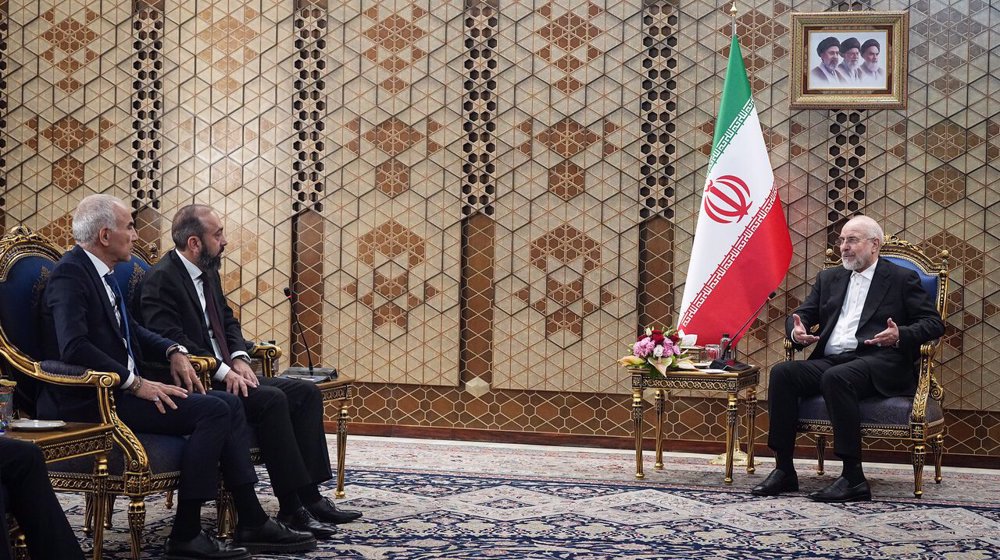
The Iranian Parliament speaker has warned against the interference of foreign powers in the Caucasus, saying the region should not become an arena for geopolitical rivalry.
Mohammad Baqer Qalibaf made the remarks during a meeting with Armenian Minister of Foreign Affairs and International Trade Ararat Mirzoyan in Tehran on Monday.
He said the Caucasus region is in need of stability, which must be ensured through the consolidation of established borders.
“The Islamic Republic of Iran and Armenia can play a constructive role in the Caucasus by exchanging views on bilateral and regional issues,” he added.
“The region should not become an arena for geopolitical rivalry among foreign powers.”
Qalibaf also said the intervention of extra-regional powers can contribute to insecurity and instability, citing the Persian Gulf region as an example.
He said foreign powers are primarily seeking to exploit the resources and capabilities of the regional countries while pursuing their own interests.
Iran’s unequivocal policy, Qalibaf said, is to expand and consolidate its relations with neighbors such as Armenia at the operational and strategic levels alike.
Meanwhile, Qalibaf voiced hope that the strategic cooperation agreement between Tehran and Yerevan would be finalized soon, saying the two countries can discuss bilateral ties and issues in the Caucasus, including transportation routes.
He also hoped that sustained dialogue and cooperation between the two countries in the political and economic spheres will help create opportunities in areas such as transit and energy.

Additionally, Qalibaf expressed appreciation for the positions taken by the people and government of Armenia during and after the recent war of aggression against Iran.
“The Americans failed to achieve any of their objectives in the military confrontation with the Islamic Republic of Iran and were defeated. Politically, they also failed to honor the terms of the Memorandum of Understanding, thereby further undermining their own credibility in this arena,” he said, referring to the war-termination deal signed on June 17.
Mirzoyan, for his part, said Armenia’s relations with the Islamic Republic are strategic, and that cooperation between the two governments would further strengthen bilateral ties.
He underlined the need for regional states to deepen their cooperation in the fields of transportation, energy, and infrastructure.
Armenia, he said, agrees with Iran in emphasizing the principle of inviolability of regional countries' borders.
Moreover, the top diplomat said Armenia would not allow any action to be taken from its territory against Iran.
The United States and Israel launched their illegal war of aggression against Iran on February 28. The Persian Gulf Arab countries supported the military assault, and some of them directly conducted deadly air raids against Iran.
On April 8, the enemies were forced to accept a ceasefire amid Iran’s resistance, decisive retaliatory operations, and a powerful grip on the Strait of Hormuz.
In July, the United States conducted waves of deadly air raids on Iran and imposed a naval blockade of the country in violation of the June 17 MoU with the Islamic Republic, signed to end the war.
In response, the Iranian armed forces launched devastating strikes against strategic American targets across West Asia and declared the Strait of Hormuz closed to all traffic.
 This makes it easy to access the Press TV website