By Maryam Bashirpour
World Teachers’ Day is a day when the world honors those who pass knowledge from one generation to the next. But in Iran, this day is no longer just a date on the calendar.
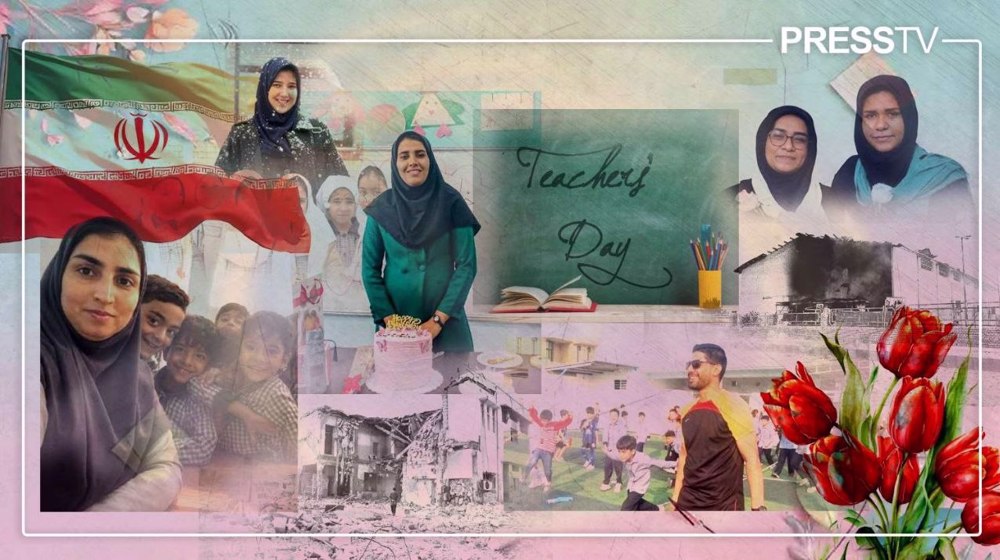
In this country, it has become a living memorial for teachers who were killed in their classrooms, for teachers who continued teaching under the specter of US-Israeli bombardment, and for teachers who lost their students and still came back.
In the recent imposed war, many schools were targeted by the wicked, murderous enemy. Among them was Shajareh Tayyebeh Elementary School in Minab, where more than 160 students and teachers were killed in cold blood on the morning of February 28.
It was an ordinary school morning in Minab, a city in southern Iran. Classrooms were filled with children between the ages of seven and twelve. They had come to learn, to read, to count, and, like children everywhere, to spend a few hours simply being children – safe within the walls of their school.
By the end of that morning, at least 168 of those children were dead, along with teachers and parents who had been there with them.
The school was struck twice by Tomahawk missiles while 264 students were inside their classrooms. Many victims lay trapped beneath the rubble for hours. Some bodies were so severely damaged that they could not be identified.
And Minab was not an isolated tragedy. According to Iran’s Ministry of Education, by late March 2026, at least 252 students and teachers had been killed and 184 teachers injured.
Around 1,300 educational and administrative centers had been damaged, while at least 1,490 schools across 22 provinces were destroyed or affected by the US-Israeli bombings. The resulting educational crisis reached nearly 19 million students and their families.
UN experts confirmed that the Minab school had been struck by Tomahawk missiles, describing the target as “a clearly identifiable civilian building” operating as a school during hours when children were inside. The overwhelming majority of those killed were between the ages of seven and twelve.
The unprovoked terrorist attack represented two of the six grave violations against children identified by the UN Security Council: the killing and maiming of children, and attacks on schools.
Under international humanitarian law, schools are protected civilian objects and must not be intentionally targeted unless they become military objectives. Minab school was not a military objective and the teachers there were not combatants. They were simply teachers.
Four fronts, one profession
The Iranian teacher in this war fought on four different fronts at once. And on each of those fronts, they left a part of themselves behind.
Teachers who chose to remain in their schools, even when those schools were no longer the safest places in the city. They did not erase the blackboard and kept showing up. They showed children that life could continue, even in the shadow of the imposed war.
In cities under the constant threat of attack, teachers chose to come to school rather than stay at home. It was not a simple choice. Every morning, every teacher who opened the door and stepped into a classroom was knowingly taking a risk – and still, they came.
When the bombardment intensified and schools began closing one after another, education did not stop; it changed its form. Across Iran, teachers moved almost overnight from physical classrooms to digital platforms.
Teachers who had spent their entire professional lives standing before blackboards suddenly found themselves alone in empty classrooms, facing computer screens and teaching children scattered across cities and villages, many of whom were still trembling at the sound of explosions.
The national “Iran Digital” system registered more than 507,000 new students during the third imposed war, bringing the total number of active users to around 3.5 million.
More than 134,000 students completed their courses and received certificates. In a country under bombardment, amid internet shutdowns that lasted nearly three months, the wheel of education kept turning.
But rural teachers themselves say this was not enough. In some villages, there was no network; connections were unstable; and online education could never replace a real classroom. They knew that, and they continued anyway – with whatever resources they had, for children who could not afford to be left behind.
The third front was the heaviest front of all. A teacher who had sat beside a student for years, called their name, corrected their notebooks, watched them grow – and then, one day, learned that they were gone. A teacher who attended the funeral of their student. A teacher who, when reading the class register, had to remove familiar names from the list.
This kind of grief cannot be measured. Yet Iranian teachers turned that grief into resolve. In memory of the students they had lost, they taught again. They held classes again and they fought again for the children who remained.
In this war, simply being a teacher was enough to put a person at risk. Teachers were killed in classrooms, on their way to school, and inside their own cars. Some had retired years earlier and were no longer even working in schools.
They were teachers who were mothers, leaving children behind. Teachers who had only recently married. Teachers with master’s and doctoral degrees who had returned to their hometowns to serve the children of their own communities.
A grief without measure
When the next school year began, classrooms across Iran bore the unmistakable signs of absence: empty chairs where students who never returned should have been sitting, and empty desks where teachers would no longer stand.
In many schools, ceremonies marking the start of the new academic year became occasions to honor the memory of martyred teachers and students.
The psychological cost of the war on Iran’s education system has been profound. A qualitative study of elementary-school teachers and students in Qazvin Province found that the sudden transition to online education during the war brought “multiple layers of shock, anxiety, technical challenges, psychological pressure, learning difficulties, feelings of longing, and the need to adapt.”
The academic performance of 12th-grade students declined by 43 percent. Parents reported that their children had become withdrawn, increasingly isolated from their classmates, and deprived of physical activity and face-to-face interaction with their teachers.
And yet, no one left the classroom.
On World Teachers’ Day, the global community celebrates the theme of “reimagining teaching as a collaborative profession” – a call to recognize teachers not as isolated individuals, but as pillars of collective human development. In Iran, this is not an abstract ideal but a lived reality, written in blood and chalk dust.
Iranian teachers have shown what collaboration means when an entire profession is under fire. They shared lesson plans over unstable connections. They turned their homes into classrooms. They organized online psychological-support sessions. They kept their cameras on to preserve a sense of human connection. And while grieving colleagues and students they had lost, they continued to teach.
But resilience is not a substitute for justice. The deliberate targeting of schools, the killing of children in classrooms, and the killing of teachers constitute grave violations of international humanitarian law.
UN experts have documented these horrendous war crimes, yet accountability remains out of reach. The international community cannot celebrate teachers while remaining silent about those who were killed simply for being teachers.
On this World Teachers’ Day, the world must remember Iran’s teachers: the teacher who stayed in the classroom, the teacher who taught online, the teacher who buried a student, and the teacher who never made it home. It must remember the father who goes every morning to the grave of his daughter, a teacher. It must remember the mother who sits beside her child before a computer screen, listening at once to a lesson and to the sound of bombs.
And it must ask itself: If a teacher cannot be safe in the classroom, where in the world is a child safe? Iran’s teachers have already answered that question — not with words, but with their lives. They stayed, taught and refused to abandon the classroom, even when the classroom became a grave. Now it is the world’s turn to answer.
Maryam Bashirpour is a university researcher and writer based in Tehran.
(The views expressed in this article do not necessarily reflect those of Press TV)
 This makes it easy to access the Press TV website