Iran's economic story is often reduced in Washington and other foreign capitals to oil, gas, petrochemicals and several other highly visible sectors, creating a deceptively narrow picture of its underlying productive capacity.
That narrowness has repeatedly encouraged predictions that pressure on a handful of strategic sectors could bring Iran's economy to its knees, overlooking the diversified structure sustaining it for almost half a century.
Iran's economic foundations span agriculture, manufacturing, mining, construction, food production, transportation, technology, engineering, services and thousands of specialized industries which rarely attract international attention.
Natural stone is one particularly revealing example, because an industry beginning with mountains and quarries extends through machinery, skilled labor, processing, architecture, logistics, exports and environmental standards.
The lineage is measured in millennia, with the magnificent, finely chiseled stones of Persepolis still standing as enduring evidence of Iran’s ancient mastery of stone craftsmanship.
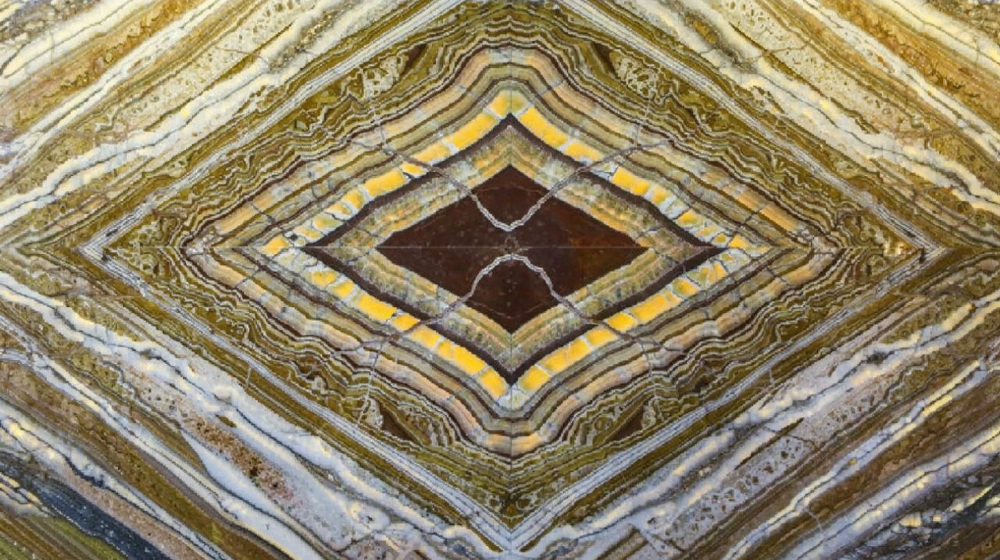
Like stone extracted from its mountains, Iran's economic foundations comprise numerous layers, each carrying distinct value while together forming a structure stronger than any single component alone.
Natural stone is unusual because geological rarity can become architectural value, allowing material extracted from a quarry to acquire an entirely different economic identity through successive stages of processing.
A block extracted from an Iranian quarry can become a polished slab, a book-matched wall, a hotel lobby floor, a façade panel, a staircase or an elaborate architectural feature.
The physical material remains stone, but its economic identity changes dramatically as it passes through cutting, calibration, polishing, finishing, design, packaging and project-specific fabrication.
Iran already has substantial experience in this transformation, with companies marketing Iranian Pietra Grey, Azna crystal, Dehbid, Harsin, Gohare and numerous travertines and granites for specialized architectural applications.
Industry estimates put Iran’s decorative-stone reserves at around five billion tonnes, including more than three billion tonnes described as proven reserves, while annual production is estimated at approximately ten million tonnes.
That geological wealth matters because the international market it feeds is large and increasingly sophisticated, with worldwide natural-stone trade generally estimated in the range of $42 billion to $45 billion annually.
Against that market, Iran's Stone Association and industry representatives have estimated that the country's stone sector could eventually generate around $5 billion annually through exports, indicating the magnitude of the opportunity.
The figure becomes more meaningful when considered alongside Iran's established quarries, processing capacity, machinery expertise and expanding international commercial relationships.
These materials serve hotels, commercial buildings, luxury residences, airports and other demanding projects, where characteristics such as color, durability, water absorption and abrasion resistance influence purchasing decisions.
The appeal is therefore not merely aesthetic, as Iranian stones combine geological diversity, durability and distinctive physical qualities that suit applications from expansive commercial surfaces to refined luxury interiors.
Specific Iranian stones are presented for hotel lobbies, airports, luxury residences, spas, and commercial headquarters, with an emphasis on both their technical properties and visual appeal.
That distinction is economically important because international stone markets reward consistency and processing expertise as much as they reward the geological character and visual uniqueness of the original material.
Italy offers an especially revealing example because its international stone position has been built not simply upon geological resources, but upon processing technology, craftsmanship, design and sophisticated global distribution.
Iranian stone already participates in that Italian ecosystem, with World Bank trade data showing that Italy imported about $1.22 million of Iranian marble and travertine blocks under the relevant 2023 trade classification.
Iran’s unprocessed stone is exported to Italy for high-end processing and re-exported—including back to Iran—at exponentially higher values, often targeting wealthy customers and illustrating the significant economics of value-added stone trade.
Other World Bank data show Iran exporting roughly $45.95 million of marble, travertine and related calcareous stone in blocks and slabs during 2023, demonstrating established international demand for Iranian geological material.
Italy’s stone industry combines machinery, craftsmanship, design, and market access, demonstrating how advanced processing can become as commercially valuable as geological resources.
Iran also increasingly has the technological capacity to capture more value domestically, supported by manufacturers and suppliers of cutting, calibration, polishing, and specialized stone-processing equipment.
Iranian companies use advanced Italian machinery while developing domestic expertise, combining international technology with local industrial knowledge to strengthen the country’s stone-processing ecosystem.
This shift is significant because Iran is moving beyond being a geological supplier by developing the industrial expertise needed to turn its diverse stone resources into globally marketable architectural products.
One of the clearest manifestations of this transformation is the Mahmoudabad industrial zone in Isfahan, widely recognized within Iran's stone industry as a major national center for processing.
Companies in the zone produce slabs and tiles from crystal, marble, and other stones, while export-focused businesses source directly from mines and processing facilities for domestic and international markets.
Iran’s universities and technical institutions strengthen this knowledge base by researching dimension-stone resources, quarry characteristics, and methods for assessing and classifying geological deposits.
The stone industry consequently connects geology to engineering, manufacturing, architecture and international trade, creating a much deeper economic ecosystem than the extraction of raw blocks might initially suggest.
Iran's geography provides another structural advantage, placing its major stone-producing regions within reach of important markets across the Gulf, Iraq, Turkey, the Caucasus, Central Asia and South Asia.
Existing trade demonstrates this geographical reach, with Iranian worked monumental and building stone exports worth about $69.5 million in 2023 under the relevant World Bank trade classification.
The figures are modest compared with the industry's resource base, but that is precisely what makes the underlying story interesting.
A country possessing billions of tonnes of decorative stone, established quarrying regions, processing clusters, domestic machinery expertise and access to multiple neighboring markets is operating in a global industry worth tens of billions of dollars.
The same logic that allowed Italy to turn processing expertise into global commercial influence can operate differently in Iran, where enormous geological variety is combined with access to a broad surrounding construction market.
There is something fitting about stone becoming part of the conversation about Iran's economic resilience.
Unlike oil, a quarry does not depend on a single global benchmark price. Unlike many manufactured goods, its distinctive colors, veining and geological characteristics cannot simply be reproduced by another factory.
And unlike a purely raw commodity, its value can be multiplied through processing, design, craftsmanship, technology and branding. Iran's strongest advantage may ultimately be the combination of all of these layers.
And this chain is only one strand in a much larger economic fabric, where thousands of overlooked activities transform Iran’s natural resources, human expertise, and geographic advantages into sustained economic value.
The stone industry is a metaphor for Iran’s broader economic structure, deeply rooted, resilient under sanctions, and far more formidable than adversaries’ wishful calculations that the country could buckle within two weeks.
 This makes it easy to access the Press TV website