By Mohammad Ali Haqshenas
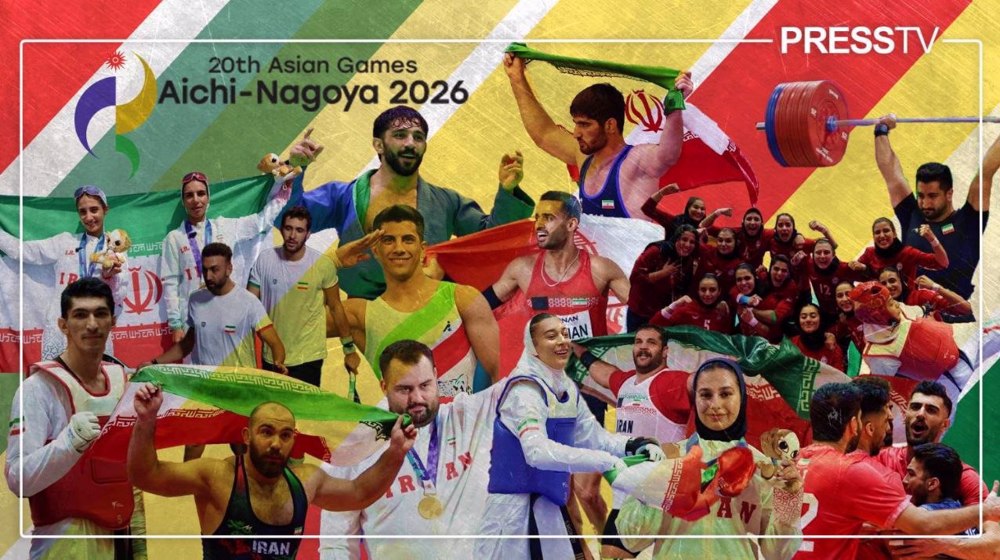
Iran finished the Aichi-Nagoya 2026 Asian Games with 19 gold, 18 silver and 15 bronze medals, climbing one place from Hangzhou 2022 and expanding the range of sports in which the Iranian representatives reached the podium.
The Aichi-Nagoya Games were held from September 19 to October 4 at venues across the two Japanese cities, bringing together around 17,000 athletes and officials from 45 countries and regions to compete in 43 sports.
Among them was Iran’s 305-member delegation, competing in 38 sports. The team was named the “Minab Angels” in tribute to the children killed in the US-Israeli attack on Shajareh Tayyebe Elementary School in Minab on February 28.
Iran’s campaign combined a stronger gold-medal return with a broader success across disciplines. Wrestling remained at the heart of the medal tally, while women’s sport and less traditional disciplines added new dimensions to the delegation’s performance.
Iran finished sixth overall with 52 medals, including six more golds than it won at the 2022 Hangzhou Games, marking a significant progress.
The comparison with the previous edition is particularly striking in terms of gold medals. Iran won 13 gold medals in Hangzhou, compared with 19 in Nagoya, while its overall haul declined slightly from 54 medals to 52. The gold share of Iran’s medal haul rose from 24.1 percent to 36.5 percent, marking the increased quality of medals.
The medal table also tells another story. Iran moved from seventh to sixth, while the number of sports in which it collected medals rose to 21, one more than the previous record of 20.
That wider spread meant the campaign was not simply carried by one or two familiar disciplines. Wrestling, taekwondo, weightlifting, rowing and karate contributed major portions of the haul, but athletics, wushu, kurash, gymnastics, kabaddi, basketball, three-on-three basketball, esports, climbing and padel also contributed.
The improvement is especially notable among Iranian women athletes, who won three gold medals in Nagoya, their best-ever return at a single Asian Games as Iranian women had won a total of four gold medals in the Games before 2026.
It also highlights firsts in women’s taekwondo and rowing, along with Iran’s first women’s weightlifting medal and other breakthroughs.
At the same time, Nagoya provided a series of individual landmarks: Mohammadreza Tayebi ended a 52-year wait for an Iranian men’s shot-put gold at the Games while setting an Asian Games record; Ali Davoudi broke Asian and Asian Games records in the super-heavyweight weightlifting competition; Iranian swimmers reached individual finals for the first time since 2010; and Iran secured its first Asian Games padel medal.
The result was therefore less a simple increase in medals than a shift in the composition of Iranian success.
Wrestling: The traditional power base delivers six golds
Wrestling once again formed the backbone of Iran’s hugely successful campaign, with six gold medals spread across Greco-Roman and freestyle divisions.
Amin Mirzazadeh began the wrestling march by successfully defending his Asian Games Greco-Roman 130kg title, beating Uzbekistan’s Rafael Tsitsuashvili 3-1 in the final.
It was his second consecutive Asian Games gold in the category and Iran’s first wrestling title in Nagoya.
Alireza Abdevali followed at 77kg, producing one of the more significant matchups of the tournament when he defeated Japan’s Olympic champion Nao Kusaka 5-3. Kusaka had won the Paris 2024 Olympic title, while Abdevali’s victory gave him the biggest senior title of his career to that point.
Mehdi Bali also won a bronze medal at 97kg.
🤼 🥇 Iranian Greco-Roman wrestler Alireza Abdoli says he believed in himself despite few expecting him to win gold.
— Press TV Sports (@presstvsports) October 1, 2026
He added that he competed boldly, fought hard and proudly, and thanked God after becoming Asian Games champion in Nagoya.@presstvsports pic.twitter.com/kCFLLCYNXW
The freestyle programme then produced four more Iranian champions. Mohammad Nokhodi won the 86kg title after defeating Japan’s Hayato Ishiguro 9-6.
Amirhossein Zare retained his 125kg crown with a 12-2 win over China’s Buheeerdun, adding another successful defence to his already extensive international résumé.
On the final day, Younes Emami defeated Japan’s world champion Yoshinosuke Aoyagi 9-5 in the 74kg final, while Amirali Azarpira dominated Uzbekistan’s Shokhruz Poyonov 10-0 in the 97kg final.
Emami had also defeated Paris 2024 Olympic champion Razambek Jamalov and world champion Nurkozha Kaipanov on his route to the final.
Six wrestling golds gave the sport a decisive role in Iran’s jump from 13 golds in Hangzhou to 19 in Nagoya. Yet the wider feature of the wrestling campaign was its spread across both styles: four freestyle titles alongside two Greco-Roman crowns.
🤼 It rained gold medals for Iranian wrestlers at the 2026 Asian Games. Two on Friday and two more on Saturday.
— Press TV Sports (@presstvsports) October 3, 2026
Yones EMAMI 🥇
Amirali AZARPIRA 🥇
[Video: @wrestling ]@presstvsports pic.twitter.com/o2UfByuS93
Taekwondo: Women break through as salimi adds another title
Taekwondo produced four Iranian medals, including two golds, one silver and one bronze.
The first breakthrough came from Saghar Moradi, who won the women’s under-67kg title to give Iran its first women’s taekwondo gold medal at the Asian Games.
The 19-year-old defeated Uzbekistan’s Ozoda Sobirjonova in the final after earlier beating Kyrgyzstan’s Tamiris Sulaimanova and Chinese Taipei’s Wang Wei-Chia.
Moradi’s victory was particularly significant because women’s taekwondo had produced medals for Iran before, but never an Asian Games title. Her performance also reflected a strong season in which she had won the same weight class at the World Taekwondo Women’s Open Championships in Taiyuan.
🥋🥇Victory lap from Iran's first female Taekwondo champion at the Asian Games.
— Press TV Sports (@presstvsports) October 2, 2026
Saghar Moradi clinched a historic gold in the -67 kg category against Ozoda Sobirjonova from Uzbekistan. @presstvsports pic.twitter.com/4DjOplkRCQ
Mahdi Hajimousaei added silver in the men’s under-68kg class. He defeated Jordan’s Paris 2024 Olympic silver medalist Zaid Kareem in the semifinals before losing to Thailand’s Banlung Tubtimdang in the final.
On the final day, Olympic champion Arian Salimi added another gold in the men’s +80kg category, defeating Uzbekistan’s Marat Mavlonov 2-0 in a commanding fashion.
Fatemeh Ahmadi completed Iran’s taekwondo haul with bronze in the women’s +67kg division.
The two women’s medals and Moradi’s landmark title made taekwondo one of the clearest examples of how Nagoya broadened Iran’s medal story beyond its traditional male-dominated strengths.
🥋🥇 Iran taekwondo coach Khanlarkhani says Iran topped the kyorugi standings at the Asian Games, becoming the only team to win two gold medals, one each in the men’s and women’s events. Other gold medals were shared among different countries.@presstvsports pic.twitter.com/BwzIobx4qk
— Press TV Sports (@presstvsports) October 3, 2026
Weightlifting: Records and a new generation of women
Weightlifting contributed four medals — two golds and two bronzes — and offered both records and one of the clearest signals of change in Iranian women’s sport.
Ali Alipour won the men’s 95kg title with a total of 398kg, a world-record total. He lifted 180kg in snatch and 218kg in clean and jerk.
Ali Davoudi then delivered a dramatic finish of the weightlifting competition in the men’s +110kg category. He totaled 466kg, including a 206kg snatch and 260kg clean and jerk, to claim gold by one kilogram and set new Asian and Asian Games records.
Iranian weightlifter Ali Alipour gives a military salute to the Iranian flag after winning the 95kg category at the 2026 Asian Games in Nagoya, Japan.
— PressTV Extra (@PresstvExtra) September 28, 2026
Follow: https://t.co/9uNLaX9z7M pic.twitter.com/p2rNtLeTSE
The women’s competition brought equally important developments.
Reyhaneh Karimi won bronze in the 77kg category, Iran’s first women’s weightlifting medal at the Asian Games. The 20-year-old lifted 107kg in the snatch and 136kg in the clean and jerk for a total of 243kg.
Mahsa Beheshti, only 17, added another bronze in the women’s 86kg event with a 259kg total. She recovered from an opening clean-and-jerk failure to lift 146kg on her second attempt and secure third place and a medal.
The four medals showed weightlifting operating on two fronts at once: established male strength at the top of the standings and an emerging women’s contingent beginning to make its presence felt.
Iran’s Mahsa Beheshti claimed the bronze medal in the women’s 86kg category at the 2026 Asian Games after lifting 113kg in the snatch and 146kg in the clean and jerk.
— PressTV Extra (@PresstvExtra) September 29, 2026
Follow: https://t.co/RuQCIFXwdR pic.twitter.com/fQ8mGRd9qC
Rowing: Women lead an important waterside breakthrough
Rowing was among Iran’s most productive disciplines, producing two golds, two silvers and a bronze.
Fatemeh Mojallal became the first Iranian woman to win an Asian Games rowing gold, taking the lightweight single sculls title in 7:24.57 at the Nagaragawa International Regatta Course.
She had previously won silver in the women’s quadruple sculls at Hangzhou.
Iran also struck gold in the women’s lightweight double sculls through Kimia Zarei and Zeinab Norouzi. The pair’s historic victory reinforced the depth of a women’s rowing group that supplied a substantial proportion of Iran’s medals at Nagoya.
Amirhossein Mahmoudpour won silver in the men’s lightweight single sculls, while the pair of Zarei and Norouzi collected another silver in women’s double sculls.
Mojallal also added a bronze in another event, underlining the breadth of her campaign.
The significance of the rowing results extended beyond the medal count. Iran had entered Nagoya with a strong history in women’s rowing, but Mojallal’s gold represented a first at the Games — another marker in a campaign where female athletes repeatedly moved into territory previously untouched by Iran.
🚣 Iranian rower Mahmoudpour reflected on winning silver in the men’s lightweight singles at the Nagoya Asian Games, saying he finally achieved the result after 12 years of hard work. His runner-up finish added another medal to Iran’s historic rowing campaign.@presstvsports pic.twitter.com/xJQ5AGcL8X
— Press TV Sports (@presstvsports) September 24, 2026
Karate: Gold, silver and Iran’s first gold of the Games
Karate delivered five medals — two golds and three silvers — and provided Iran’s first title of the Games.
Morteza Nemati won the men’s under-75kg kumite gold, defeating Kazakhstan’s Nurkanat Azhikanov and becoming the first Iranian gold medalist of the Aichi-Nagoya campaign.
His brother, Mahmoud Nemati, then added another title in the men’s +84kg category.
Iran also took silver through Ali Asghar Asiabari and Fatemehzahra Saeidabadi in men’s kumite -84kg and women’s kumite -55kg categories respectively.
🥇Morteza Nemati clinched a gold medal in karate, with Iran’s national anthem playing at the venue at the Asian Games.@presstvsports pic.twitter.com/OZX6ifHQmu
— Press TV Sports (@presstvsports) September 22, 2026
Furthermore, Iran women’s kata team comprised of Fatemeh Sadeghi, Zeynabalsadat Hosseini, and Sepideh Amini clinched the silver medal.
That gave karate five medals in total and placed the sport among Iran’s early medal engines.
The discipline’s contribution mattered not only because of its volume but also because it changed the narrative of the opening days.
Before wrestling and weightlifting entered their decisive phases, karate had already given Iran a pair of titles and ensured that its eventual medal surge was not dependent exclusively on the country’s traditional power sports.
🥋 Iran’s women’s team kata squad won the silver medal at the 2026 Nagoya Asian Games, finishing runner-up in the karate competition and adding another medal to the country’s tally.@presstvsports pic.twitter.com/zjBAPjvrW3
— Press TV Sports (@presstvsports) September 22, 2026
Wushu: Four finalists, one gold and three silvers
Wushu produced four medals — one gold and three silver — with Iran placing a finalist in each of the four sanda divisions in which it competed.
Soheil Mousavi won the men’s 75kg title after defeating competitors from India, South Korea and Uzbekistan before beating Kazakhstan’s Abdulrashid Abdullayev in the final.
Sogand Sinkaie took silver in the women’s 52kg class after reaching the final against China’s Wu Di. Shoja Panahi was runner-up in the men’s 65kg division, while Erfan Moharrami Piraghom finished second at 70kg.
The medal distribution was significant. Iran reached four finals and came away from one of the most competitive martial-arts environments in the Games with a medal in every division it contested.
🥊 Iran’s wushu chief praised the team’s performance at the Nagoya Asian Games, saying one gold and three silver medals were particularly valuable, given China won 14 of the 15 available wushu golds. He credited Iran’s success to courage and determination.@presstvsports pic.twitter.com/8XHcS3yJqn
— Press TV Sports (@presstvsports) September 24, 2026
Athletics: A gold 52 years in the making
Athletics contributed four medals for the Iranian contingent — one gold, two silver and one bronze — with two achievements standing out.
Mohammadreza Tayebi won the men’s shot put with a 20.81-metre effort, setting an Asian Games record. This was Iran’s first shot-put gold at the Games in 52 years.
Zahra Zarei added silver in the women’s 400 metres with a time of 52.38 seconds, while Sadegh Samimi won bronze in the men’s discus throw. Ali Amirian then completed the campaign with silver in the men’s 800m, clocking 1:44.97.
The four medals were spread across both men’s and women’s events, and athletics also produced one of the campaign’s most discussed non-medal episodes when leading heptathlete Fatemeh Mohitizadeh was disqualified over footwear regulations after remaining in medal contention through six events.
🥇🏃🏻➡️ Four medals and a historic first: Iran’s athletics team finishes Asian Games campaign@presstvsports https://t.co/SljpguniGR
— Press TV Sports (@presstvsports) September 29, 2026
Kurash: A first Asian Games gold
Kurash gave Iran one gold, one silver and one bronze, with Majid Vahid Barimanlou converting a previous silver into a gold with his spectacular performances.
Barimanlou won the men’s -66kg gold after beating Tajikistan’s Bobokulonov in the final. His victory represented Iran’s first Asian Games title in the discipline, two years after he had won silver at Hangzhou in the same weight category.
Ramin Ahmadzadeh added silver in the men’s -81kg category, while Fatemeh Barmaki took bronze in the women’s +87kg division.
Kurash therefore followed a pattern seen repeatedly in Nagoya: established competitiveness was converted into a first-place breakthrough.
🥋🥇 Historic kurash gold for Iran at 2026 Asian Games courtesy Barimanlou@presstvsports pic.twitter.com/zBPvjFkACY
— Press TV Sports (@presstvsports) September 29, 2026
Gymnastics: Back-to-back vault silvers and new apparatus medal
Iran won two gymnastics silvers, both in men’s artistic gymnastics, in this edition of the Games.
Arman Khodaei took silver on pommel horse with a score of 14.566, finishing behind Uzbekistan’s Utkirbek Juraev and ahead of Japan’s Daiki Hashimoto. It was Iran’s first Asian Games medal on the pommel horse and its second medal in artistic gymnastics overall.
Mahdi Olfati then repeated his silver-medal finish from Hangzhou in the vault. He averaged 14.533 from his two final vaults and finished only 0.066 points behind Filipino Olympic champion Carlos Yulo.
The results gave Iran continuity and expansion at the same time: Olfati confirmed himself as one of the continent’s established vault specialists, while Khodaei added another apparatus to Iran’s medal map.
Trampoline gymnastics provided one of the notable breakthroughs for Iran in Nagoya, with the country making its debut in the discipline at the Asian Games. The milestone was shared by the men’s and women’s representatives, giving Iranian trampoline a significant presence on the continental stage.
🤸 Iranian women’s trampoline gymnasts expressed satisfaction with their performances at the 2026 Nagoya Asian Games, following their historic debut in the continental multi-sport event.@presstvsports pic.twitter.com/AX3tVbWry8
— Press TV Sports (@presstvsports) September 27, 2026
Iran’s debut was more than a first appearance. Two Iranian men reached the final, marking the first time Iran had placed two athletes in an Asian Games trampoline final.
They finished fifth and seventh, while Fatemeh Tavassoli reached the women’s final and finished fifth.
Tavassoli and Yalda Hassan Shokati also made history as the first Iranian women to compete in trampoline at the Asian Games.
Kabaddi: Two silvers after tight finals
Iran’s men’s and women’s kabaddi teams both reached the finals and both finished with silver.
The men lost 40-34 to defending champions India after leading 18-17 at halftime, while the women went down 37-34 after another tightly contested final.
Iran men’s captain Fazel Atrachali pointed to the experience gap between the teams, saying Indian players “perhaps play around 100 matches in a year,” while women’s captain Zahra Karimi said her side had lost by “a very small margin” and believed it could have won.
The two silvers nevertheless represented a substantial contribution to Iran’s overall haul and confirmed that the country remained competitive in both versions of the sport.
🤼 Iranian women’s kabaddi team advanced to the Asian Games final in Nagoya with a convincing 23–19 victory over Chinese Taipei. The Iranian side controlled the semifinal to secure its place in the gold-medal match.@presstvsports pic.twitter.com/Y0Uv51mkwU
— Press TV Sports (@presstvsports) September 25, 2026
Esports: Iran’s first gold in the new generation
Esports supplied a single gold medal, but its significance was larger than its numerical contribution.
Hassan Pajani and Abolfazl Aghaeinasab won the eFootball title after beating Saudi Arabia in the quarterfinals, Japan in the semifinals and Malaysia 4-2 in the final.
The result added a completely different type of competition to Iran’s medal portfolio. Alongside wrestling and weightlifting, a digital discipline had now become part of the country’s Asian Games medal history.
🥇Historic medal as Iran’s esports football team wins gold at the 2026 Aichi-Nagoya Asian Games.@presstvsports pic.twitter.com/XbGiZGHam8
— Press TV Sports (@presstvsports) September 23, 2026
Basketball: A bronze that opened the campaign
Basketball provided Iran’s first medal of the Games in the initial phase of the continental competition.
The men’s team defeated China 79-70 in the bronze-medal game after recovering from a difficult start to the tournament.
The bronze became an important opening marker. At the time, Iran’s campaign had not yet moved into its medal-heavy second half, and the team’s victory over China established the first podium result for a delegation that would later climb much higher in the table.
3x3 Basketball: Another team medal
Iran also reached the podium in three-on-three basketball, taking bronze in the men’s competition.
Mohammadmahdi Rahimi, Mohammadbasir Momeni, Sarem Jafari and Seyedmohammad Ghafari formed the medal-winning side, which defeated the Philippines in the bronze-medal game after losing to Qatar in the semifinals.
🏀 Iranian men’s 3x3 basketball team secured bronze at the Asian Games in Nagoya after a dominant 21–10 victory over the Philippines in the third-place playoff. The result capped Iran’s campaign with a podium finish in the continental competition.@presstvsports pic.twitter.com/pTwOM2YrV3
— Press TV Sports (@presstvsports) September 25, 2026
Boxing: A sole bronze and historic debut
Iran also secured a bronze in boxing through Amir Esmaeili in men’s +90kg category.
The medal added another combat sport to Iran’s medal portfolio, alongside karate, wushu, kurash, taekwondo and wrestling.
Meanwhile, the 2026 edition marked Iran’s first-ever participation by a female boxer at the Asian Games, with Sarina Naghsh making history by competing in the women’s 65kg category and finishing fifth.
🥊 Iranian boxer Sarina made history at the Nagoya Asian Games, becoming the first Iranian woman to compete in boxing at the continental event. She marked the milestone with a victory in her opening bout, delivering an impressive performance inside the ring.@presstvsports pic.twitter.com/sorQkOXAlH
— Press TV Sports (@presstvsports) September 24, 2026
Fencing: Pakdaman keeps Iran on the podium
Ali Pakdaman won bronze in the men’s sabre, adding fencing to the list of medal-winning disciplines.
Pakdaman reached the semifinals before losing 15-9 to China’s Shen Chenpeng, having earlier defeated compatriot Mohammad Fotouhi 15-7 to secure a podium place.
Shooting: Mixed-team bronze
Hanieh Rostamiyan and Vahid Golkhandan won bronze in the mixed-team 10m air pistol event.
The Iranian pair scored 415.8 points in the final, finishing behind India and South Korea.
Canoe Sprint: Bronze on the water
Ali Aghamirzaei and Peyman Ghavidel claimed bronze in the men’s K2 500m canoe sprint.
The Iranian pair clocked 1:32.869, finishing behind South Korea and Japan.
Sport climbing: Silver for Alipour
Iran also reached the podium in sport climbing, with Reza Alipour taking silver.
The veteran Iranian climber had won gold medals of the discipline in the past two editions of the Games.
💢 Iranian speed climber Reza Alipour won the silver medal in the speed climbing event at the Nagoya Asian Games, reaching the final and securing a place on the podium for Iran.@presstvsports pic.twitter.com/RXXaNJo5W7
— Press TV Sports (@presstvsports) October 1, 2026
Table Tennis: Alamian adds another bronze
Noshad Alamian contributed a bronze medal in table tennis.
Noshad Alamian’s path to bronze in Nagoya was one of the more striking individual runs of Iran’s campaign. Despite being ranked 344th in the world, the Iranian captain defeated Singapore’s Pang Yu-En in the round of 32 before overcoming Hong Kong’s Wong Chun Ting, then ranked 38th in the world, 4-2 in the last 16.
He saved his biggest upset for the quarterfinals, edging world #4 Japan’s Tomokazu Harimoto 4-3 in a seven-game thriller (11-9, 11-7, 3-11, 11-6, 14-16, 6-11, 11-9). Harimoto had been unbeaten at the Games and had helped Japan win the men’s team title — its first Asian Games team gold in 60 years.
Alamian’s run ended in the semifinals against China’s Wang Chuqin, the world No. 1, who won 4-1, but reaching the last four secured Iran’s bronze.
The medal carried added weight because it matched Alamian’s individual bronze from Jakarta 2018, making Nagoya a return to the Asian Games singles podium after eight years; he had also won team and doubles bronzes at Hangzhou.
🏓 Noshad Alamiyan, who won bronze in the men’s singles table tennis at the 2026 Asian Games, said his semifinal run could have gone better. He dedicated his medal to the Iranian people, saying he was happy to bring them joy.@presstvsports pic.twitter.com/o7xKPgXc2e
— Press TV Sports (@presstvsports) September 28, 2026
In the doubles events, the Iranian pairs also made a competitive run in Nagoya. Noshad and Nima Alamian reached the quarterfinals after beating pairs from Pakistan, Kazakhstan and Hong Kong, before losing 3-0 to China’s Wen Ruibo and Xiang Peng.
Benjamin Faraji and Arian Ghafari also advanced from their opening match before bowing out to Kazakhstan.
Iran’s participation in mixed doubles carried additional significance, as it was the country’s first appearance in the event at the Asian Games.
The pairs of Arian Ghafari and Mahshid Ashtari and Benjamin Faraji and Setayesh Ilohkhani both exited in the opening round but gained the required experience.
Padel: A medal at the sport’s Asian Games debut
Padel provided one of the clearest new-sport milestones of the Games.
Farsad Shahi and Amirmohammad Jamshidi defeated compatriots Hami Golestan and Arya Roghani 2-0, winning 6-3, 6-4 in the all-Iranian bronze-medal match.
The fact that both Iranian pairs reached the semifinals meant the country was guaranteed a medal before the bronze-medal match was played.
‼️Shahi, Jamshidi win Iran’s historic bronze as padel debuts at Asian Gameshttps://t.co/Iyhe2GMCb1@presstvsports
— Press TV Sports (@presstvsports) October 3, 2026
Swimming: No medal, but a return to the final
Swimming did not add to Iran’s medal tally, but its campaign nevertheless carried importance.
Homer Abbasi and Amir Motaee reached individual finals, giving Iran its first individual swimming final appearance at the Asian Games since 2010. Both improved their national records again in the final.
Abbasi finished seventh in the men’s 50m backstroke in 25.23 seconds, while Motaee was seventh in the 100m breaststroke in 1:00.57.
For a medal-based assessment, those finishes do not enter the tally. In a broader reading of the campaign, however, they illustrate how Nagoya produced progress even where the podium remained out of reach.
Volleyball: The established standard
Men’s volleyball entered the Games with perhaps the most straightforward challenge of all: defend the continental title.
Iran had won the previous three Asian Games editions and reached the final again in Nagoya after an unbeaten run in Pool B as Roberto Piazza’s men gained victories over Kyrgyzstan, Thailand and Indonesia.
The team then defeated India and Pakistan before overcoming Japan in the final.
The team gained a 3-1 victory over the host nation on Saturday to defend their title and also to earn the last medal for the Iranian delegation.
Iran's National Volleyball Team beats Japan 3-1 and clinches gold at the 2026 Asian Games.
— PressTV Extra (@PresstvExtra) October 3, 2026
Follow Press TV on Telegram: https://t.co/1ymjeez4mJ pic.twitter.com/DxRJb4hMy3
A wider medal base changes the shape of the campaign
What ultimately distinguished Nagoya from Hangzhou was not simply the six-medal increase in gold.
Iran had traditionally relied heavily on wrestling, weightlifting and a group of established combat sports. Those disciplines remained decisive in 2026. Wrestling alone accounted for six golds, while weightlifting supplied two and taekwondo two.
But the campaign also produced medals in esports, artistic gymnastics, padel, sport climbing, basketball, three-on-three basketball, canoe sprint, shooting, fencing, boxing and table tennis.
Iranian athletes won medals in a record 21 sports, surpassing the previous mark of 20.
The gender dimension was equally important. Three women’s golds — including Moradi’s taekwondo title and Mojallal’s rowing victory — accounted for a large share of all the women’s golds Iran had won in Asian Games history before Nagoya.
There was also evidence of depth among younger athletes. Beheshti was only 17 when she won her weightlifting bronze, while Moradi was 19 when she captured the women’s taekwondo title. Their medals came alongside established names such as Mirzazadeh, Zare, Salimi, Davoudi and Pakdaman.
‼️Iran’s Sports Minister Ahmad Donyamali praised the country’s performance at the 2026 Nagoya Asian Games, saying the war had doubled athletes’ motivation.
— Press TV Sports (@presstvsports) October 4, 2026
However, he stressed that Iranian sports must not be satisfied with the current level of achievement.@presstvsports pic.twitter.com/20GmGX5yPv
The campaign was not without disappointments. Several disciplines did not reach the podium in Nagoya. Judo and jiu-jitsu both finished without medals, although some athletes reached the later stages of competition.
Iran’s men’s Under-23 football team was eliminated in the group stage after a 4-1 defeat against North Korea, while archery also ended without a medal.
In beach volleyball, both Iranian pairs advanced from the group stage, with one reaching the quarterfinals.
But the broader direction was clear. Iran finished with 52 medals, six more golds than at Hangzhou, one place higher in the overall standings and a record number of medal-winning sports.
The most revealing statistic may therefore be the one that sits behind the headline totals: 35.53 percent of the 304-athlete delegation were credited with a medal equivalent in the supplied report.
That figure captures the central feature of Iran’s Nagoya campaign. Its traditional champions were still there, and in some cases they were stronger than before. But around them, new medal routes were opening — on the track, in the boat, at the gymnastics apparatus, in the esports arena and on the padel court.
And the achievements came despite disruptions to the training camps of athletes caused by the unprovoked US-Israeli aggression on Iran since February.
 This makes it easy to access the Press TV website