
Iran’s handmade carpet industry is entering a new phase of global trade, with production rising, exports reaching dozens of markets, digital sales channels expanding, and policymakers reshaping overseas sales.
The numbers remain modest beside the industry’s historical magnitude, but Iranian producers are rebuilding the commercial infrastructure needed to place their carpets directly before customers again.
During the first ten months of the Iranian year 1404, more than $30 million worth of handmade carpets was exported to sixty-one countries, according to Iran’s National Carpet Center.
The leading destinations were the UAE, Germany, Japan, China and South Africa, reflecting continued demand in established markets alongside expansion into new commercial destinations beyond traditional Western channels.
Production is providing another indication of activity, with 2.43 million square meters of handmade carpet reportedly produced nationwide during the first ten months of 1404.
More recently, production increased eight percent during the first four months of 1405, exceeding one million square meters. Officials have also begun planning for additional export markets and broader financing mechanisms.
The significance of those figures lies in the capacity they represent, because between 70 and 80 percent of Iranian handmade-carpet production is ordinarily intended for export.
That production continues across an unusually broad national ecosystem, extending from Tabriz and Azerbaijan to Kashan, Kerman, Nain, Mashhad, Kurdistan, Isfahan, Fars and numerous smaller weaving communities with distinct designs and techniques.
There was a neat reminder of that wider geography recently in New York, where a 400-year-old Iranian carpet appeared beneath a diplomatic meeting involving Georgia’s foreign minister and the head of the Persian Gulf Cooperation Council.
It was a telling image where beneath a contemporary diplomatic conversation sat a carpet carrying the imprint of a commercial and cultural geography that long predates today’s political arrangements.
Iran’s ambassador to Georgia, Ali Mojani, later noted that political geography changes while historical geography remains, observing that the carpet recalled the old connections linking Iran with the Caucasus, Persian Gulf, India and Central Asia.
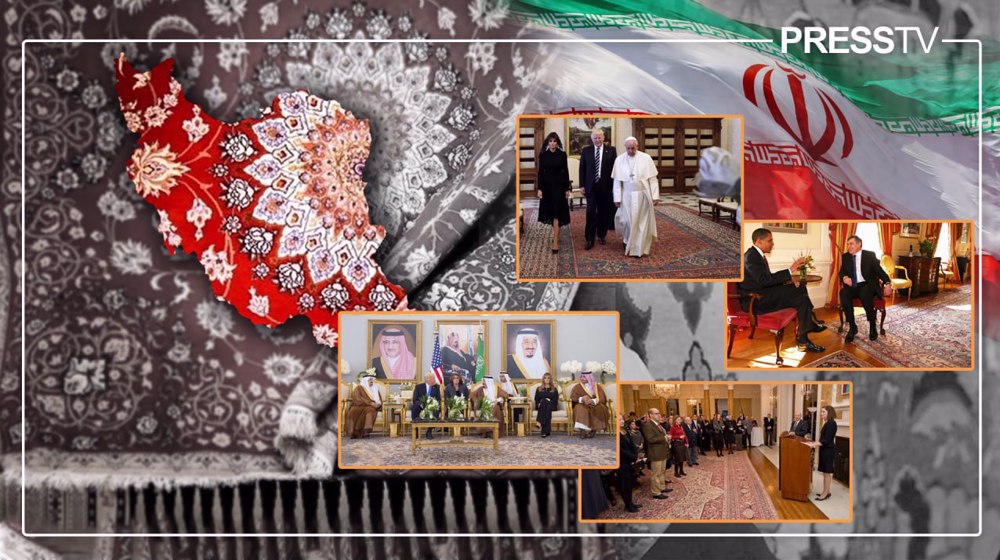
What is changing now is the route through which that system reaches the buyer, as Iranian producers experiment with online catalogues, internet auctions, direct sales and multilingual digital presentation.
The Iran Carpet Company now runs recurring online auctions alongside physical sales, allowing traditional and used handmade carpets to reach buyers digitally rather than relying solely on showroom transactions.
Private platforms are following suit, showcasing carpets from weaving centers nationwide and connecting buyers more directly with producers while reducing reliance on traditional intermediaries.
That transition matters because a handmade carpet is unusually well suited to digital commerce where its dimensions, materials, knot density, origin, colors, design and provenance can become searchable information before physical inspection.
Iranian designers are also being trained to work with digital tools and programs designed to improve digital presentation and modern marketing within the traditional carpet sector.
This matters particularly after years in which American sanctions and associated financial restrictions narrowed Iran’s direct access to valuable traditional markets.
The emerging response is to pursue neighboring and Asian markets, digital channels and alternative routes to international buyers rather than depend entirely on the reopening of traditional markets.
The industry is also expanding the global identity of Iranian carpets, with ten more weaving regions recently gaining international geographical-indication registration, bringing the total to 45 regions across 23 provinces.
The move has commercial value because geographical indications turn regional reputation into a market asset, helping exporters distinguish authentic Iranian carpets from similar designs marketed under other identities.
Iranian industry representatives have complained that competitors reproduce Iranian designs or employ Iranian terminology, allowing similar products to compete internationally without carrying the same production costs.
The concern extends beyond lost sales because when Iranian designs become detached from the communities that created them, weakened income can undermine both artisans’ livelihoods and the transmission of their skills.
That is why restoring Iranian carpet to international markets carries significance beyond reopening revenue streams. It is also a practical way of keeping a millennia-old artistic inheritance productive, identifiable and attached to the people who still make it.
The artisans’ answer is increasingly visible in the way they are adapting the old craft to new commercial tools instead of treating tradition as something that must remain frozen in the past.
Iran is also changing the regulatory environment around exports, with the latest foreign-exchange rules giving handmade-carpet exporters fifteen months to meet designated currency-return obligations.
The change does not remove sanctions or international payment restrictions, but it gives exporters a longer financial horizon for transactions whose sales cycles can be substantially slower than those of ordinary manufactured goods.
These initiatives matter because the strongest future for Iranian carpet will depend on building complete value chains capable of retaining design, manufacturing, branding, marketing and customer relationships inside the country.
The approach is being tested in East Azerbaijan and Tabriz, while Kurdistan is being considered for an industrial-cluster model that could later be adapted nationwide.
Tabriz, with its combination of production knowledge, design traditions, exporters, universities and commercial institutions, provides a practical laboratory for testing whether the broader ecosystem can be modernized.
The same principle is visible in Tehran, where the national handmade-carpet exhibition increasingly brings producers, exporters, traders and other parts of the value chain into one commercial setting.
The exhibition strategy is evolving beyond simply displaying carpets toward creating relationships among producers, designers, financiers, technology providers and foreign buyers who can potentially convert visibility into transactions.
The current evidence points toward a different Iranian carpet business in which producers can identify, reach and understand buyers more directly.
That model could make small orders commercially viable, allow niche regional designs to find specialized international audiences, and give individual workshops access to customers that once required several layers of foreign distribution.
The regulatory change allowing individuals to send up to twenty-four square meters of handmade Iranian carpet annually through postal procedures also creates another potential channel for smaller transactions.
The most important development may ultimately be the accumulation of digital records allowing every regional carpet to carry its own commercial identity into markets that once knew Iran only through intermediaries.
A carpet made in Tabriz, Kashan, Kerman or Kurdistan can increasingly arrive before a foreign buyer not merely as merchandise, but as a searchable proposition containing origin, design, maker, materials, authentication, imagery and price.
That changes the competitive equation because the question is no longer whether Iran can produce enough carpets for the world, but whether Iranian producers can make the world discover precisely which carpet it wants.
The next export frontier may consequently be measured not by rebuilding yesterday’s billion-dollar peak, but by turning millions of individual Iranian designs into thousands of identifiable digital market opportunities.
And perhaps that is the most interesting thing about the carpet beneath the diplomats in New York.
Its journey began centuries ago along the old routes of Iranian geography, but its next journey may begin with a buyer, thousands of kilometers away, finding its maker with a few clicks.
 This makes it easy to access the Press TV website