‘World is not America’s backyard’: Iran deputy FM slams US Treasury’s attempt to dictate trade
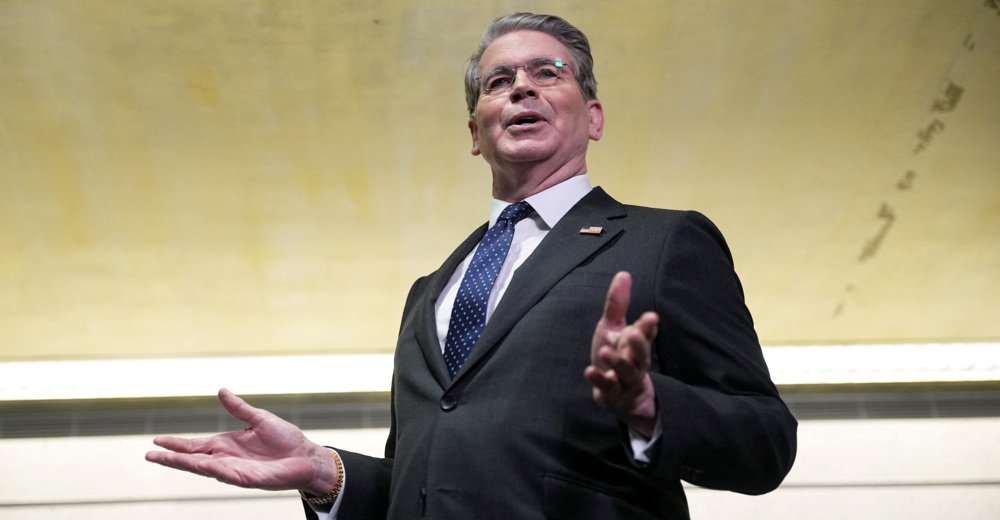
A senior Iranian diplomat has condemned the US Treasury Secretary’s admission of dispatching envoys worldwide to strong-arm countries into cutting economic ties with Tehran, declaring that the era of Washington imposing its will through threats and sanctions is coming to an end.
Kazem Gharibabadi, the deputy foreign minister, took to X to rebuke US Treasury Secretary Scott Bessent, who recently boasted about his global arm-twisting campaign aimed at enforcing what he dubbed "economic D-Day" against the Islamic Republic of Iran.
"Bessent speaks of dispatching teams to countries to issue orders regarding economic relations with Iran, as if they consider the world their backyard," Gharibabadi wrote. "Independent governments determine their relations with Iran based on their own interests and benefits; not the orders of the US Treasury. The era of imposing will through threats and sanctions is drawing to a close."
Gharibabadi’s remarks come in direct response to Bessent’s recent claims of success in isolating Iran.
"At my direction, teams were dispatched across the globe to engage with countries and demand action against the Iranian regime," Bessent posted on X. "These efforts are delivering results."
According to the Wall Street Journal, the Treasury’s assistant secretary for terrorist financing, Jonathan Burke, recently toured the Middle East and Europe to pressure nations into compliance, with the US Treasury claiming to have held discussions with over 50 countries.
While Washington has managed to coerce some regional states into partial compliance, such as the UAE halting flights by Iranian carriers and blocking transactions by Iran's Bank Melli, and Turkey revoking the license of Bank Mellat, the much-vaunted "total shutdown" of Iran's global connectivity has largely failed.
Bessent previously boasted that all Iranian airlines "will be shut down around the world."
However, data from international flight trackers reveal massive loopholes in the US blockade.
The failure of the US diplomatic coercion campaign has forced Washington to resort to blatant psychological warfare.
Qalibaf ridicules Bessent’s suggestion that US economy is doing wellhttps://t.co/xoHuW2SQAG
— PressTV Extra (@PresstvExtra) September 6, 2026
Earlier this month, Bessent attempted to project an image of internal Iranian collapse, falsely claiming at the G20 Summit and before US lawmakers that Iranians were enduring "three, four-hour gas lines" due to the US naval blockade.
This narrative was swiftly and publicly dismantled by Iranian lawmakers.
Ebrahim Azizi, the spokesman for the Iranian Parliament’s National Security and Foreign Policy Commission, shared extensive field reports and footage from gas stations across Iran showing a smooth, uninterrupted, and entirely normal refueling process, exposing Bessent’s claims as "baseless lies."
"Once again, it has been proven that your ‘so-called’ intelligence is nothing more than baseless lies," Azizi stated, warning the US against further strategic miscalculations.
The US claims of fuel shortages and economic isolation are the latest iterations of a sprawling economic war that Washington has waged against Tehran, which recently escalated into a full-scale naval blockade alongside the ongoing US-Israeli military aggression.
US Treasury Secretary Bessent says "We've got a spike in oil prices today that I don't really understand."
— PressTV Extra (@PresstvExtra) August 20, 2026
Follow Press TV on Telegram: https://t.co/1ymjeeywxb pic.twitter.com/KwjlKvPRAi
Since unilaterally withdrawing from the 2015 nuclear deal, the United States has sought to cripple Iran’s oil exports, freeze its foreign assets, and block its access to the global financial system.
The ultimate goal has been to induce economic collapse, spark domestic unrest, and force the Iranian government into capitulation.
In response, Iran has spent the last decade developing a "Resistance Economy"—a strategic doctrine aimed at neutralizing the impact of Western sanctions by boosting domestic production, diversifying trade routes, and relying on indigenous technological advancements.
'Contrary to UN charter and Islamic teachings': Iran slams Saudi massacre at Yemen market

‘Not just a catch, an intelligence prize’: IRGC spokesman hails seizure of second US underwater dron
US just 'gaslighting' over Hormuz: Iran's Parliament speaker



‘Sayyed of resistance is alive’: IRGC hails Nasrallah’s enduring legacy on 2nd martyrdom anniversary
‘World is not America’s backyard’: Iran deputy FM slams US Treasury’s attempt to dictate global trad
Netanyahu makes secret visit to Abu Dhabi amid deepening alliance: Report
VIDEO | 'Contrary to UN charter and Islamic teachings': Iran slams Saudi massacre at Yemen market
‘Not just a catch, an intelligence prize’: IRGC spokesman hails seizure of second US underwater dron
VIDEO | Iran warning US against miscalculation
Arab League slams dangerous Israeli escalation at al-Aqsa Mosque and across West Bank
VIDEO | Martyr Nasrallah made people believe in possibility of victory, liberation: Political activist


 PressTV NEWSLETTER
now
PressTV NEWSLETTER
now
 This makes it easy to access the Press TV website
