University of Tehran scientists develop bio-scaffolds for bone repair
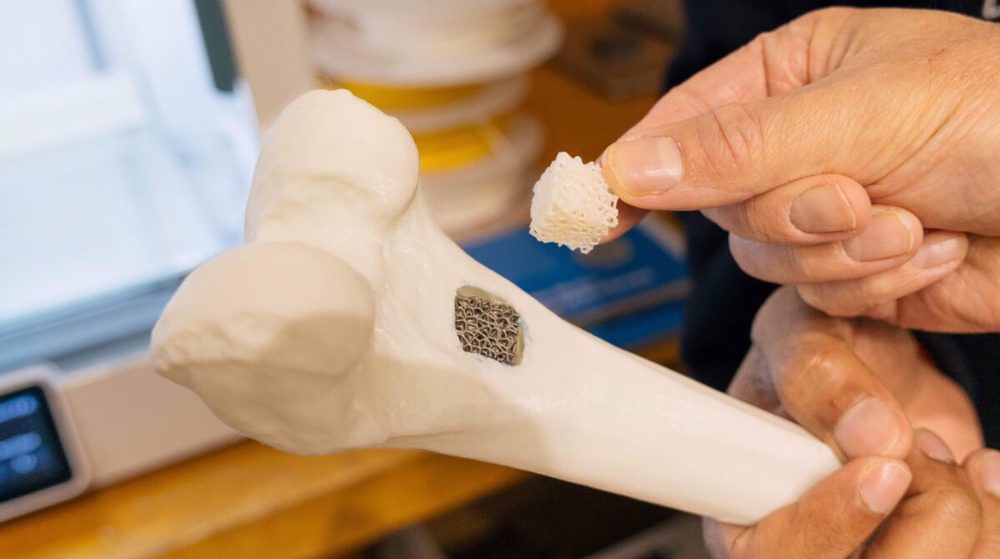
Scientists at the College of Interdisciplinary Science and Technology Studies at the University of Tehran have designed and fabricated novel bio-scaffolds for repairing bone defects, combining green carbon nanotechnology with 3D printing to advance personalized regenerative medicine.
According to the University of Tehran, the research, led by Mehdi Rahaei-Jahromi, a faculty member at the university’s College of Interdisciplinary Science and Technology Studies, focuses on developing a new generation of smart scaffolds that can be tailored to regulate cellular responses and support tissue engineering.
“Given the rapidly growing elderly population and the increasing incidence of musculoskeletal injuries, the need for innovative and efficient approaches to repairing bone defects is becoming more pressing,” Rahaei-Jahromi said.
He explained that the research team developed scaffolds based on polycaprolactone (PCL) and carbon dots (CDs) using extrusion-based 3D printing.
While PCL is suitable for 3D printing and has been approved by the US Food and Drug Administration (FDA) for certain applications, its hydrophobic and bioinert nature can limit interactions with cells, he noted.
To address this limitation, Rahaei-Jahromi said, the Iranian researchers synthesized carbon dots through a one-step hydrothermal process using black cumin seeds.
The resulting nanoparticles were incorporated into the PCL matrix through melt blending, after which composite scaffolds were fabricated using a 3D printer, he added.
The additive manufacturing approach allowed the researchers to create complex geometries and precisely controlled porosity, features that are important for cell infiltration and the transport of nutrients, he said.
According to Rahaei-Jahromi, increasing the carbon-dot content significantly altered the morphology and surface properties of the scaffolds.
The scaffolds developed greater surface roughness and improved hydrophilicity, changes attributed to the presence of polar functional groups on the carbon dots, he highlighted.
“These changes create favorable conditions for the adsorption of extracellular matrix components and, consequently, for cell adhesion and spreading,” Rahaei-Jahromi said.
He added that mechanical evaluations showed that increasing the carbon-dot content reduced the compressive strength of the scaffolds.
Iran develops smart device to measure depth of anesthesia using EEG, brain modelinghttps://t.co/yth3G1xeRA pic.twitter.com/E5KbySG7FD
— Press TV 🔻 (@PressTV) August 23, 2026
However, he noted, at lower concentrations, the scaffolds maintained compressive strength within an acceptable range for relatively load-bearing applications, including the repair of cranial, jaw and vertebral defects.
The researcher said the findings point to a tunable trade-off between mechanical properties and biological activity, allowing the properties of the scaffolds to be adjusted according to their intended application.
Biological assessments using human tissue-derived mesenchymal stem cells also showed that certain carbon-dot concentrations enhanced cell adhesion, proliferation and cellular density, he said.
He also pointed out that fluorescence microscopy further demonstrated relatively uniform cell distribution throughout the depth of the scaffolds, indicating favorable permeability and biocompatibility.
“These findings show that green-synthesized carbon dots can serve not merely as inert reinforcing agents, but as biologically active components capable of creating a favorable microenvironment for cellular activity,” the researcher said.
The study proposes the controlled incorporation of carbon dots as a key design strategy for developing personalized scaffolds for clinical applications, ranging from bone-defect repair to soft-tissue engineering, Rahaei-Jahromi said.
The researcher noted that the approach could contribute to the development of next-generation smart scaffolds whose cellular responses can be tailored by simply adjusting the type or concentration of a nanofiller to meet individual patient needs.
Iranian academic and entrepreneur wins top prize at BRICS women’s startup contest
Iran unveils two locally-made strategic catalysts for oil, gas and petchem industries amid sanctions
Iranian knowledge-based company develops nanofilters to reduce power plant energy consumption



Blast rocks military site in Syria’s Dayr al-Zawr, killing 11 HTS forces
EU urges US to reconsider visa denial for Palestinian UN delegation
Iran dismisses White House accusations as ‘flight from reality,’ ‘act of projection’
Pentagon probe finds ‘cascade of preventable failures’ behind US strike on Minab school
Iranian CO2 recovery project named a finalist of 2026 WPC Energy Excellence Awards
BRICS paving way for alternative world order, not a war machine against West: Analyst
Iran, Pakistan FMs discuss regional developments, energy supplies
VIDEO | Black smoke, flames rise near Riyadh airport amid Yemen strikes


 PressTV NEWSLETTER
now
PressTV NEWSLETTER
now
 This makes it easy to access the Press TV website
