Discover Iran: Tabriz’s Blue Mosque, where glorious history meets timeless Iranian architecture
By Ivan Kesic
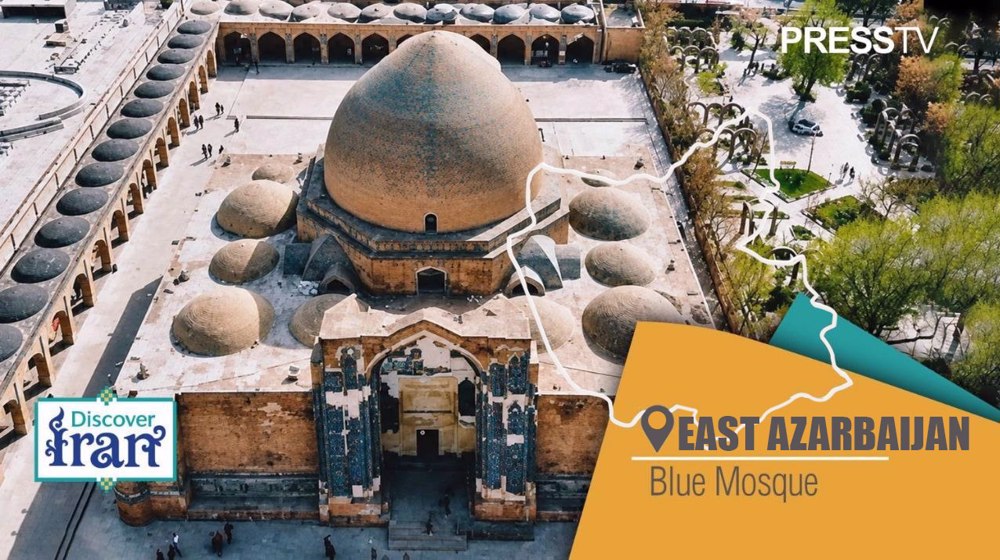
- The Blue Mosque, completed in 1465 under the Qara Qoyunlu dynasty and endowed by Khatun Jan Begum, is the only major structure of that dynasty still standing in Tabriz and was inscribed by UNESCO in July 2010 as part of the Tabriz Historic Bazaar Complex.
- Its unusual T-shaped plan, twin minarets, and fully domed roof resemble Ottoman architecture such as the Green Mosque in Bursa, reflecting the movement of Tabrizi craftsmen across Iran and Anatolia, while its decoration combines mosaic, gilded, luster, and underglaze blue-and-white tiles in a variety unmatched in 15th-century Iran.
- After earthquakes, wars, and abandonment reduced it to ruins, the mosque was renovated in the 20th century, and modern seismic studies show its domes can survive a seventy-five-year earthquake with only minor cracking.
Few monuments in Iran combine architectural ambition, political history and ceramic artistry as vividly as the Blue Mosque of Tabriz.
Known in Persian as Masjed-e Kabud and historically as Mozaffariyeh Mosque, the monument was built under the Qara Qoyunlu ruler Jahan Shah and completed, according to the inscription on its portal, in 1465.
It was conceived not simply as a mosque but as the central element of the much larger Mozaffariyeh religious and charitable foundation established by Jahan Shah's wife, Khatun Jan Begum.
The building that survives today is only a fragment of that once-extensive complex. Earthquakes, political upheaval, neglect and later looting reduced the monument to a ruin before 20th-century restoration returned much of its architectural form.
Yet its surviving decoration remains extraordinary. Mosaic tile, gilded tile, lusterware, blue-and-white glazed tiles, carved brick and monumental calligraphy were combined with unusual sophistication, creating a decorative language that reflects artistic connections between Qara Qoyunlu Iran, Timurid Khorasan and Ottoman Anatolia.
The Blue Mosque is also an architectural survivor. Its unusual T-shaped plan, enormous brick dome and heavily decorated surfaces were created in a city repeatedly affected by destructive earthquakes.
Much of what visitors see today is therefore the result of both medieval craftsmanship and modern conservation.
Together, these layers make the monument not merely an example of 15th-century architecture, but a record of how Iranian architectural traditions developed, interacted with neighboring cultures and endured through catastrophe.
Monument born from royal patronage
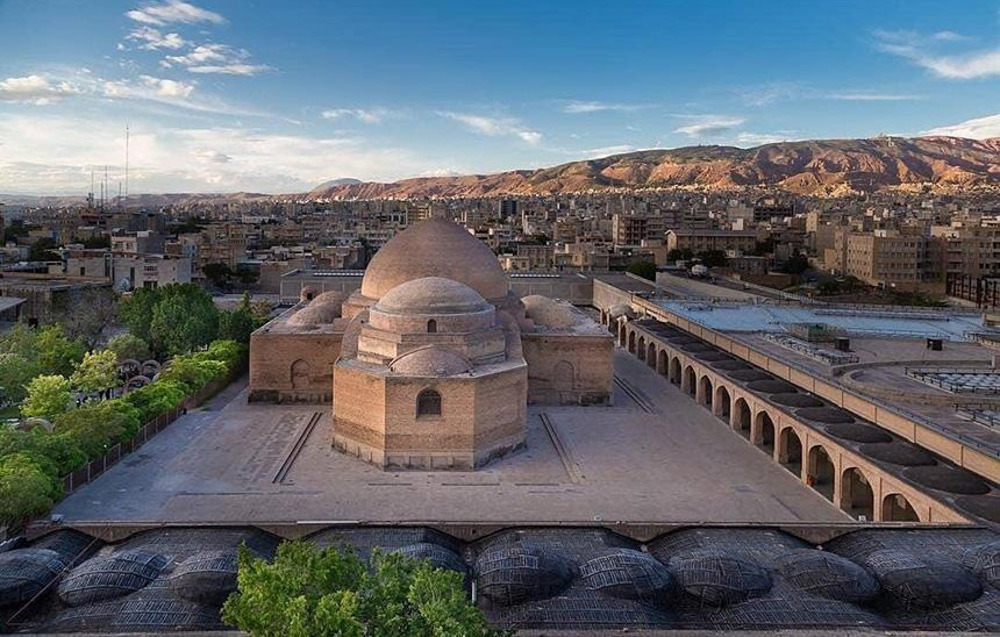
The history of the Blue Mosque begins with the Mozaffariyeh complex, an extensive religious and charitable foundation associated with Khatun Jan Begum, wife of Jahan Shah, the most powerful ruler of the Qara Qoyunlu dynasty.
Jahan Shah ruled from 1439 to 1467, when Tabriz served as the political center of his expanding kingdom. Under his rule, the city became an important center of architecture, literature, commerce and artistic production.
The portal inscription of the mosque gives the date 4 Rabi I 870, corresponding to 25 October 1465, as the date associated with the completion of the construction.
The monument is therefore commonly identified as a 1465 building, although the history of its completion was more complicated.
The Qara Qoyunlu state itself was already approaching a political crisis, and the Aq Qoyunlu conquest of Tabriz interrupted the final stages of the project.
The Mozaffariyeh was considerably more than a single mosque. Historical sources describe a complex containing a khanqah, or Sufi convent, a qanat water system, and a garden known as Begumabad or Bagh-e Begum.
A madrasa and bathhouses may also have existed within the foundation. Beside the complex was a bazaar containing 55 shops, some of which were owned by members of the founder's family.
The foundation also served as a dynastic funerary complex. Khatun Jan Begum was buried there with her children, while Jahan Shah is traditionally said to have been buried at the site as well.
The original tombs have disappeared, however, leaving only traces of three graves in the crypt. The story is particularly significant because it illustrates the important role of women in architectural patronage.
Khatun Jan Begum was not simply associated with the monument through marriage to its ruler; she established her endowment and was closely connected with the institution that sustained it.
The Blue Mosque consequently preserves evidence of a form of elite female patronage that played a substantial role in the religious and architectural life of medieval Iran.
The political circumstances surrounding its completion were equally complex. After Jahan Shah and Khatun Jan Begum died, their daughter Saleha Khatun continued supervising the project.
Under the Aq Qoyunlu ruler Yaqub, who reigned from 1478 to 1490, the mausoleum's cupola and principal elements were completed. Some alabaster elements, however, indicate that portions of the mausoleum were never entirely finished.
From Safavid capital to ruin
The Blue Mosque remained an active place of worship during the first half of the 16th century, a period when Tabriz became the first capital of Safavid Iran.
Shah Ismail I entered Tabriz in 1501 and established the city as his capital. Its strategic position, however, also made it vulnerable to Ottoman attack. Following the Ottoman invasion in 1514, Ottoman troops occupied and looted Tabriz.
The Blue Mosque was among the buildings affected. At least eight carpets were taken from the mosque to Istanbul, and some were later presented by Sultan Selim I to the newly constructed Gazi Husrev Bey Mosque in Sarajevo.
The damage inflicted by warfare was followed by a more persistent threat: earthquakes. Tabriz lies in one of Iran's most seismically active regions, and repeated earthquakes damaged the city and its monuments over several centuries.
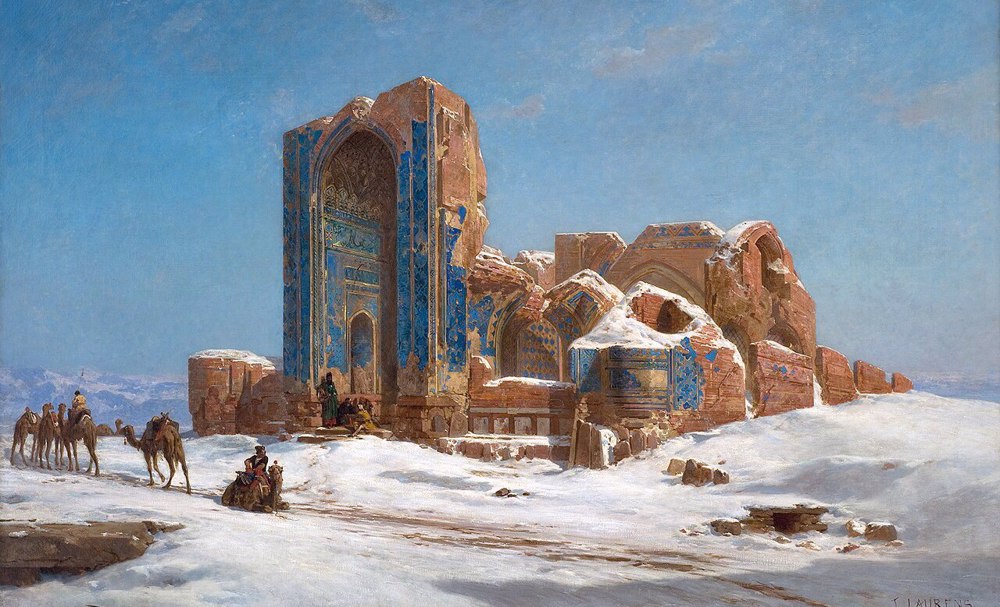
By the17th century, the Blue Mosque had fallen into ruin and was abandoned. During the 19th century, parts of the ruins were reportedly plundered by local inhabitants.
The catastrophic earthquake of 1780 is generally associated with the collapse of the mosque's major domes and the roof of the mausoleum.
By then, much of the complex had already deteriorated. What survived was consequently less a functioning medieval mosque than a monumental ruin.
The building's modern appearance owes much to restoration. Major work took place during the 20th century, including extensive reconstruction between 1950 and 1966.
The central dome and portions of the interior walls date from this period, while further work in 1973 reconstructed the mausoleum roof and the main dome chamber.
This history creates an important distinction between the medieval monument and the building visible today. The Blue Mosque is unquestionably a 15th-century monument, but substantial portions of its present structure are reconstructed.
Its historical importance therefore lies not only in original surviving fabric but also in the documentary evidence, fragments, archaeological remains and restoration work that together allow its original architectural character to be understood.
Modern engineering studies suggest that the renovated domes could withstand a seventy-five-year earthquake with only minor cracking.
Unusual T-shaped mosque
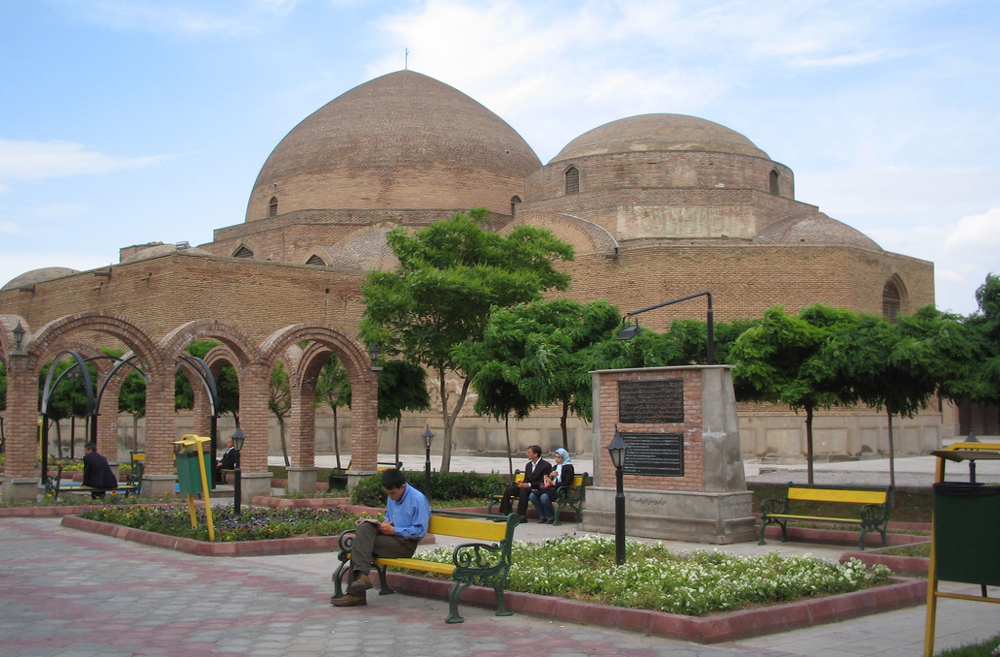
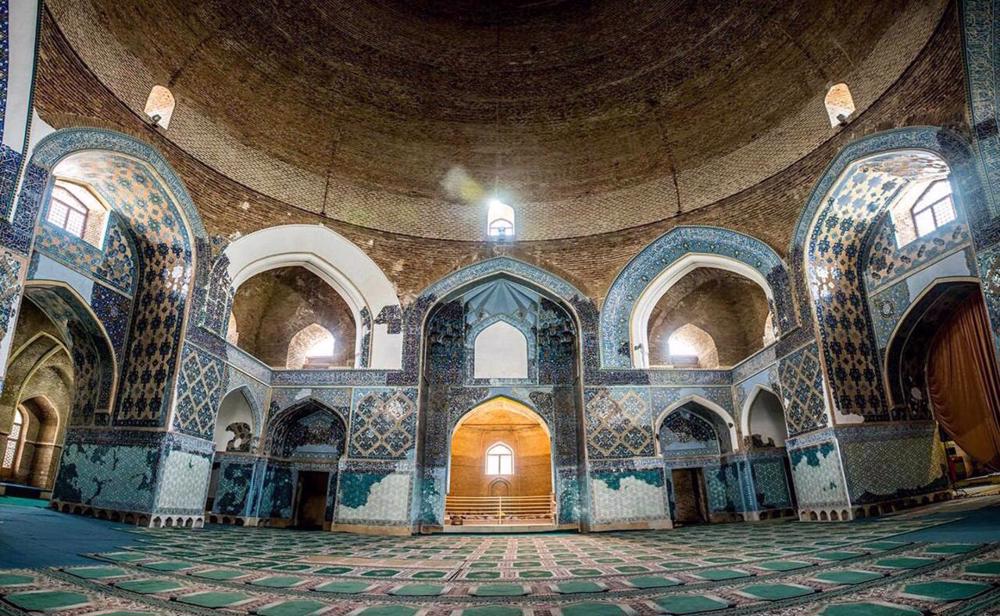
Architecturally, the Blue Mosque differs from the courtyard-and-iwan mosque type that became so characteristic of later Iranian architecture. Its plan is organized around a central domed chamber and surrounding spaces arranged in a T-shaped configuration.
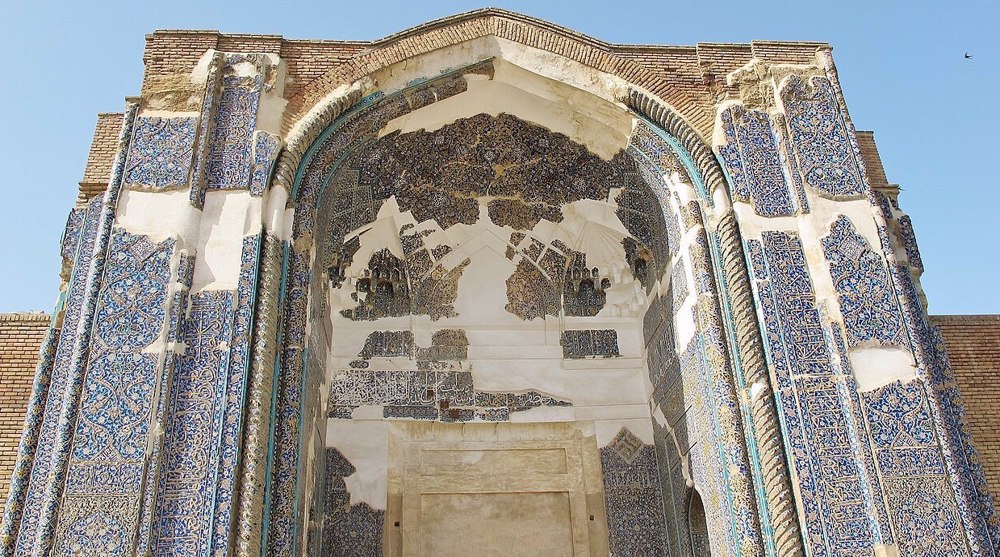
A monumental iwan (vaulted portal) with a pishtaq on the northern side forms the principal entrance, originally flanked by two minarets.
Beyond it lies an antechamber connected to a gallery surrounding the central dome chamber on three sides. The two lateral arms lead toward prayer niches on the southern side, while a series of smaller cupolas and vaults cover the surrounding spaces.
The central dome rises approximately 22 metres and is supported by eight arches. Four upper galleries are incorporated into the corner structures associated with these arches.
The arrangement creates a dramatic interior in which the principal dome dominates the spatial composition.
The mausoleum occupies the southern side of the central prayer chamber. Its relationship with the mosque was carefully controlled: its wooden entrance could normally remain closed, preventing the funerary space from dominating the prayer hall, while concealed openings provided access.
The mausoleum itself was supported by four arched bays and contained a crypt beneath the mihrab.
The architectural arrangement has attracted particular attention because of its relationship with Ottoman Anatolian architecture.
The Blue Mosque's T-shaped organization, twin-minaret entrance and concentration of domed spaces have parallels with the early Ottoman mosque tradition, particularly the Green Mosque of Bursa, constructed in the early 15th century.
This connection is not necessarily evidence of simple imitation. Tabriz was itself an important center of artistic production, and Iranian craftsmen worked across Anatolia during the 15th century.
The Green Mosque in Bursa, for example, is associated with craftsmen identified as masters from Tabriz. The architect of the aforementioned Gazi Husrev Bey Mosque in Sarajevo was an Iranian from Tabriz, as were the craftsmen who made the tiles and decorations for the Dome of the Rock in Al Quds, Palestine.
The architectural relationship between the two monuments therefore provides evidence for the movement of craftsmen, techniques and visual ideas across political boundaries.
At the same time, the Blue Mosque should not be reduced to an Ottoman-derived building. Its architectural language emerged from the interaction of several traditions, including those of northwestern Iran and Timurid Khorasan.
Its importance lies precisely in the way these influences were reinterpreted within the artistic environment of medieval Tabriz.
Brick, tile and a world of color
The Blue Mosque's reputation ultimately rests on its decoration. The structure has a stone foundation and a fired-brick body, while tile and decorative brickwork cover much of the architectural surface.
Alabaster was used for the mausoleum's dado, its three mihrabs, some windows and probably elements of its door. The 17th-century traveler Jean-Baptiste Tavernier noted the warm reddish light produced by the alabaster panels.
The decorative program brought together several ceramic techniques that were individually established elsewhere but combined here with exceptional sophistication.
Mosaic tile was particularly important. Small pieces of colored glazed tile were cut and assembled into intricate geometric and vegetal compositions. Dark blue, turquoise, white, dark purple, ochre and green form the dominant palette.
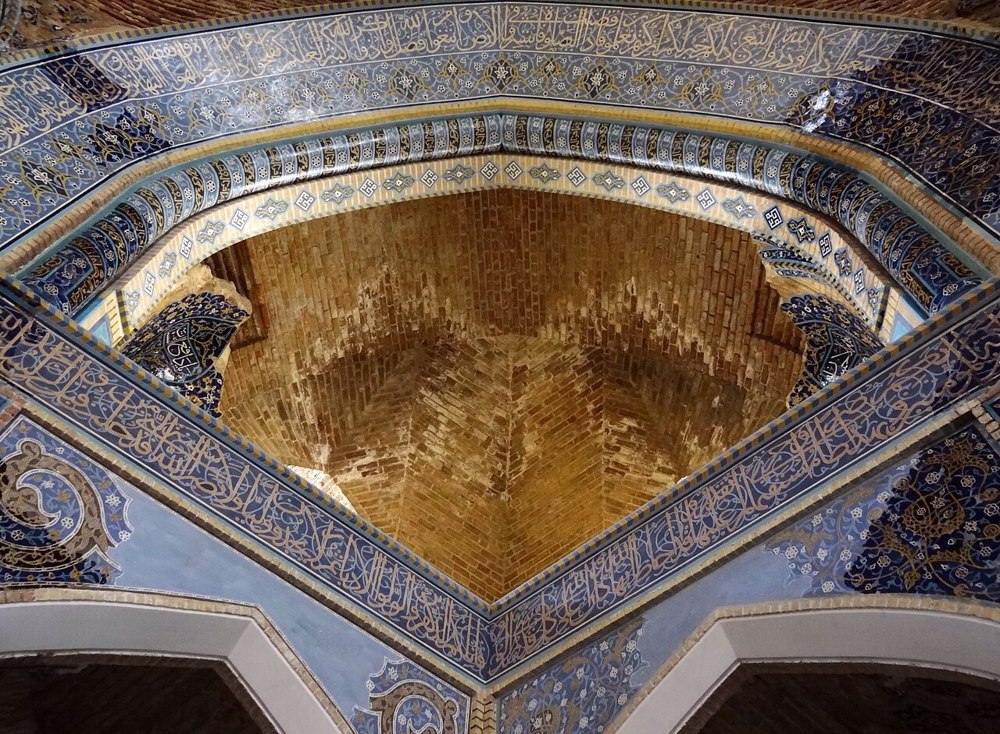
Calligraphy is equally important. Inscriptions cover major portions of the iwan and mausoleum, with Kufic and thuluth scripts integrated into geometric and floral backgrounds.
One surviving craftsman's signature belongs to Nematollah ibn Mohammad al-Bawwab, a calligrapher associated with the artistic circles of Tabriz.
Brick and tile were frequently used together. Geometric designs could be formed from mosaic tile while brick supplied the structural or graphic outlines.
The contrast between glossy blue ceramic surfaces and the rougher texture of brick created an effect that was both decorative and architectural.
Rather than treating ornament as something applied independently to the building, the designers integrated it with arches, walls and vaults.
The mosque's original appearance was even richer than what survives. Historical descriptions record extensive gilded tiles in the mausoleum, including hexagonal blue tiles decorated with gold.
Although only a small number remain in place today, these fragments provide evidence of a highly sophisticated decorative scheme.
The surviving luster tiles are especially unusual. Luster decoration had a long history in Iranian ceramics but was comparatively uncommon in 15th-century architectural decoration.
Small luster tiles survive near the base of the iwan columns, carrying floral designs in white, brown and blue. Their position in relatively inconspicuous locations is significant because it makes them unlikely to have been later decorative additions.
Another distinctive feature is the use of blue-and-white glazed tiles. Square tiles approximately five centimetres across, together with triangular and lozenge-shaped pieces, formed part of the building's decorative vocabulary.
Similar blue-and-white work can be found in contemporary Timurid monuments, but its use at the Blue Mosque is particularly important for understanding the development of ceramic decoration in 15th-century Iran.
The combination of these techniques explains why the Blue Mosque occupies such an important place in the history of Iranian tilework.
Its craftsmen did not necessarily invent every technique they employed. Instead, they brought established traditions together and pushed them toward an unusually unified and sophisticated visual effect.
Tabriz between Iran, Central Asia and Anatolia
The Blue Mosque makes most sense when viewed within the wider artistic world of the 15th century. Tabriz was positioned between several major cultural regions, and its rulers maintained political and commercial relationships extending from Anatolia to Central Asia.
The building's decorative language reflects these connections. Timurid Khorasan contributed important traditions of tilework, calligraphy and geometric design, while contacts with Ottoman Anatolia help explain the mosque's unusual spatial organization.
Craftsmen from Tabriz were active beyond Iran, while artists and techniques moved in the opposite direction.
The mosque can therefore be understood as evidence of artistic exchange rather than as an isolated expression of one national architectural style.
Its architecture belongs firmly to the Iranian world, yet it also demonstrates how fluid 15th-century artistic networks could be.
This becomes especially apparent in comparison with the Green Mosque in Bursa. Both buildings employ a T-shaped organization and extensive colored tile decoration, while documented Tabrizi craftsmen worked on the Ottoman monument.
The relationship is consequently a useful reminder that artistic borders did not coincide neatly with political borders.
The Blue Mosque also belongs to a longer Iranian tradition of combining brick construction with ceramic ornament.
Earlier Seljuk and Ilkhanid monuments had established important techniques, while Timurid architecture in Khorasan developed increasingly elaborate tile compositions. The Mozaffariyeh brought these traditions into a distinctive Qara Qoyunlu setting.
Its relationship with earlier monuments around Tabriz can also be seen in the broader development of brick-and-tile architecture.
The Maragheh Observatory, established under Hulegu Khan in the 13th century, belongs to an earlier Ilkhanid environment in which brick, stone and decorative tile were employed in a very different architectural context.
The Blue Mosque, almost two centuries later, demonstrates how far Iranian decorative architecture had evolved toward increasingly elaborate geometric, floral and calligraphic surfaces.
The comparison is useful not because the two buildings served similar purposes—they did not—but because together they illustrate the continuing development of architectural craftsmanship in northwestern Iran.
Surviving masterpiece of Tabriz
The Blue Mosque represents an extraordinary convergence of architecture, political history and craftsmanship. Its architectural form reflects connections with the wider world, while its decoration demonstrates the sophistication of Tabriz's ceramic workshops.
What makes the monument particularly valuable is not any single decorative technique. Mosaic tile, gilding, luster, blue-and-white ceramics, brick ornament and monumental calligraphy all had earlier precedents.
The achievement of the Blue Mosque lies in the exceptionally ambitious way these traditions were brought together.
The mosque's inclusion within the Tabriz Historic Bazaar Complex, inscribed on the UNESCO World Heritage List in 2010, recognizes this wider historical environment.
UNESCO's documentation specifically includes the 15th-century Blue Mosque within the nominated property, alongside the historic bazaar and Sorkhab bazaar area.
The designation reflects the importance of the larger urban and cultural landscape rather than suggesting that the mosque alone constitutes the World Heritage property. However, the mosque was also nominated independently in 2007.
Today, the Blue Mosque stands as one of the clearest surviving expressions of the artistic culture of medieval Tabriz.
Its walls no longer carry all the dazzling decoration recorded by earlier travelers, and its original complex has largely disappeared. Yet the surviving blue mosaics, gilded fragments, calligraphy and brickwork are enough to reveal the ambition of its creators.
The monument is therefore more than a beautiful historic mosque. It is a document of cultural exchange, royal and female patronage, ceramic experimentation and architectural resilience—a building in which the artistic worlds of Iran and the wider region met in 15th-century Tabriz, and whose surviving fragments continue to tell that story.
200 nights, one resilient nation: Iranian people’s epic in defense of homeland and Revolution
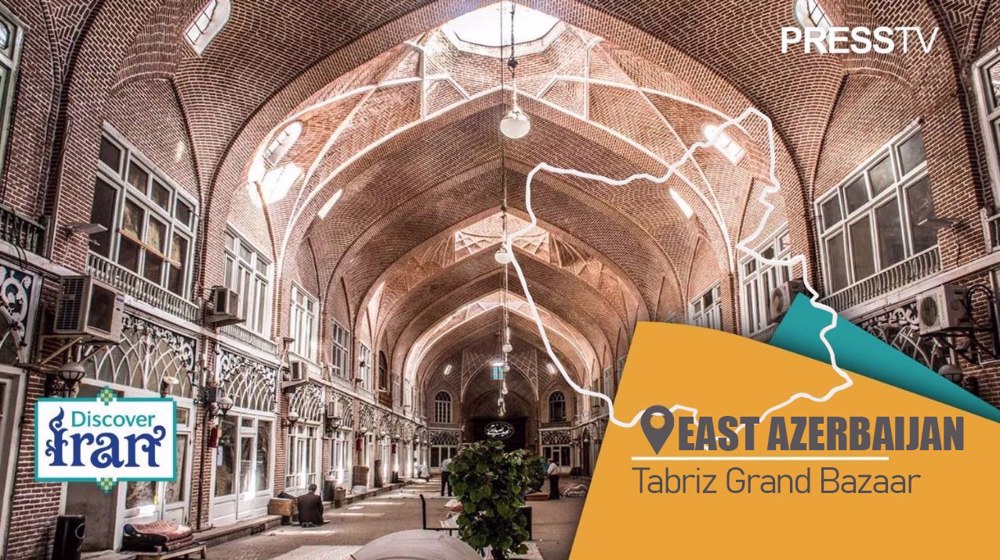
Discover Iran: Tabriz Grand Bazaar, where centuries of trade, culture and craftsmanship still thrive
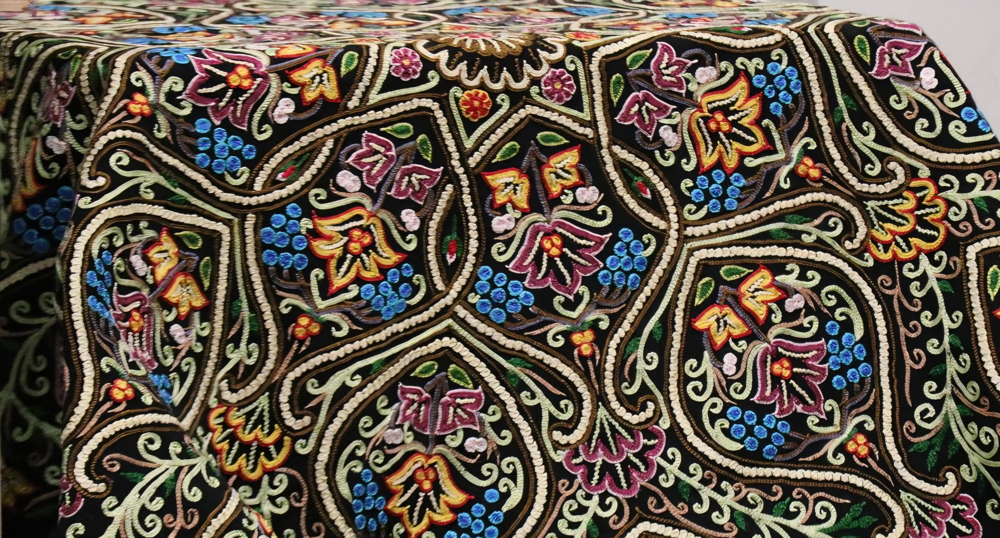
Rashti embroidery showcases Iranian heritage at BRICS summit



Russia, China veto US backed anti-Iran resolution at UN Security Council
Araghchi welcomes Xi’s initiatives, hails China-Iran strategic partnership
VIDEO | Gaza transport crisis deepens as 70% of vehicles remain out of service
VIDEO | Press TV's news headlines
Iran summons German ambassador over Berlin’s hostile positions, interventionist activities
Israeli occupation court extends detention of Press TV journalist Naqaa Hamed
Iran rejects Sweden’s allegations, orders Swedish diplomat to leave within 48 hours
UN fact-finding mission finds ‘reasonable grounds’ US committed war crimes in Iran


 PressTV NEWSLETTER
now
PressTV NEWSLETTER
now
 This makes it easy to access the Press TV website
