Inside Yemen’s new warfront: Ground advances, precision strikes, and a rising cost for the aggressor
By Mohammad Molaei
Full-scale war has not returned quietly to Yemen, but it has returned through a coordinated sequence of ground advances, precision strikes, and retaliatory salvos against the external players and their operations that have changed the battlefield dynamics completely.
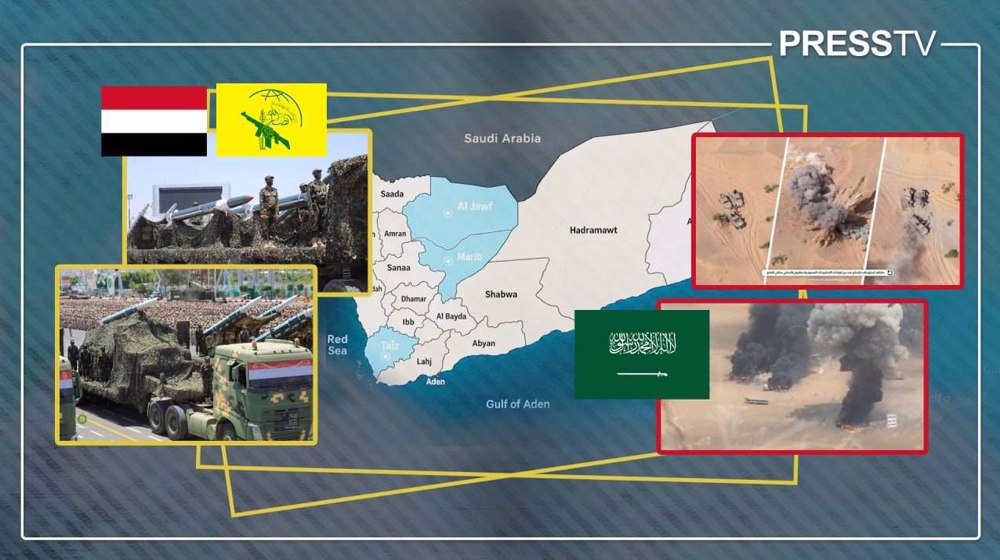
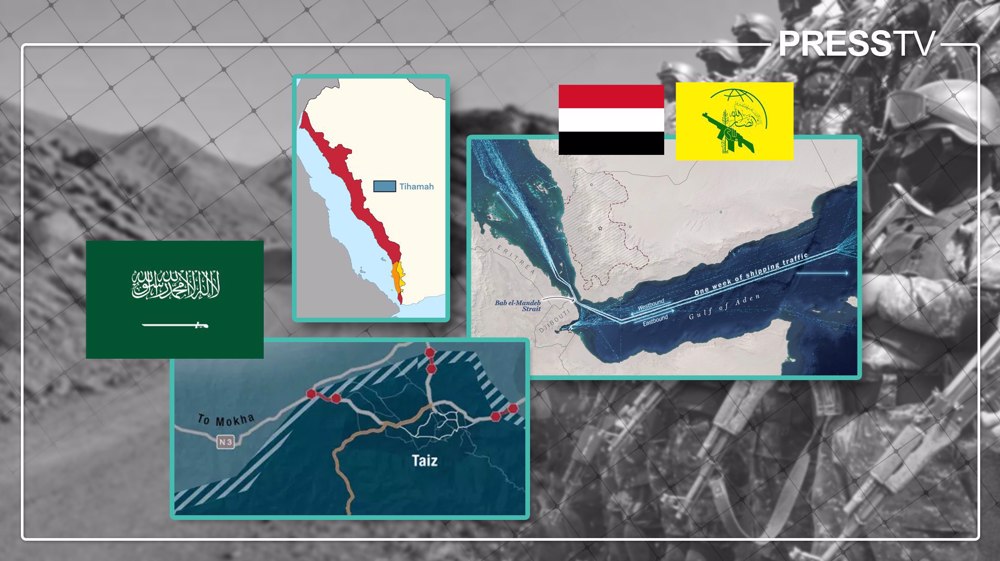
Recent Yemeni military operations, most notably the August 24 strike, which was followed by the stunning advance along the Red Sea coast, are not isolated incidents. Rather, they form part of a broader strategy by Sana’a involving an intensified operational push along two strategic corridors: the Taiz axis and the road toward Mokha on the Red Sea coast.
Taiz has long been a key pressure point and is significant as Yemen’s third-largest city. Mokha, however, is the real strategic prize. As a critical coastal node, its loss threatens Saudi Arabia’s Red Sea access and the supply lines on which Saudi-backed mercenaries depend across the entire southwestern theater.
Whoever controls the road linking Taiz to Mokha gains significant operational leverage over the forces in the south. Yemeni military calculated that these corridors offer the highest return on effort, allowing it to consolidate territorial control in the southwest while forcing Saudi-backed mercenaries to stretch their capabilities across multiple fronts.

Severing Taiz’s Lifeline
After repeated strikes on Saudi-backed concentrations and logistics infrastructure in recent weeks, Yemeni forces advanced along the Taiz–Al-Mokha road and seized part of it at the Sharaja intersection in the Al-Kawdha area.
The road is one of the main logistical and support routes keeping Taiz accessible to PLC-affiliated forces, and losing the intersection degrades their capacity to supply, reinforce, and rotate units inside the city.
Yemeni military is not attempting to hold every meter of ground in the southwest. It is targeting the connective tissue, roads, intersections, and junctions that allow Saudi-backed mercenaries to function as a coherent military formation rather than a collection of isolated positions.
The Saudi-backed response was concentrated on opening a second front. PLC forces and tribal militias, backed by Saudi airstrikes, launched a large-scale offensive in Al Jawf province in the north.
Frame by Frame: Wadi’ah convoy strike
The centerpiece of recent exchanges of fire has been the footage from August 24. Yemeni military media released video documentation of what it described as the identification and destruction of Saudi military supply convoys near the Wadi’ah border crossing, one of the principal land entry points connecting Saudi Arabia to northeastern Yemen.
The footage, read alongside publicly available satellite imagery that had already noted the convoy before the Yemeni military's official statement, constitutes a substantial evidentiary record of both the event and the capability behind it.

The sequence begins before the strike. A large number of trucks are visible in dispersed positions, a deployment pattern that itself carries information. The spacing between vehicles indicates that the convoy was already operating under an assumption of threat; some awareness that an attack was not out of the question had shaped its movement and parking.
Anti-convoy drills, dispersal, and separation of fuel from other cargo are standard responses to an anticipated strike environment. This tactical dispersion did not prevent what followed, but it confirms that the convoy operators did not believe they were safe, only that dispersal would reduce the effect of a strike. It proved insufficient.

A drone maintained persistent surveillance of the convoy throughout. This detail matters more than any single explosion in the footage. The released video shows not a target-of-opportunity engagement but sustained intelligence, surveillance, and reconnaissance.
A platform remains overhead, continuously tracking the trucks and providing the data chain needed for the strike sequence that followed. The ability to hold a target under watch near a major border crossing in Saudi-held territory, rather than in the Yemeni interior, speaks directly to the depth of the Yemeni military’s current ISR capabilities.


When the missiles arrive, the sequence follows a visible logic. Fuel-carrying trucks erupt in flames dramatically, their cargo providing the most definitive visual confirmation of effect.
Secondary explosions are visible in other vehicles after impact, consistent with the detonation of additional fuel, ammunition, or stored equipment.
Within minutes, the whole area depicted is filled with smoke and fire, and the targets are engulfed.

Commanders’ meeting strike: Ballistic precision on a time-sensitive target
The convoy strike was not the only recent precision operation. Yemeni military media released footage of a separate missile attack directed against a meeting of several commanders of Saudi-backed forces.
The weapon used appears to belong to the Badr or Saeer family, solid-fueled, short-range ballistic missiles that the Yemeni armed forces have unveiled and displayed in multiple variants in military parades in recent years, with the Badr series documented in four versions.

This strike differs in character from the convoy interdiction, and the difference is analytically important.
The retaliatory attack demonstrates that the Yemeni military has the capability to conduct precision attacks that were not assumed possible in earlier phases of the war.
The more significant implication lies in targeting. Striking a meeting of mercenary commanders rather than a fixed installation implies a time-sensitive targeting chain, involving human intelligence, signals intelligence, or a combination of both, capable of identifying a high-value gathering and converting that identification into a ballistic strike on a narrow time window.
Attacking logistics degrades an adversary’s capacity over time; attacking command nodes degrades the decision-making architecture itself. The pairing of both categories of strike in the same operational window is not coincidental. It reflects a deliberate pattern of simultaneous pressure on supply and command, and it raises the cost of field coordination for Saudi-backed mercenaries at every level.

The retaliatory salvo against Saudi territory
More significantly still, the Yemeni military conducted its largest retaliatory attack on Saudi soil in years.
According to the statement of the Yemeni Armed Forces, 121 missiles were fired from planes stationed at King Khalid Air Base in Khamis Mushait and King Fahd Air Base in Taif over three days, striking the governorates of Marib, Al-Bayda, Al-Hodeidah, Taiz, and Al-Jawf.
The statement singled out a strike on the central prison of Al-Hazm city in Al-Jawf, in which it said a large number of prisoners, including visiting women and children, were killed, and described this as the latest in a series of major crimes in a twelve-year campaign of aggression and siege.
In response, the statement says the Yemeni armed forces carried out a major and extensive operation against Aramco oil facilities in Abha, Najran, and Jizan, as well as the Khamis Mushait air base, using dozens of ballistic missiles and drones, which it described as precise and causing great damage.
Publicly available satellite footage and videos circulating on social media confirm hits on the Abha International Airport, ARAMCO’s Abha Bulk Plant, King Khalid Air Base in Khamis Mushait, ARAMCO’s oil refinery in Jizan, and ARAMCO’s Bulk Plant in Najran.

The targeting logic is layered. Striking ARAMCO infrastructure attacks the revenue base of the Saudi war effort, the economic foundation that sustains air operations and logistical support for Saudi-backed mercenary forces.
Striking King Khalid Air Base is more direct: it is one of the bases from which the missiles fired at Yemeni governorates originated, making the response an act of military symmetry rather than purely punitive escalation.
This operation signals an intent to eliminate the asymmetry of cost from the conflict. If Saudi air bases can strike Yemeni governorates at scale, Ansarullah’s position is that Saudi economic and military infrastructure will carry equivalent exposure.

The road ahead
Taken together, the recent Yemeni operations tell a story about capability that matters beyond any single engagement. The Wadi’ah strike demonstrates persistent ISR coverage near a major international border crossing at a key logistics node for the Saudi side.
This is not the ISR of a force relying on local informants and improvised observation. It is platform-based, continuous, and integrated with a strike chain capable of converting surveillance data into weapons effect within the time it takes a convoy to reach a vulnerable position.
The exposed vulnerability is real and structural. Saudi-backed mercenary forces depend on road networks and border crossings that the Yemeni military can now survey, track, and strike with demonstrated accuracy. The commanders’ meeting attack adds the human dimension to this reality.
Every convoy is now a potential target, every fuel truck a potential secondary explosion, every commanders’ meeting a potential ballistic strike.
This was the largest attack the Yemeni military has conducted against Saudi land in recent years. However, the simultaneity is new: ground advances cutting supply roads, convoy interdiction near a border crossing with full ISR documentation, precision strikes on command meetings, and a strategic retaliatory barrage against Saudi economic and military infrastructure, all inside a short window.
Yemen taught US Navy ‘a hard lesson’: Ansarullah
Saudi warplanes bombard areas recently liberated in Yemeni army’s advances
Ansarullah takes over Bab al Mandab Strait



Hamas welcomes BRICS's supportive position on Palestine
Irish, Scottish and Welsh leaders to meet to discuss UK break-up
Yemen taught US Navy ‘a hard lesson’: Ansarullah
Inside Yemen’s new warfront: Ground advances, precision strikes, and a rising cost for aggressor
Iran will be ‘far more advanced technologically’ in any new war: Acting defense minister
Israeli strike kills two in Gaza as hospitals face energy shortages
Iran calls on UN to protect Lebanese civilians as Israel’s attacks continue
Yemeni military advance along Red Sea alters balance of power amid Saudi siege, aggression: Analyst


 PressTV NEWSLETTER now
  This makes it easy to access the Press TV website