
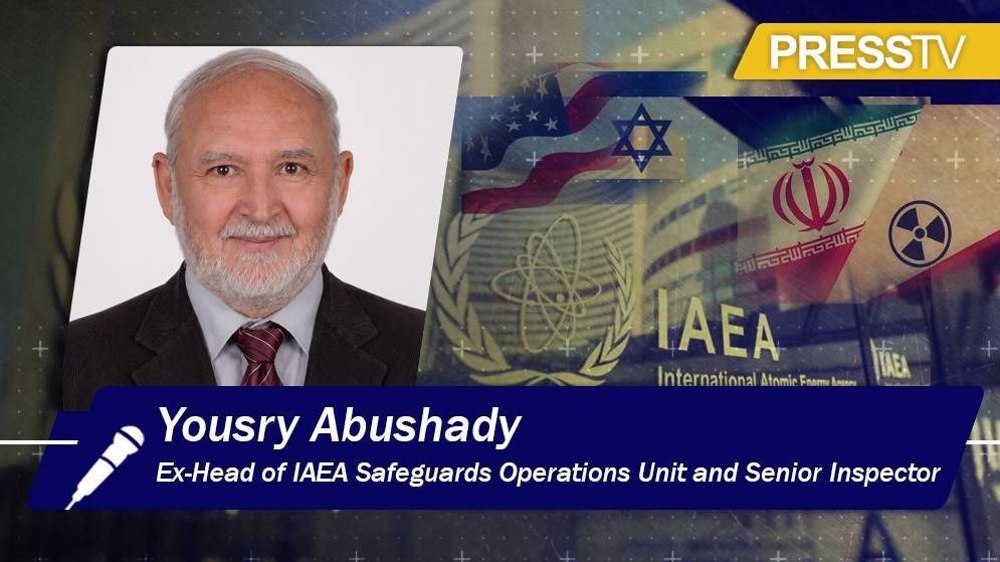
By M. Salimi
Professor Yousry Abushady served as a safeguards section head and senior inspector at the International Atomic Energy Agency (IAEA) for nearly three decades.
In a detailed interview with the Press TV website, he discussed the UN nuclear agency’s politicized approach to the Islamic Republic of Iran and its nuclear program.
The IAEA director general’s May 31, 2025 report, which was issued weeks before Israel’s aggression against Iran, contained “old, fabricated problems” that had been resolved years earlier, Professor Abushady said.
The report, along with the subsequent Board of Governors resolution adopted on June 12, 2025, served as the direct pretext for Israel’s military aggression against Iranian nuclear facilities on June 13, 2025, which was joined by the United States on June 22.
Professor Abushady warned that the IAEA safeguards system is at risk of collapse due to mounting politicization.
He also criticized the UN agency’s failure to condemn the attacks against Iran and its nuclear facilities despite clear violations of international law and called for fundamental reforms to restore its neutrality and independence.
The following are excerpts from the interview:
Q: Professor Abushady, as the IAEA prepares for its 70th General Conference starting on September 14, how would you assess the current state of the UN agency. Has it remained true to its founding principle of "Atoms for Peace," or has it strayed from its original mandate, particularly given the regular attacks on peaceful nuclear facilities?
A: Since Iran announced its new nuclear activities in 2003 and invited the IAEA to inspect its new nuclear facilities, political interference began to influence the agency’s reports and the manner in which it announced its decisions. This interference also led to the illegal leaking of information to Western media outlets by a number of senior IAEA officials.
From this point, the nuclear crisis with Iran began to take on many dimensions, culminating in the US and Israel attacking Iranian nuclear facilities that were subject to the Nuclear Non-Proliferation Treaty and under intensive IAEA inspections.
Perhaps the IAEA report of May 31, 2025, which included old accusations that had been resolved and closed positively years ago, and the decision of its Board of Governors on June 12, 2025, were the pretexts upon which Israel based its first war on June 13, 2025, joined by the United States on June 22, 2025.
Unfortunately, despite the legal violations of striking nuclear facilities under the safeguards system and subject to IAEA inspections, these attacks were not condemned by the IAEA, the UN Security Council, any other international organization, or any Western country, except for some general statements.
Press TV’s @ReinischDieter provides updates from the IAEA Board of Governors meeting, where a US-drafted resolution seeks to refer Iran to the UN Security Council over Tehran’s alleged failure to cooperate with the nuclear watchdog.
— Press TV 🔻 (@PressTV) September 9, 2026
Follow: https://t.co/GHI09iA8ru pic.twitter.com/MyFsqATTNV
Q: You have warned that the IAEA's safeguards system is at risk of collapse due to politicization. Could you explain how the agency, particularly under Director-General Rafael Grossi, has been politically hijacked by the West and what this means for the credibility of its inspections and reports?
A: Let us first acknowledge the important and vital role of the IAEA in other areas, particularly in promoting the peaceful and safe use of nuclear energy around the world. The IAEA Safeguards Department played an important role in stopping the nuclear weapons programs and ambitions of more than 40 countries seeking such weapons.
However, the interaction of political pressure with the West’s contribution of more than two-thirds of the Agency’s budget since its early beginnings, together with the system for forming its 35-member Board of Governors – which has given the West a majority – has made such pressure influential in some of its reports and decisions. This is particularly evident in the well-known high-profile crisis cases, such as those involving Iraq, North Korea, Iran, Syria, and others.
Despite changes in the Agency’s leadership, the positions and approaches of its Directors General have, to a large extent, remained similar, including those of the current Director General.
Unfortunately, however, some positions taken by the Agency’s Directors General have subsequently been used as a pretext for wars, such as the US-led Western invasion of Iraq in 2003 and the US-Israeli attacks on Iran in 2025 and 2026.
Perhaps the positions of the current Director General, Rafael Grossi, as well as the official accusations made against him by Iran, particularly regarding the alleged disclosure of confidential information entrusted to the Agency, have significantly weakened his prospects of being selected for the position of Secretary-General of the United Nations.
Q: The attacks on Iran's nuclear facilities in June 2025 came shortly after the IAEA Board of Governors adopted a US-drafted resolution against Iran. Do you believe the IAEA has become a tool for justifying military aggression against peaceful nuclear programs and how does this affect the Agency's integrity?
A: The IAEA report issued on May 31, 2025, contained old, fabricated problems, particularly regarding the American method invented after the first Iraq War. This method concerns the significance of environmental sample analysis results, which deal with microscopic particles of uranium or plutonium, no more than micrograms in size. These particles can be produced by various causes but cannot prove the existence of a military nuclear program.
Therefore, this IAEA report revived doubts about old Iranian sites that had been positively resolved and acknowledged by the IAEA in 2016 when the implementation of the 2015 nuclear agreement began.
The agreement confirmed that all issues between the IAEA and Iran had been resolved and that the peaceful nature of all Iranian nuclear facilities had been verified and confirmed.
Consequently, this new report by the IAEA Director General faced strong opposition not only from outside the agency but also from within. Unfortunately, this report was the justification for the decision of the Agency’s Board of Governors on June 12, 2015, and for the Israeli aggression hours later.
Iran: IAEA’s silence on US-Israeli strikes exposes its ‘credibility’ crisishttps://t.co/2m1xEEhR5G
— Press TV 🔻 (@PressTV) September 8, 2026
Q: Israel remains outside the NPT with an undeclared nuclear arsenal and faces no IAEA inspections. You have called this a "selective approach" that destroys the Agency's credibility. In your view, what would be required to ensure genuine peace and non-proliferation in the region – particularly the need to dismantle Israeli nuclear infrastructure?
A: In 1995, the Treaty on the Non-Proliferation of Nuclear Weapons (NPT), which had entered into force in 1970 for a period of only 25 years, expired. At that time, most countries in the world, including all Middle Eastern countries, had signed the treaty, with the exception of Israel.
Before the treaty’s expiration, it was extended indefinitely under two conditions: first, that the five nuclear-weapon states relinquish their weapons without a time limit; and second, that the Middle East be made free of all nuclear weapons and weapons of mass destruction. Since Israel is the only one that has not signed the NPT, it is the one directly affected by this decision.
Therefore, the decision to extend the treaty indefinitely is illegal, as the conditions related to Israel’s compliance have not been fulfilled after more than 30 years. For decades, Israel exploited its non-signatory status to refuse to allow IAEA inspectors access to all its nuclear facilities, limiting itself to a small American-built nuclear reactor at Nahal Sorek. This is one of the treaty’s shortcomings: allowing some to remain non-signatories without facing penalties.
Therefore, I personally, on several occasions, have called on the countries of the Middle East, including the Arab countries, to threaten to suspend their ratification of the treaty until the condition of extending the treaty indefinitely is implemented, till Israel complies with the decision to agree to the Middle East region be free of all nuclear weapons.
Q: Looking ahead, what is the most important lesson from your extensive experience as a senior IAEA inspector that you would like to share with the global audience about the future of the Agency, the need for a truly impartial IAEA and the steps necessary to restore its credibility as an independent international body?
A: As mentioned before, the role of the Agency in all fields is essential and highly valuable. However, its role in safeguarding nuclear materials and facilities can be subject to political pressure, which should be eliminated to ensure the neutrality and independence of this important international organization. The IAEA should remain firmly committed to its technical findings and avoid bias toward any side.
One major recommendation would be to reconsider the current arrangements for selecting its Board members, which result in a Western majority.
Another would be to review the system of budgetary contributions in order to promote a more balanced representation between the West and the East, particularly given China’s recent emergence as the Agency’s second-largest financial contributor.
In addition, the Agency should increase the recruitment of inspectors from developing states, particularly from Africa, Asia, and Latin America, supported by appropriate technical training programs.
The selection of its senior staff, particularly its Director General, should ensure professionalism, neutrality, and resistance to political pressure from any side.
 This makes it easy to access the Press TV website