
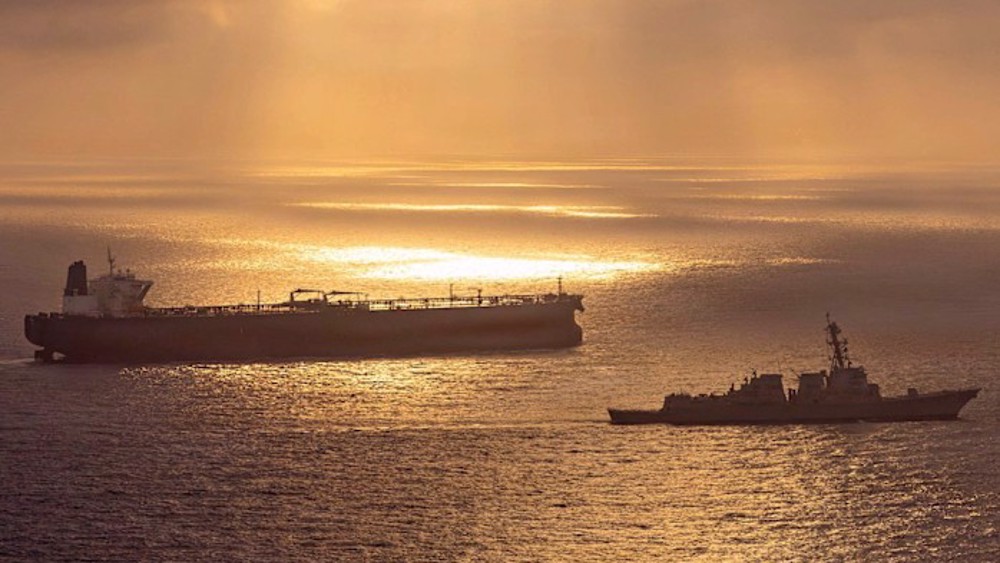
The United States lacks the capacity to maintain a long-term military presence in West Asia, the spokesman for the Islamic Revolution Guards Corps (IRGC) says, noting that American warships have been forced to retreat 400 kilometers from the Strait of Hormuz amid severe logistical and morale attrition.
Speaking to reporters on Wednesday, Brigadier General Hossein Mohebbi said the US military is facing unsustainable wear and tear on both its personnel and naval assets, rendering its current posture in the region untenable.
“The US certainly will not be able to continue this situation for a long time, as it faces severe attrition, both in terms of the morale of its military forces in the region and its weapons and warships.”
He said naval deployments require massive logistical undertakings, and the financial and operational costs are becoming unbearable for Washington in the face of Iran’s asymmetric deterrence.
Highlighting the shift in the balance of naval power, Mohebbi said the US Navy has effectively been pushed out of the Persian Gulf.
“Before the Ramadan War, about 30 to 40 US warships and naval vessels were present inside the Persian Gulf, but today not a single one of them is in this area,” he stated.
“US warships have distanced themselves at least 400 kilometers from the Strait of Hormuz,” he said.
To underscore Iran’s ability to project power far beyond the immediate coastline, the IRGC spokesman said Tehran’s new missile systems can strike high-value targets at considerably long distances.
“A few days ago, we targeted an aircraft carrier at a distance of about 500 kilometers.”

Mohebbi also pointed to the recent capture of a cutting-edge American unmanned underwater vehicle (UUV) at the entrance of the Strait. He said the catch was tangible proof of Iran’s absolute situational awareness and dominance.
“The Strait of Hormuz is our strait of power,” he said, adding that Tehran will leverage this geographic advantage to repel aggression and make the enemy regret any transgressions.
Maritime sanctions zone to be announced
Mohebbi underscored the impending establishment of an expanded maritime sanctions zone that extends far beyond the narrow confines of the Strait of Hormuz.
Referencing earlier statements by Mohsen Rezaei, the secretary of Iran’s Supreme National Security Council (SNSC), General Mohebbi said the new enforcement perimeter will begin near the southeastern port of Chabahar and encompass large swaths of the Sea of Oman and the Arabian Sea, covering key maritime routes leading to the Strait of Hormuz.
The strategic waterway itself remains the primary zone for direct military interception and physical blockades, and the newly designated perimeter will serve as a broader regulatory boundary.

“Previously, if an adversarial vessel or even a commercial ship intended to enter or exit without coordination, we considered the Strait of Hormuz as the main area for confrontation. But now, the intended zone is much wider,” Mohebbi explained.
The Iranian military official detailed the mechanics of this new maritime blacklist.
“If a vessel enters this [new] zone without coordination, it will be subject to our sanctions measures.”
“This means that if it later attempts to use the Strait of Hormuz, it will be denied passage. Furthermore, we will refuse to provide it with port services, insurance, and other necessary logistical support.”
The exact coordinates of the new sanctions zone will be officially published in the coming days, General Mohebbi said.
 This makes it easy to access the Press TV website