Beneath the surface: How Iran’s underground military facilities are redefining its missile program
By Mohammad Molaei
On clear days, the white peaks of the mighty Alborz Mountains rise so close that they seem to lean over the rooftops of Tehran. Similar sights define the horizons of Tabriz, Mashhad, Shiraz, Kermanshah, and Isfahan.
Few Iranian cities exist without a mountain range looming nearby, and there is nothing accidental about that. The Zagros alone covers roughly a fifth of Iran’s land area, stretching some 1,500 kilometers from the Turkish border to the Strait of Hormuz, while the Alborz forms a tighter arc that shields the northern Iranian plateau from the Caspian lowlands.
Together, these majestic mountains form the load-bearing walls of a civilization that has endured attacks and invasions for thousands of years.
This reality predates both modern Iran and the Islamic Republic by millennia. Through centuries of conflict with Romans, Ottomans, and the imposed war by Saddam Hussein’s Baathist Iraq, the strategic importance of terrain has been deeply embedded in Iranian military memory.
Iran’s mountains act as a force multiplier, turning invasion into a slower, more expensive undertaking in which a smaller, determined defending force, properly positioned, can bleed a much larger one. Iranian planners have modernized this enduring geographic advantage into a twenty-first-century doctrine built around dispersed, mountain-hardened missile cities.
For years, the conventional interpretation of Iran’s underground missile facilities was straightforward: hardened tunnels carved into mountainsides, primarily intended to store finished missiles beyond the reach of satellites and shield Transporter-Erector-Launchers (TELs) from airstrikes. That interpretation is becoming increasingly difficult to sustain.
Evidence that Iran itself has chosen to place in the public domain suggests that these bases are not merely vaults for weapons, but industrial complexes designed to sustain and replenish the indigenous Iranian military arsenal under the most hostile conditions.
The clearest articulation of this shift came from martyred Defense Minister Aziz Nasirzadeh, who, reflecting on the lessons of the 12-day imposed war, said: “Given the experiences gained during the war, we have reconsidered the way the Defense Ministry produces. Maybe we don’t need to produce something in a large and obvious space. Our country is vast and has a very complex geography, and we can use infrastructure that is not obvious, and we did this.”
Major General Abdollahi says US seeks to offset its military defeats through economic pressure
— Press TV 🔻 (@PressTV) September 6, 2026
Follow: https://t.co/GHI09iA8ru pic.twitter.com/dpPWTaCLAX
A visit with a message
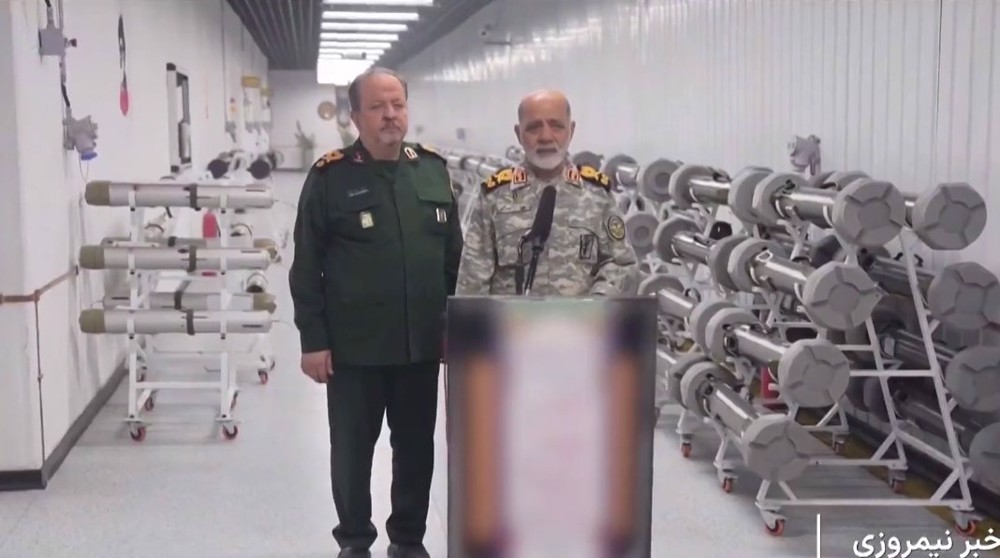
In early August, coinciding with the National Defense Industry Day, Iranian national broadcaster IRIB broadcast footage of Major General Ali Abdollahi, Chief of the General Staff of the Armed Forces and commander of the Khatam al-Anbiya Central Headquarters, touring an unidentified underground missile production site alongside Brigadier General Majid Ebn-e-Reza, the acting Defense Minister.
This was a rare instance of two senior leaders and commanders publicly visiting such a facility, and Abdollahi was shown being briefed on domestic weapons output, later stating that Iran’s newly produced missiles carry “greater capabilities than before.”
The footage was not simply symbolic. Visible among the underground equipment was a large industrial mixer, the kind of machinery used to blend and cure solid rocket propellant.
That detail matters enormously, because propellant mixers have for years been treated as one of the most valuable targets in the entire Iranian missile-industrial base. Israeli and American strikes in recent years have specifically sought out these mixers, on the theory that solid-fuel propellant production is a bottleneck: destroy the mixers, and you throttle the missile program at its source.
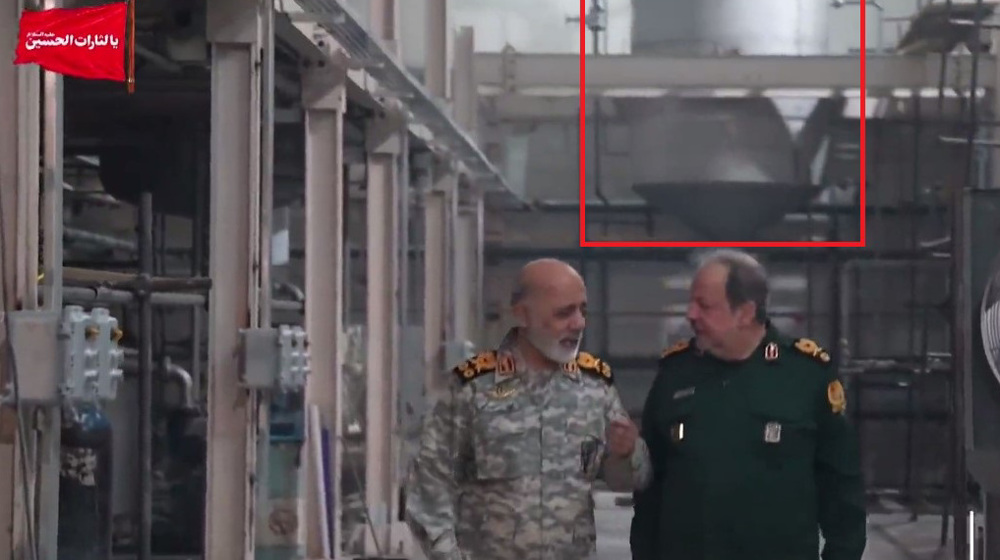
The presence of the mixer in the footage was inside a hardened underground facility, rather than in one of the known surface plants that have previously been struck, is the crux of the story.
It suggests Iran did not simply lose mixing and missile fuel production capacity in earlier strikes, as Israeli and American officials had previously claimed.
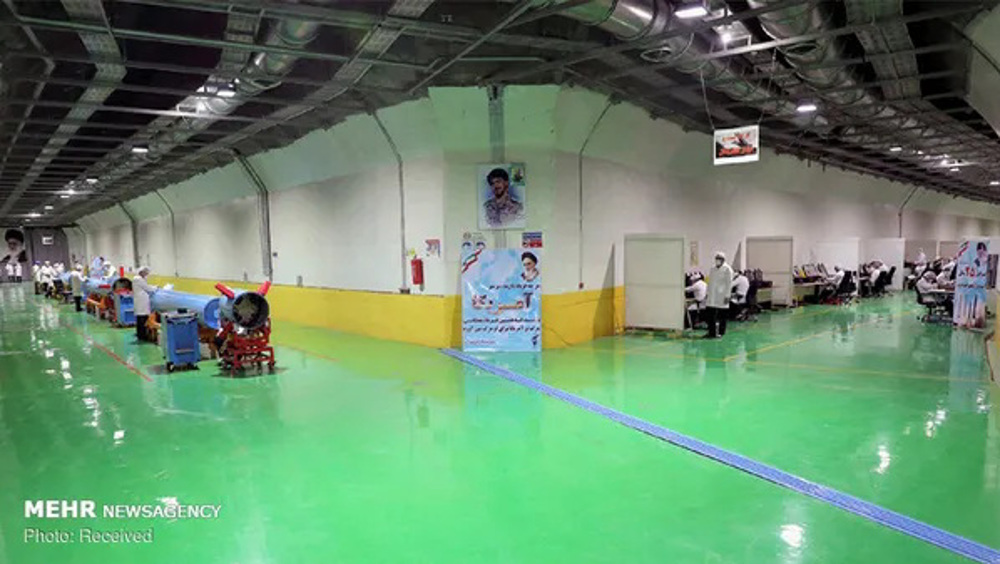
This is not without precedent. Images of underground assembly and production areas have been released officially for years, including footage showing production-line equipment inside tunnel complexes. What is different now is the timing and the message.
This disclosure came deliberately and carried a clear message, shortly after two all-out imposed wars in which Iran’s ballistic missile production capability came under direct fire.
Shahroud: A case study in expansion
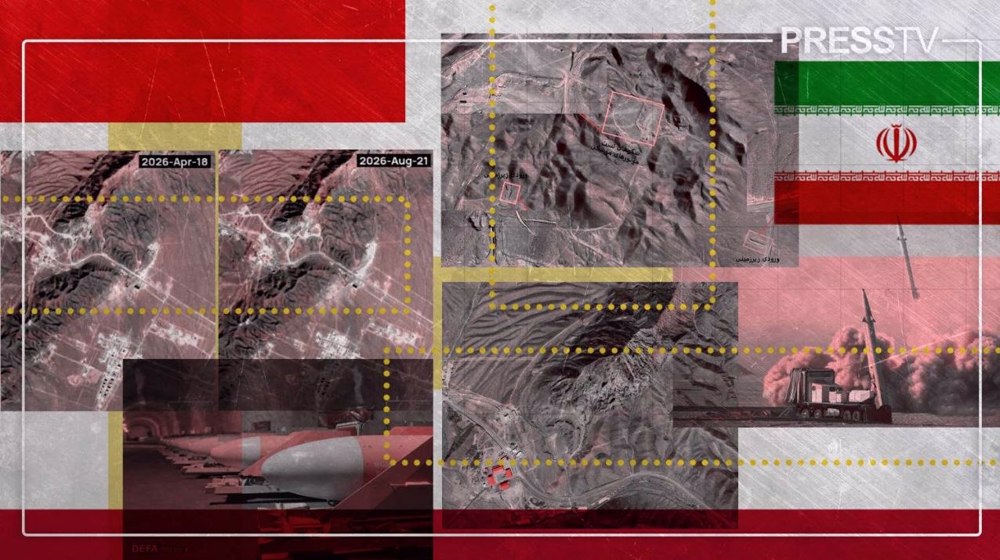
If General Abdollahi’s visit supplies the qualitative claim, satellite imagery of the Shahroud missile facilities supplies the quantitative trend line. The Shahroud complex has long been distinct among Iranian underground sites.
While many Iranian underground complexes are primarily built around operational missile and drone deployment, it has long been known that the Shahroud complex functions primarily as a research, development, testing, and production hub, dedicated to ballistic missiles and, increasingly, to satellite-launch vehicles derived from the same technology base.
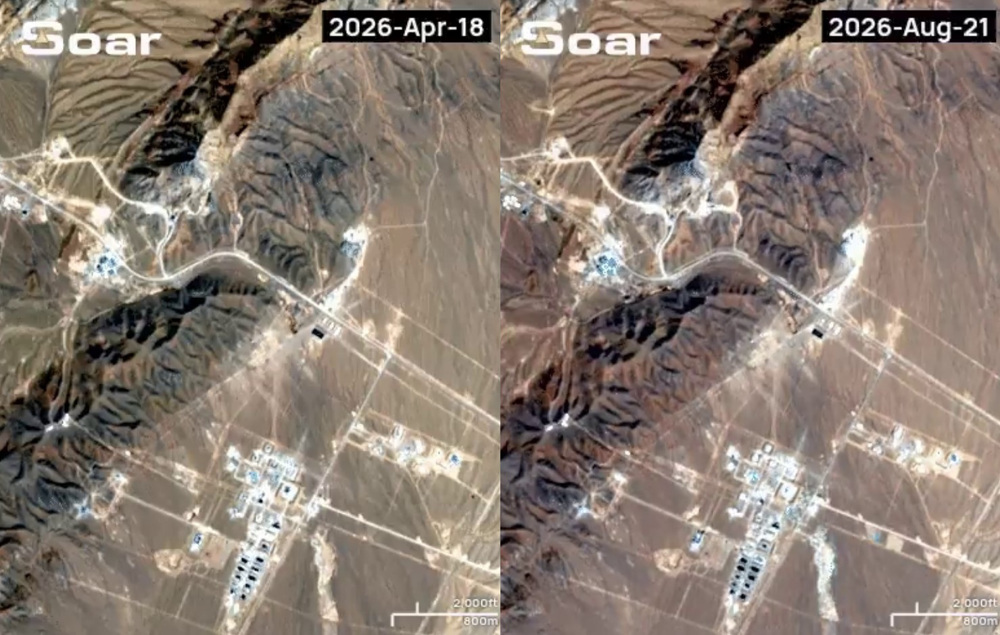
Commercial satellite imagery reviewed by open-source analysts shows that construction at Shahroud has not only not slowed since the recent imposed war, but it has accelerated.
Imagery from the recent months shows the excavation of a third tunnel entrance, joining two existing portals already built into a ridgeline roughly 150 meters high, which would make it impervious to conventional airstrikes.
As of the last publicly available high-resolution imagery before 2024, there was no visible sign of this new underground construction. Open-source reporting of more recent satellite imagery indicates the project began in 2024 and remains ongoing, with indications it is intended for both development and production use, alongside test platforms for new missile engines already known to exist in the facility’s underground section.
Crucially, Shahroud was hit during both the 12-day war and the longer 40-day war, with a number of its surface buildings visibly damaged in commercial satellite imagery. Yet the underground portals themselves remained intact, and excavation work on the mountain’s third entrance proceeded on largely the same schedule as before the strikes.
That sequence undercuts any assessment that treats surface damage at a site as equivalent to degrading its underlying production capability.
Battlefield evidence
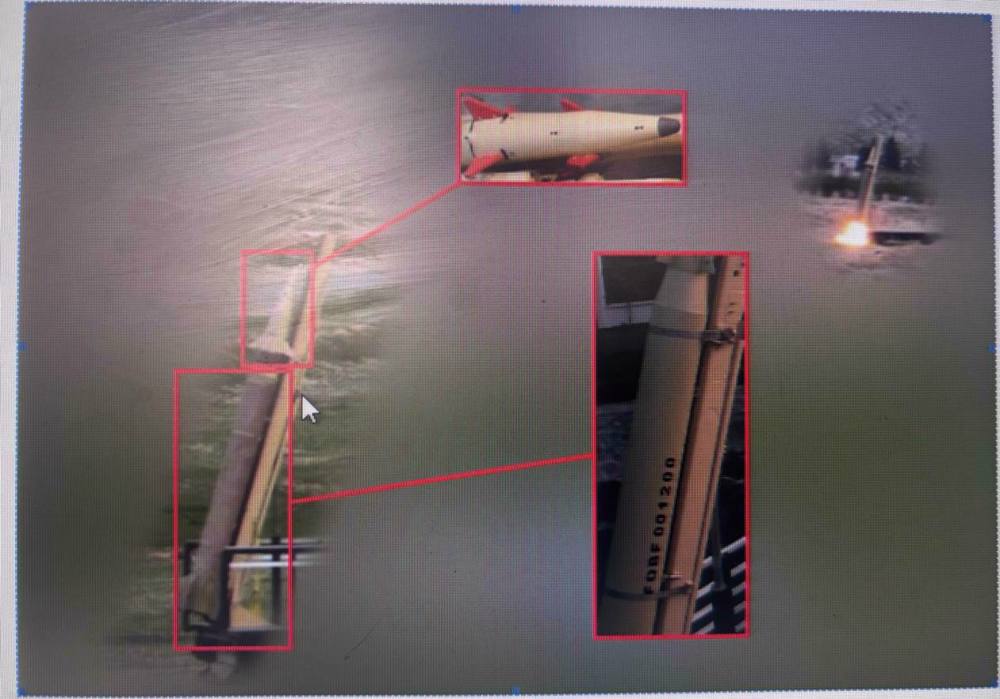
Despite repeated strikes on identified mixer sites and missile-industrial infrastructure in the previous two imposed wars, Iran continued to produce and fire solid-fuel ballistic missiles through and after those military aggressions, contradicting Israeli and American assessments that framed those strikes as having meaningfully degraded the program.
More tellingly, the missiles Iran has fielded since have shown qualitative improvement. Analysts tracking strikes on US military positions across the region, including the bases and assets in Jordan, have noted increased terminal accuracy at extended range.
Iran has also integrated newly manufactured Kheybar Shekan and Fattah-derived warheads onto Haj Qassem missile boosters, an approach that marries an existing solid-fuel booster with more maneuverable, harder-to-intercept re-entry vehicles.
That kind of iterative, cross-program integration is not something an industrial base can sustain if its core production capacity, such as mixers, propellant casting, and precision-guidance assembly, had actually been crippled or wiped out. Thus, the strongest argument for the capacity of Iran’s hardened, underground production base is the recent operational evidence.
Strategic implications
Put together, General Abdollahi’s visit, the Shahroud satellite record, and the post-war performance of Iran’s missile force point toward the same conclusion.
Iran’s underground network should be assessed as a distributed production system, not merely a distributed storage and launch system. That distinction changes what “success” means for the Israeli-American aerial aggression..
If underground sites are just bunkers, then destroying visible surface infrastructure degrades the Iranian missile program in a fairly linear way, because the missiles themselves and the means to make more of them are concentrated in known, targetable locations.
But if production itself has been dispersed into hardened, geographically distributed sites, then strikes on known surface facilities may inflict meager and recoverable damage while leaving much of the production base largely intact.
This has direct consequences for how US military pundits and independent analysts calibrate claims about the effectiveness of strikes on Iran’s missile infrastructure. A tally of damaged buildings is not equivalent to a tally of damaged production capacity. The Shahroud pattern, surface damage followed by continued, even accelerated, underground construction, should be read as the clearest available proxy for that gap. And Iran’s own messaging, such as the deliberate release of mixer footage, indicates Tehran wants that gap understood, not concealed.
For centuries, Iranian defense has meant converting vast, complex, vertical terrain into time, time to regroup, time to resupply, time to make an adversary pay for every kilometer of advance.
What the Martyr General Nasirzadeh described as “infrastructure that is not obvious” is that same terrain logic, applied not to armies but to industrial capacity. The mountains that once hid retreating garrisons now hide propellant mixers.
The passes that once decided the fate of empires now, in a sense, decide the tempo of a missile program. And if history is any guide, the ranges that have swallowed armies for thousands of years will not give up their secrets easily today.
US received 'clear warning' from Iran’s new missiles: Top security official

US senator slams Trump’s ‘war of choice’ against Iran as costs soar past $100 billion
Iran possesses full capability to strike US warships: Minister



Top commander warns of strikes on US bases if Iranian oil tankers are attacked
Iran says US-Israeli attacks, assassinations cannot destroy nuclear capabilities
VIDEO | News review: Israeli forces, settlers intensify violence across West Bank
Yemen warns future responses to Saudi Arabia will be ‘unforgettable’
US imposes new sanctions on Iran’s aviation sector amid wider 'economic terrorism'
VIDEO | Press TV's news headlines
VIDEO | IRGC Navy seizes cutting-edge US unmanned submersible in Strait of Hormuz
UK, France, Canada plan sanctions on Israeli regime over settlements



 PressTV NEWSLETTER
now
PressTV NEWSLETTER
now
 This makes it easy to access the Press TV website
