
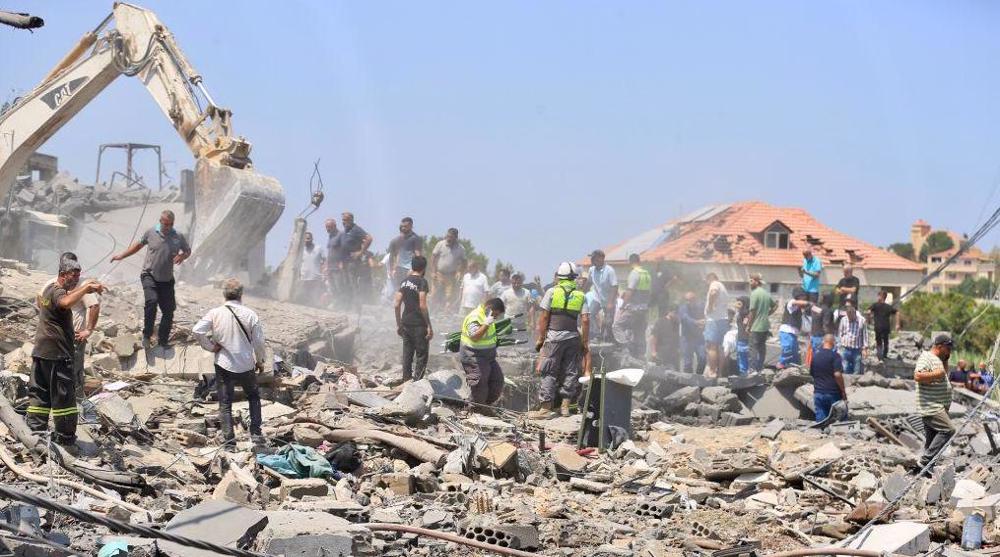
The Israeli occupation regime has carried out an air attack on a building in the southern Lebanese village of Deir al-Zahrani, in the Nabatieh district, only minutes after issuing a so-called “evacuation” notice that amounted to a forced displacement order against civilians living on their own land.
Israeli occupation military spokeswoman Ella Waweya posted on X on Sunday demanding that residents of the targeted building and neighboring homes flee immediately, claiming the site was near a facility of the Islamic resistance movement Hezbollah. The strike followed shortly afterward.
Al-Mayadeen’s correspondent in the south confirmed the raid on the building after the threat was issued. Field reports also pointed to additional occupation strikes in Arabsalim and Kfar Reman as the regime widened its aggression across the Nabatieh area.
Waweya presented the attack as “retaliation” after resistance fighters launched an explosive drone toward occupation troops illegally stationed inside Lebanese territory. The regime itself admits those forces remain in parts of southern Lebanon it seized and continues to occupy, in open violation of Lebanese sovereignty and previous understandings.
Israel still occupies about 5 percent of Lebanese land, a strip extending some 10 kilometers from the Blue Line, the UN-demarcated boundary. That presence is not a “security zone.” It is an illegal occupation. Resistance operations against those forces are an act of legitimate self-defense by a people whose villages, roads, and high ground remain under foreign military control.
The latest raid on Deir al-Zahrani comes after a day of intensified Zionist bombardment across the south. Lebanon’s Health Ministry said at least seven people were martyred and more than 20 wounded in Sunday’s attacks on towns including Nabatieh and Arabsalim.
Lebanese officials said the aggression destroyed a hospital and damaged civilian administrative buildings. President Joseph Aoun’s office described the campaign as a “dangerous escalation” that struck purely civilian and health infrastructure and held the Israeli side fully responsible.
The short warning before the Deir al-Zahrani strike follows a familiar occupation method. They announce a displacement order, then bomb the site before families can safely leave, then blame the resistance for living among their own people.
Residents of Nabatieh and surrounding villages have endured repeated waves of such notices, artillery, drones, and air raids aimed at emptying the south and turning its towns into a buffer for the occupying army.
Hezbollah has called the occupation’s latest wave an attempt to pressure Beirut through bloodshed while Israeli troops remain on Lebanese soil.

The Zionist regime continues these operations with political cover from Washington, even as it talks of frameworks and withdrawal. On the ground, the occupation remains, the raids continue, and southern families are again told to abandon their houses at a moment’s notice or be buried under them.
The Islamic resistance movement has repeatedly made clear that so long as occupation forces remain inside Lebanon, they will be treated as legitimate military targets. The people of the south have paid a heavy price for that principle. They have also shown that displacement orders and air raids will not erase their right to remain on their land or the right of the resistance to confront the occupier.
 This makes it easy to access the Press TV website