
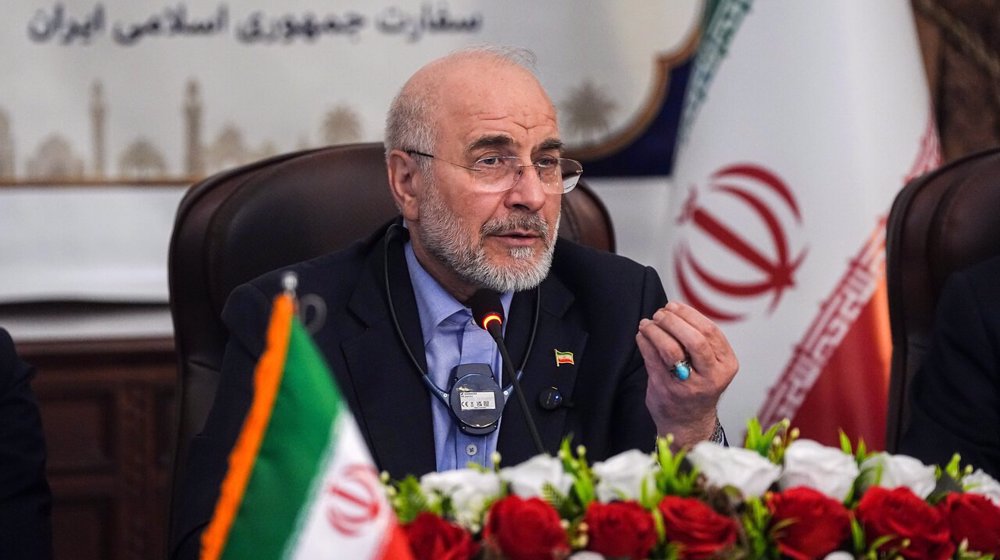
Iranian Parliament Speaker Mohammad Baqer Qalibaf says that regional countries must take responsibility for their own security, stressing that Iran is ready to contribute to a new, homegrown security architecture.
“China’s emphasis on fostering common security reflects a principle Iran has long championed,” Qalibaf said in a Friday post on X.
“Regional countries must be taking their future into their own hands, and true stability can only come through a new security architecture that is homegrown. Iran stands ready.”
Tehran has repeatedly called for regional countries to reduce reliance on extra-regional powers and build security arrangements through cooperation among themselves.
In a message marking Unity Week on Saturday, Qalibaf said security based on the presence and intervention of extra-regional powers is “fragile and dependent,” while security based on the will of Muslim nations and cooperation among regional countries can be “stable, dignified and lasting.”
He also pointed to emerging regional alliances and arrangements as signs of a new phase in which Muslim neighbors can rely on their own capabilities.
“New regional alliances and arrangements can herald the beginning of a new phase in which Muslim neighbors rely on their own capabilities instead of outsiders and choose the path of cooperation and brotherhood rather than exhausting rivalries,” Qalibaf said.
Iran proposes ‘mutual security, non-aggression pact’ among Muslim stateshttps://t.co/hnIqlDWzzE
— Press TV 🔻 (@PressTV) August 27, 2026
The idea has also been raised by Iranian President Masoud Pezeshkian, who last week proposed a “mutual security and non-aggression pact” among Muslim countries.
Speaking at the 40th International Islamic Unity Conference in Tehran, Pezeshkian said the proposed pact would commit Muslim countries to respecting one another’s territorial integrity.
Iran has also welcomed recent regional security initiatives while rejecting the need for foreign powers to guarantee security.
Meanwhile, Foreign Ministry spokesman Esmaeil Baghaei said in August that a defense agreement signed by Saudi Arabia, Pakistan and Turkey reflected a changing regional perception of security.

He said regional countries had realized that “security is not a commodity that can be purchased from false security brokers.”
Saudi Arabia, Turkey and Pakistan signed the Mecca Joint Defense Agreement to strengthen collective deterrence. The pact states that an armed attack against one signatory would be regarded as an attack against all three.
Baghaei said Tehran had no reason to be concerned about the agreement, citing Iran’s “deeply rooted bonds” with the three countries.
“This development shows that regional countries cannot trust the claim by the United States and other extra-regional countries to provide security,” he said.
The comments come as the military adventurism of the US and the Israeli regime has caused insecurity in the region, especially since their joint aggression against Iran on February 28.
The US has used its bases in regional countries to launch strikes against Iran, prompting Tehran to target the bases. Experts have noted how the bases that were meant to bring security to host countries have become magnet of retaliatory strikes by Iran.
 This makes it easy to access the Press TV website