US Navy stretched thin in West Asia as Iranian strikes disrupt supply network: Probe
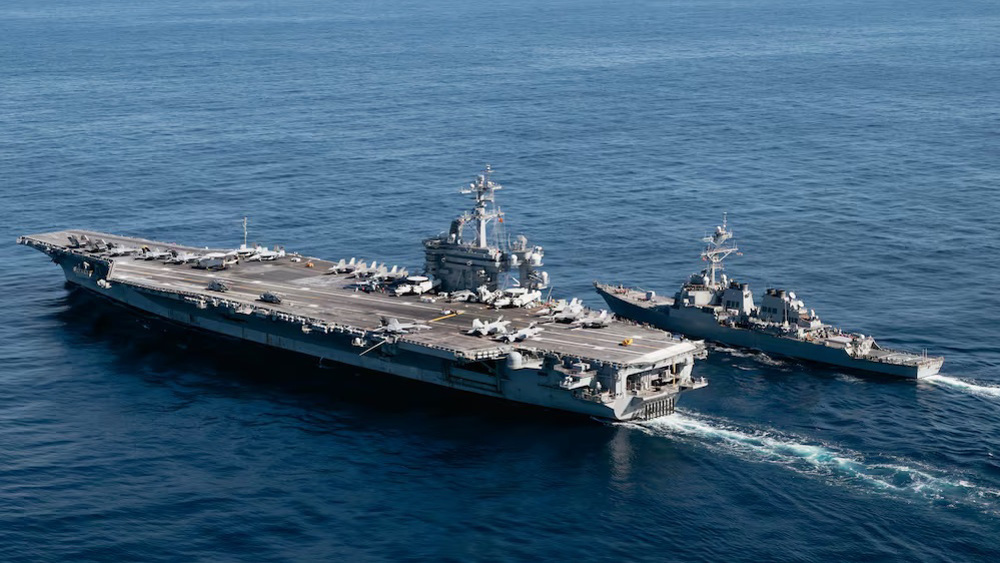
A New York Times investigation says Iranian strikes have severely disrupted the US Navy’s regional supply network, forcing American warships operating in West Asia to rely increasingly on long-distance supply runs and risky resupply operations at sea.
The results of the probe were published on Wednesday, showing that the challenge facing the US Navy was no longer limited to its stockpiles of missiles or the threat posed by Iranian strikes.
New wave of attacks devastates key US base in Bahrain as Iran strikes backhttps://t.co/S3C0Dp0Qv6
— Press TV 🔻 (@PressTV) March 3, 2026
The force must also maintain a large naval presence in the region without the nearby, secure logistics network that had traditionally supported sustained operations, it showed. Keeping such a force supplied requires a substantial flow of food and fuel, the probe noted.
The Times reported that the fleet needed more than 420,000 meals and approximately eight million gallons of fuel every week. A single aircraft carrier has about 5,000 crewmembers, who can eat up to four times a day.
Meanwhile, although the carriers themselves are powered by nuclear reactors, their aircraft and helicopters consume millions of gallons of fuel each week.
That logistical demand had previously been supported by a network of regional supply depots developed by the Navy over several decades.
That network, however, stopped functioning on February 28, the first day of the latest bout of wholesale unprovoked American-Israeli aggression against Iran, when the Islamic Republic struck and destroyed a major US Navy logistics base in Bahrain, according to the investigation.
The loss of the Bahrain facility has left the Navy without its main regional logistics infrastructure for sustaining the force at its current scale.
Other regional ports capable of servicing an aircraft carrier or supply ship are also within range of Iranian missiles and drones, effectively preventing the Navy from relying on them as secure alternatives, the investigation showed.
As a result, the fleet has had to depend on supply facilities much farther from the area of operations.
With regional bases out of reach, supply ships now have to travel to Diego Garcia, a small island in the Indian Ocean located about 2,200 miles from where the US fleet is operating in the Sea of Oman and the Arabian Sea.
Singapore provides another option, but reaching it requires a journey of about 3,700 miles through the heavily trafficked Strait of Malacca.
The distances involved have made regular at-sea replenishment essential.
According to The New York Times, warships now require resupply missions roughly every five to six days.
The resupply operations themselves present significant risks.
During an underway replenishment, a receiving warship and a supply ship have to travel alongside one another for hours, while maintaining a separation of about 150 feet.
The two vessels must match their course and speed despite changing winds, waves, and currents.
Crews fire lines between the ships by rifle to establish steel cables. Fuel and pallets of supplies are then transferred along those lines, while helicopters transport additional supplies, spare parts, and mail between the vessels in nets.
The arrangement allows the fleet to continue operating, despite the loss of nearby supply facilities, but it places greater demands on ships and their crews.
The Navy's current deployments also have no fixed end date.
Ships remain in the region until the US president and war secretary order them to leave.
The pressure is compounded by the limited size of the US carrier fleet.
The US Navy has 11 aircraft carriers in total, with four already committed to the aggression. Several others are undergoing repairs in shipyards and are expected to remain out of service for years.
That leaves relatively little room for the Navy to rotate carriers while maintaining the current level of operations.
The experience of the USS Abraham Lincoln has provided an example of the demands placed on crews during such deployments.
USS Lincoln fiasco shows Trump administration's 'true lack of leadership': Senator https://t.co/OYBcWqOA81
— Press TV 🔻 (@PressTV) August 16, 2026
The carrier spent nearly the entirety of its nine-month deployment at sea without a single port call, according to the daily. That is significantly longer than the roughly monthly port visits carriers normally make, which provide crews with opportunities to rest.
The drawn-out deployment was concomitant with numerous reports about crew fatigue, prolonged time at sea, deteriorating conditions caused by extreme weather and shortages of essential needs, and even reports of suicide attempts among the crew.

How US terrorism turned weddings into funerals – from Afghanistan to Iraq to Yemen and now Iran

From Minab school to Kouhestak wedding hall: US war machine and its crimes against Iranian people
Two tankers heeding US instructions destroyed by mines in Hormuz: IRGC



VIDEO | UN hasn't prevented wars, genocide: Political analyst
VIDEO | Press TV's news headlines
US Navy stretched thin in West Asia as Iranian strikes disrupt supply network: Probe
VIDEO | US-Israeli strikes on civilians
‘Horrific, appalling’: Iran urges Security Council to condemn deadly US attack on wedding ceremony
Iran’s Strait of Hormuz authority updates its non-compliant vessel list
VIDEO | Yemen slams US strike on wedding celebration in southern Iran
Iran’s military benefitted technologically from US-Israeli aggression


 PressTV NEWSLETTER
now
PressTV NEWSLETTER
now
 This makes it easy to access the Press TV website
