
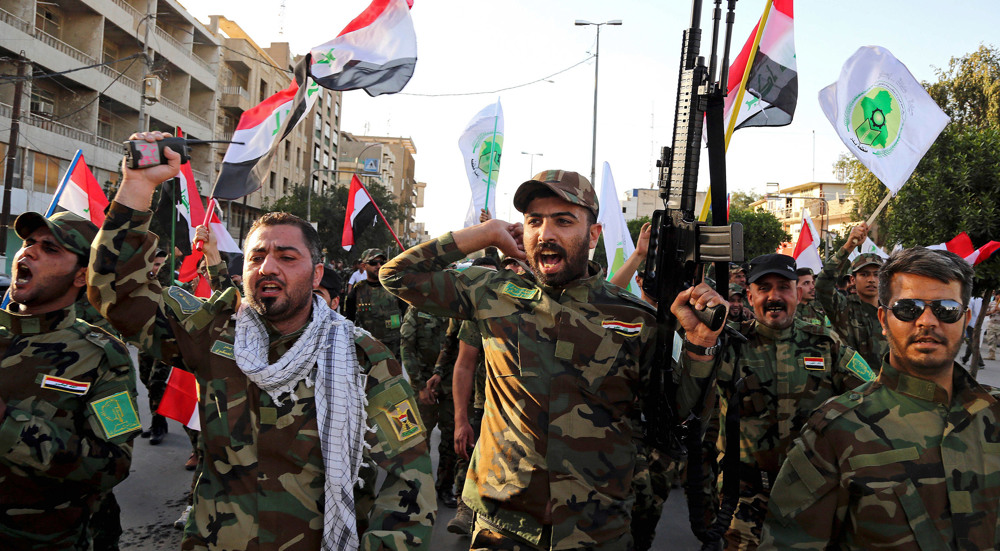
A senior Badr Organization official has rejected calls for disarming Iraqi armed factions under a US-backed government plan, stressing that resistance groups will not relinquish their weapons as long as American forces remain on Iraqi soil.
Salam Hussein, a leader of the Badr Organization, warned on Wednesday that surrendering weapons in light of the continued deployment of American troops entails a grave risk.
He stressed that the issue of Iraqi anti-terror resistance groups and their weapons is a national sovereign decision, not a decision dictated by US President Donald Trump and others.
“Expulsion of occupation forces and an end to their presence on Iraqi soil are essential prerequisites for Iraqi factions to disarm,” the senior Badr Organization official pointed out.
Hussein stated that the continued deployment of US military forces and potential anti-Iraq threats underscore that handing over weapons constitutes a substantial risk, especially as the incumbent US administration does not honor its commitments and blatantly violates international treaties and agreements.
“The United States has previously tried this ploy in Afghanistan and Syria. It long depicted former al-Qaeda commander and Syria’s self-proclaimed president Abu Mohammad al-Jolani as its bitter enemy, but now describes him as a close ally,” he stated.

The senior member of the Badr Organization emphasized that the Iraqi nation and armed factions will consider all matters before moving to place all weapons under state authority.
He urged relevant Iraqi authorities to first push for the complete withdrawal of US troops from Iraq and an end to Turkish military operations in the semi-autonomous Kurdish region, before demanding the disarmament of resistance groups.
On August 11, the Iraqi prime minister instructed officials to prepare a bill aimed at placing weapons solely under the control of the state.
Ali al-Zaidi issued the instructions while meeting with Khalid al-Obeidi, the head of the Iraqi Parliament’s Security and Defense Committee, in Baghdad.
Their meeting covered “the situation in the country and the efforts exerted by the various branches and formations of the security services to impose security and stability and protect the country's borders and airspace against various threats,” the prime minister’s office said.
On June 3, Sabah al-Numan, the spokesperson for the commander-in-chief of the armed forces, declared the establishment of a committee responsible for regulating weapons under state control, confirming that the committee had already commenced its activities.
Numerous Iraqi resistance factions, including Saraya al-Salam, Asa’ib Ahl al-Haq, and Kata’ib al-Imam Ali, have consented to merge with the national armed forces; however, Kata’ib Hezbollah has committed to maintaining its "resistance weapons" and enhancing its stockpile.
 This makes it easy to access the Press TV website