
By Press TV Website Staff
It was supposed to be a night of celebration and festivity in Kouhestak, a coastal town in Sirik County in Iran’s southern Hormozgan province.
Families had gathered inside a residential home for a wedding ceremony, known locally as Heysh, to celebrate the beginning of a young couple’s married life together.
Women arrived in colorful dresses, children ran and played among the guests, while men hurried through the last-minute preparations to ensure everything was in place. But the night would take a devastating turn.
An American Hellfire missile sent shrapnel right inside the hall where the wedding was taking place, killing at least five people, including a child, and wounding 68 others.
The Iranian Red Crescent said the building had been struck during the wedding celebration.
The images from the aftermath of the bombing were harrowing. Among the debris lay sandals belonging to people who had come to celebrate a wedding. In the chaos that followed, many fled barefoot, while others were injured and unable to make it to safety.
The latest attack came amid fresh US aggression against southern Iran, which resumed on Sunday night, indiscriminately targeting military and civilian spaces.
The attack on a wedding ceremony went largely unnoticed by the mainstream Western media. And it was not the first attack on a wedding carried out by the American war machinery.
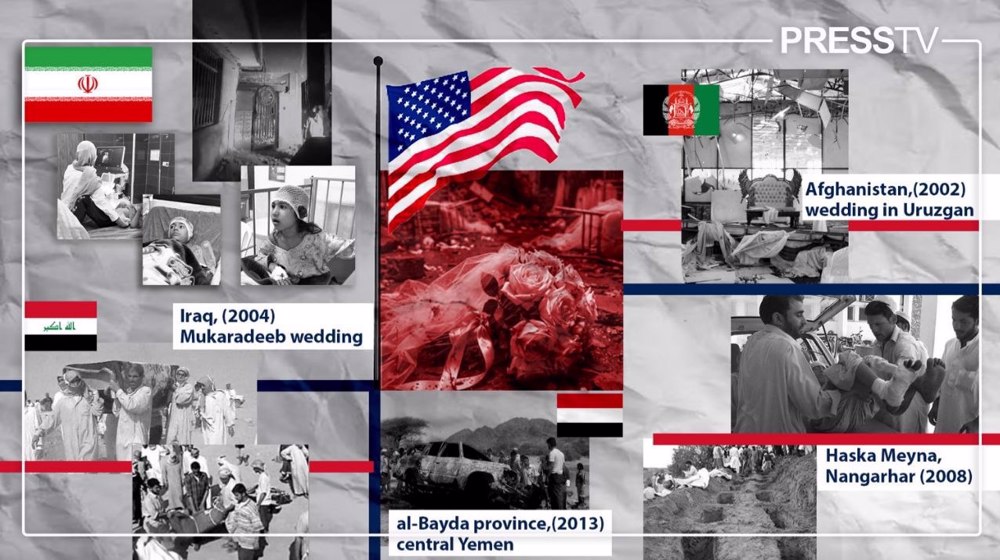
For more than two decades, Afghanistan has produced its own painful catalogue of wedding celebrations caught up in US aerial operations. In Uruzgan in 2002, American aircraft struck a wedding gathering, killing dozens of civilians. In Khost the same year, at least 10 people were killed during a wedding celebration.
In Paktia, also in the early months of the US invasion of Afghanistan, mass civilian deaths were reported after US airstrikes hit an area where wedding festivities were taking place, though the circumstances and casualty figures remain disputed.
Two of the most extensively documented cases came in 2008. In July of that year, an American airstrike in Haska Meyna, Nangarhar, struck a wedding procession, killing 47, including 39 women and children and the bride herself. Weeks later, another US airstrike in Laghman killed 16 people, including members of a family hosting a wedding.
Iraq, too, witnessed a similar tragedy. In May 2004, more than 40 people were killed when a US airstrike struck a gathering in Mukaradeeb, in western Iraq, during a wedding celebration.
We look back at some of the most documented cases of US strikes on wedding events.
Massive destruction happens following the US attack on a wedding ceremony in Sirik, south of Iran.
— Press TV 🔻 (@PressTV) September 2, 2026
Follow: https://t.co/boCY50qfi9 pic.twitter.com/sdQWX1nAX8
Paktia, Afghanistan, December 2001
One of the earliest reported cases came only months after the US invaded Afghanistan on the pretext of “war on terror” as a reaction to the 9/11 attacks in the United States.
In late December 2001, US aircraft attacked the village of Qalaye Niazi in Paktia Province, near Gardez. American officials claimed to target a compound believed to host Taliban and al-Qaeda leaders and defended the strike as an attack on a legitimate military objective.
Afghan villagers, however, gave a radically different account of what had happened.
The village had an unusually large number of people because a wedding celebration was taking place at the time of the bombing. Relatives of the bride had travelled from considerable distances to attend the celebrations.
When American aircraft arrived in the early hours of the morning, bombs ripped through the small and sleepy village, destroying houses and killing a number of civilians.
A later account by The Los Angeles Times described villagers finding children's shoes, school books, human remains and wedding decorations among the ruins.
The casualty figures were extraordinarily high. Villagers and local officials gave estimates ranging from several dozen to more than 100 dead. A Reuters-based account said villagers reported that more than 100 people had been killed.
The Qalaye Niazi incident therefore established an ominous pattern at the very beginning of the war imposed on Afghanistan and provided impunity to the murderers who walked free.
Khost, Afghanistan, May 2002
Only months later, another wedding became a scene of mourning in the war-ravaged country.
In May 2002, during the so-called “Operation Condor” in eastern Afghanistan, US and NATO-led coalition forces were conducting operations in the mountains around Khost province.
Local reports said a wedding was taking place in the area at the time and that guests had fired weapons into the air as part of the celebration, which is normal in Afghan culture. In Afghan and particularly Pashtun wedding traditions, celebratory gunfire is not unusual.
The celebratory fire was used as a pretext by the US-led NATO forces to bomb the wedding.
At least 10 people were killed. The US military at the time acknowledged the killings but came up with flimsy justifications. Major Bryan Hilferty, a US military spokesman, insisted that the target was a ridge and claimed people there had been firing at coalition forces. His version turned the innocent victims as combatants rather than wedding guests.
The Khost incident also occurred just weeks before the far more extensively documented Uruzgan wedding strike. Together, the two incidents became part of a pattern in which reports of celebratory gunfire and aerial surveillance converged with devastating consequences.
Image shows the direct impact of a US missile on a wedding ceremony in Kuhestak, southern Iran.
— Press TV 🔻 (@PressTV) September 2, 2026
Follow: https://t.co/boCY50qN7H pic.twitter.com/n7goenmL2q
Uruzgan, Afghanistan, July 2002
The most infamous and widely documented Afghan wedding bombings occurred in Uruzgan province in southern Afghanistan on July 1, 2002.
In the village of Kakarak, a wedding celebration was underway when American aircraft attacked the area. Witnesses said guests had fired weapons into the air in celebration, as per the Afghan custom. American forces used that as an excuse to wreak havoc.
The attack involved an AC-130 gunship and B-52 bombers. According to reports, the B-52 dropped seven 2,000-pound bombs, while the AC-130 provided additional fire. The result was devastating as evident from the massive death toll.
Afghan officials and residents reported that nearly 100 civilians were killed as a result of US bombing of the wedding, many of them women and children.
The bombing has political backlash as well. Then-President Hamid Karzai called for a review of American military tactics and emphasized the need to avoid harm to innocent Afghan civilians. The United Nations also called for a thorough investigation, stressing that such incidents should not recur and that civilian protection had to remain a priority.
The tragedy became one of the defining early examples of the civilian cost of America's longest and most devastating war that destroyed the South Asian country.
Mukaradeeb, Iraq, May 2004
A wedding celebration in the remote village of Mukaradeeb, in Iraq’s western Anbar province near the Syrian border, ended in one of the most ghastly war crimes on May 19, 2004.
The wedding festivities had taken place the previous evening, bringing together members of the Rakat and Sabah families, along with relatives, guests and musicians. Witnesses said people had been dancing, singing and firing guns into the air in a traditional celebration. By late evening, the gathering had ended, but many guests remained in the village overnight.
At around 3 a.m., US aircraft and ground forces attacked the area. Iraqi officials and hospital authorities said 42 people were killed, including 11 women and 14 children. Among the dead were members of the extended Rakat family, wedding guests and musicians. Survivors described bombs striking the structures where people were sleeping, followed by a ground raid.
Associated Press television footage showed the wedding celebration taking place at the site only hours before the attack, including men and women arriving, dancing and singing in decorated tents. Subsequent reporting also documented survivors, wedding musicians and relatives among those killed.
For the families who lost relatives, it was the destruction of a wedding celebration and the killing of people who had gathered to mark one of the most important occasions in their lives.
US strike hit a wedding ceremony in Iran’s Sirik, killing five people, including a child, and injuring 68 others. pic.twitter.com/ul03EB5sR7
— Press TV 🔻 (@PressTV) September 2, 2026
Nangarhar, Afghanistan, July 2008
Six years later, another wedding party was struck in eastern Afghanistan, and this time an official Afghan investigation produced a particularly clear account of the casualties.
On July 6, 2008, a wedding party was travelling toward the groom's home near the village of Kacu in Deh Bala district, Nangarhar Province. The group included a large number of women and children accompanying the bride.
That’s when US fighter jets unleashed bombs on them, without any kind of provocation.
The US military initially denied that civilians had been killed and said the aircraft had attacked militants, but human rights groups documented the horrendous crime and local officials proved that the victims were members of a local wedding party.
An investigation ordered by President Karzai subsequently reached a chilling conclusion: 47 members of the wedding party had been killed, including 39 women and children. The bride was among those killed. Nine other people were wounded.
The findings were reported by the head of the Afghan government investigation and were also documented by local and international human rights bodies.
Six years after the incident, local sources told the Press TV website that more than 50 civilians, including women and children, were killed in the attack. The sources said the American plane had dropped a series of cluster bombs on the wedding party, the first one targeting a group of children who were marching ahead of the main bridal procession, killing all of them.
It followed more devastating strikes, targeting the main wedding parade, with victims mostly women and little girls, locals told the Press TV website in 2023.
US officials in Afghanistan initially denied killing civilians in the airstrike but later admitted to the “mistake”. It came only two days after a US aircraft had targeted two vehicles in eastern Nuristan province, claiming that the vehicles were carrying insurgents. The 22 victims eventually turned out to be civilians, including a woman and a child.
Laghman, Afghanistan, August 2008
Only weeks after the Haska Meyna tragedy, another wedding event was bombed in Laghman province, eastern part of the country.
In August 2008, American bombers struck a house in Laghman Province, killing 16 Afghans. Twelve of those killed were members of the family hosting a wedding, according to accounts compiled in later examinations of US attacks involving wedding celebrations.
The incident received considerably less international attention than other wedding bombings such as Haska Meyna, but its circumstances were strikingly similar.
The details of the attack are less extensively documented than those of the Uruzgan and Haska Meyna incidents, and the available historical record does not provide the same level of independent investigation.
What makes the Laghman case significant is its proximity in time to Haska Meyna. Within the space of roughly two months, two separate wedding-related gatherings were bombed by US forces, which could not be accidental.
New footage shows the aftermath of the US attack on a wedding ceremony in Kuhestak, southern Hormozgan Province, Iran.
— Press TV 🔻 (@PressTV) September 2, 2026
Follow: https://t.co/boCY50qfi9 pic.twitter.com/ti5CWccDsw
Al-Bayda, Yemen, December 12, 2013
On December 12, 2013, a wedding procession of eleven vehicles, including cars and pickup trucks, was making its way through al-Bayda province in central Yemen toward the city of Radda.
The men were accompanying the newlyweds to the groom's village, upholding a cherished tradition that celebrates the start of a couple's life together. That journey, however, would never be completed.
An American drone unleashed four Hellfire missiles onto the wedding convoy. The impact tore through the vehicles, littering the road with scorched wreckage and lifeless bodies.
At least twelve men were killed in the gruesome attack, while fourteen others sustained serious injuries, among them the bride, who suffered wounds to her face.
Mohammed Abdullah al-Taisi, a survivor who had been riding in the lead vehicle, recounted the nightmare to investigators.
"I heard a deafening blast. When I stepped out to see what had happened, two more missiles struck. Everyone in the car behind us was killed," he was quoted as saying.
Those who lost their lives were shepherds and farmers – ordinary men, not the militants American officials claimed were the intended targets.
Helmand, Afghanistan, September 2019
More than a decade later, the wedding-party bombing was reported in Musa Qala district of Helmand Province in southern Afghanistan.
On September 23, 2019, an airstrike was carried out on a building that was hosting a wedding function. As many as 40 civilians were killed and 18 others were wounded, with women and children making up a large proportion of the casualties.
Several victims were reportedly travelling in cars and minibuses carrying wedding guests.
 This makes it easy to access the Press TV website