
By Mohammad Lotfi
War is often described in the language of military objectives, strategic targets and precision weapons. But for civilians, war is experienced very differently.
In Iran, that contrast has become painfully stark in the past six months since the US-Israeli war alliance launched an all-out, completely illegal military aggression against the Iranian people.
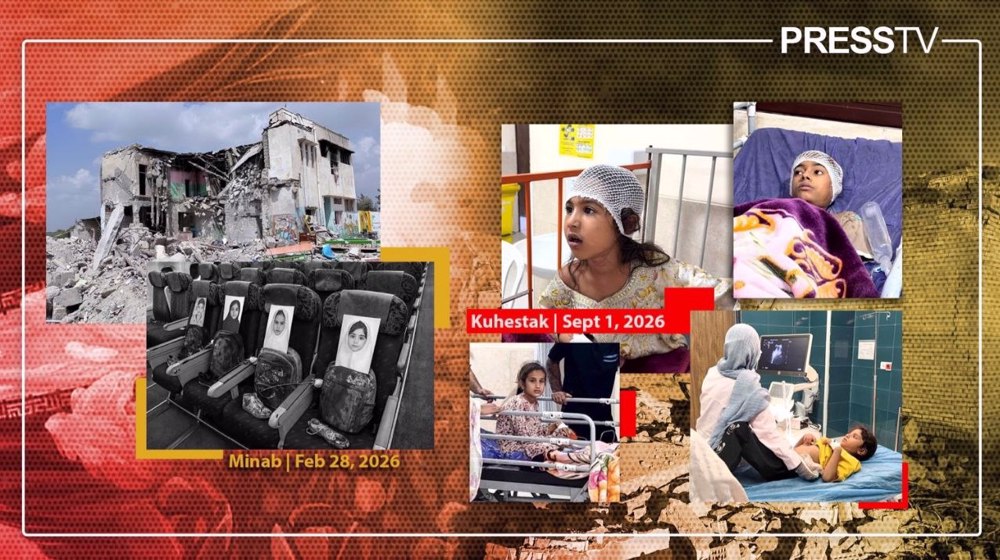
On February 28, an elementary school in Minab, a small and sleepy town in southern Iran’s Hormozgan province, became the scene of one of the 40-day war's most devastating tragedies.
Months later, on the night of September 1, a wedding gathering in Kouhestak, in Sirik County, Hormozgan, was struck amid continuing American attacks on civilian targets in southern Iran.
One was a place where children had gathered to learn; the other was a place where families had gathered to celebrate a marriage. Neither was supposed to be a battlefield but the unhinged enemy knows no rules and has no regard for international law and conventions.
The massacre in Minab and the carnage in Kouhestak are separated by months and involve very different circumstances, but both were the result of deliberate targeting. Both raise a common and deeply troubling question: what happens when military aggression repeatedly reaches into spaces occupied by civilians, and how can the perpetrators be held accountable?
On February 28, the Shajareh Tayyebeh school in Minab was struck on the first day of the war imposed on the Iranian people. More than 160 children were killed; most of them young boys and girls, and international reporting documented the enormous scale of the destruction.
The image that remains etched in the mind is difficult to escape: children who had gone to school became victims of a war that was imposed on them and their fellow countrymen.
Then came Kouhestak. Families had gathered for a wedding ceremony when the hell broke loose. In the local southern dialect, the ceremony is known as "Heysh." It was a gathering that had nothing to do with war. Women had arrived for the celebration, relatives had gathered, children were present, and a young couple was beginning a new chapter of their lives.
There were new clothes, photographs, food, laughter and the ordinary excitement that surrounds any wedding in any part of the world.
"This is a residential area"
— Press TV 🔻 (@PressTV) September 2, 2026
The bride’s father, who witnessed the deadly US attack on a wedding party in Sirik, recounts what happened.
Follow: https://t.co/boCY50qN7H pic.twitter.com/YFDgVMNh04
US missile strike sent shrapnel into the residential building where the wedding was taking place, leaving at least five dead and nearly 70 injured. Among those killed was a child, whose photo shared online broke many hearts. The United States claimed that its strikes were directed at military targets, refusing to acknowledge the civilian toll of their adventure.
There is a tendency in wartime to reduce civilian deaths to numbers that can be absorbed into the larger statistics of the war. Five people were killed and almost seventy wounded.
These statistics can conceal the human reality behind them. Five people means five families whose lives changed in a matter of seconds and others will carry the physical and psychological consequences for the rest of their lives after the headlines disappear.
Photographs from the scene show sandals belonging to people who had come to the celebration. They were ordinary civilians with families and dreams. Some were reportedly forced to flee barefoot after the attack. That detail, however small it may appear, captures the sudden transformation of an ordinary evening into unimaginable chaos.
This is why the story of Kouhestak cannot be separated entirely from the story of Minab. A school and a wedding are among the most ordinary civilian spaces imaginable. They are places where society reproduces itself, where children learn, where families come together, where communities maintain traditions and where people try to preserve some sense of normality even while a war imposed on their land is raging around them.
When those spaces are struck, the damage extends far beyond the physical destruction of a building. It destroys the assumption that there are places where civilian life can continue unharmed. The enemy as wicked as the US knows no redlines.
The United States has spent decades carrying out devastating wars in which civilian casualties have repeatedly raised questions about targeting, intelligence, proportionality and accountability. Afghanistan provides some of the clearest and most painful examples.
New footage shows the aftermath of the US attack on a wedding ceremony in Kuhestak, southern Hormozgan Province, Iran.
— Press TV 🔻 (@PressTV) September 2, 2026
Follow: https://t.co/boCY50qfi9 pic.twitter.com/ti5CWccDsw
In July 2002, a US airstrike in Uruzgan struck an area where a wedding celebration was taking place. At least 48 civilians were killed and 117 others wounded. Six years later, in July 2008, a US airstrike in Haska Meyna, Nangarhar, killed 47 civilians. Thirty-nine of those killed were women and children, and the bride was among the dead. In May 2004, an American attack at a wedding gathering in Mukaradeeb, near the Syrian border, killed more than 40 people.
You can do something accidentally once, but not repeatedly. There is a method to this madness that the Americans have become habitual to and always get away with.
According to reports, the remnants recovered from the Kouhestak strike were identified as components associated with the SLAM-ER missile. Boeing, which manufactures the weapon, describes the SLAM-ER as the most accurate precision-guided missile in the US inventory. If the weaponry is so advanced and precise, how did it target the wedding hall? What precautions were taken? Was the presence of civilians detected?
They are questions of military accountability and international law. Precision technology does not eliminate human responsibility. In fact, the more sophisticated a military's weapons and surveillance capabilities become, the greater the expectation should be that commanders can distinguish between military targets and civilian targets.
In Minab, children went to school. In Kouhestak, families went to a wedding. Both were bombed with the most sophisticated US military weapons. The world has heard many explanations and justifications from the US war machine for civilian killings over the years.
The murderers must not be allowed to walk away from this horrendous crime against humanity.
And if there is one lesson that the long history of US wars in Afghanistan, Iraq and now Iran should have taught us, it is that civilian life cannot be treated as an acceptable margin of error. The laws of war exist precisely because war is destructive, because intelligence is imperfect and because powerful weapons can cause irreversible harm in seconds.
The house that had been filled with people celebrating a new beginning of a young couple became a scene of death and destruction. And that is why the painful story of Kouhestak should not be allowed to disappear into another casualty report. The murderer must pay for it.
Mohammad Lotfi is a Tehran-based writer and researcher.
(The views expressed in this article do not necessarily reflect those of Press TV)
 This makes it easy to access the Press TV website