
By Humaira Ahad
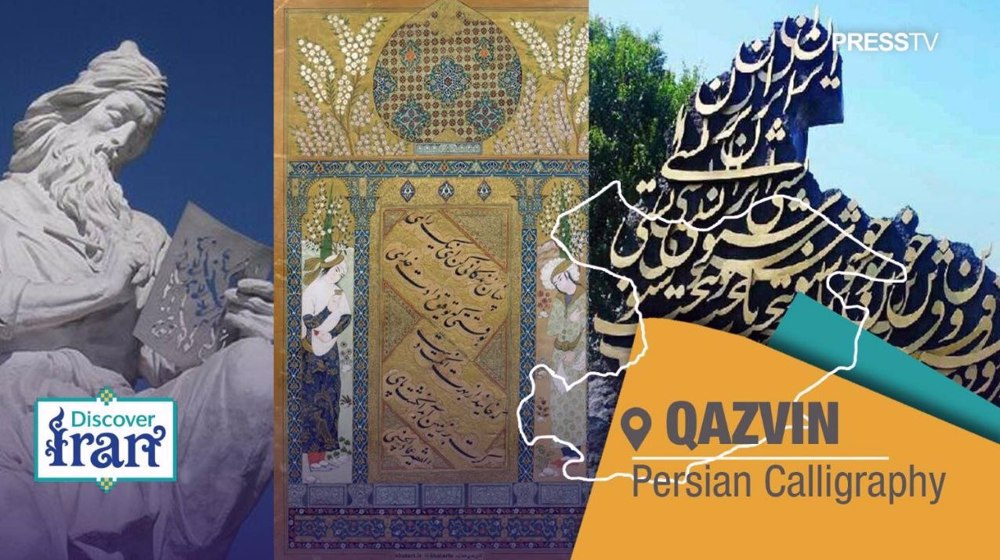
- Qazvin has been closely associated with the art of Persian calligraphy for centuries, with religious schools, Qur’anic study, royal patronage, and master-apprentice traditions helping establish and preserve the city’s reputation as a major center of calligraphy and manuscript production.
- The city reached a high point in the 16th century under the Safavids, when Shah Tahmasp made Qazvin his capital and established a royal library and workshops where calligraphers worked alongside painters and illuminators. The period also saw Nastaliq develop to a new level of refinement, strengthening Qazvin’s role in the history of Persian calligraphy.
- Qazvin became associated with a distinctive “Qazvin School” of calligraphy, defined by rigorous master-apprentice training and refined aesthetic principles. Its most celebrated figure is Mir Emad Hassani Qazvini, widely regarded as one of the greatest masters of Nastaliq and a defining figure in the city’s calligraphic heritage.
In the old quarters and religious schools of Qazvin, generations of scribes once sat with reed pens in hand, carefully shaping letters by candlelight. The city has long been closely associated with the art of handwriting, a tradition that has endured through centuries of Iran’s history.
Qazvin’s reputation as a center of calligraphy grew from a cultural tradition sustained over generations through religious schools devoted to Qur’anic study, royal patronage, and the close relationship between masters and apprentices.
That long tradition has earned Qazvin a place in Iran’s cultural memory as the Capital of Iranian Calligraphy.

Roots in schools and Safavid court
Qazvin’s connection with calligraphy goes back centuries. In the early Islamic period, the city was already an important center of scholarship, with religious schools devoted to the study of the Qur’an and Hadith. The growing need to copy religious and scholarly texts helped establish a tradition of professional scribes.
Early work was largely written in Kufic (earliest Islamic calligraphy style), before the more fluid Naskhi (cursive style) script became widely used. By the seventh and eighth centuries AH, as libraries and scholarly institutions expanded, calligraphy was developing beyond a practical skill and was increasingly valued as an art in its own right.
Religious schools and Sufi lodges became important places for this development. The study of the Qur’an, literature and other scholarly works went hand in hand with the careful training of calligraphy, helping establish a tradition that would remain part of Qazvin’s cultural life for centuries.
Qazvin reached a turning point in the mid-16th century, when Safavid ruler Shah Tahmasp made the city his capital. The move brought the royal court, along with a royal library, workshops for miniature painting and illumination, and artists and scholars from across the Persian world.
The royal workshops produced Qur’ans, poetry collections and historical chronicles, with calligraphers working alongside painters and illuminators. Each manuscript could involve the work of several specialists, and the quality of the handwriting was given the same attention as the artwork surrounding it.
It was during this period that Nastaliq, already being developed by earlier Iranian masters, reached a new level of refinement and Qazvin became one of the important centers in the script’s development.
As books were highly valued objects in the Safavid court, their production was also an exercise in art and craftsmanship. That demand for beauty in writing helped raise the standards of those who practiced it.
Qazvin school and Mir Emad
Historians of Persian calligraphy speak often of the “Qazvin School” as a shared set of educational methods, aesthetic values and master-apprentice traditions cultivated in the city over generations.
In traditional teaching, a student might spend years under a master’s watch simply practicing individual letters, the angle of the pen, the pressure of the stroke, and the balance between thick and thin. Only after mastering individual letters would a student progress to joining them into words, and then to composing full works.
It was a discipline built patiently, letter by letter, and it produced calligraphers whose names would eventually become known far beyond Qazvin’s walls.
No name is more inseparable from Qazvin than that of Mir Emad Hassani Qazvini, born in the city in the second half of the tenth century AH and recognized, almost from childhood, as possessing an extraordinary sense of calligraphy.
Driven by his passion to perfect his craft, the young Mir Emad left Qazvin for Tabriz to study under Mulla Mohammad-Hossein Tabrizi. One day, he presented his master with a piece of calligraphy so refined that Mulla Mohammad-Hossein, unaware it was his own student’s hand, remarked, “If you can write like this, then write, otherwise, put down the pen.”
When Mir Emad revealed that the work was his, his master kissed both the page and the young calligrapher’s face, declaring,“Today you are the master of calligraphers.”

Historical accounts tell of his growing skill and reputation, which spread to Semnan, Damghan, Bastam, Tabaristan, Khorasan and Gilan, before finally carrying him, in his last years, to Isfahan, the new Safavid capital under Shah Abbas.
Mir Emad’s distinction lay in the grace and harmony of his work, a fluidity between letters that many consider the high point of Nastaliq calligraphy. For nearly four centuries, calligraphers found themselves drawn into his influence.
To write beautifully was, for a time, to write like Mir. Those who succeeded earned nicknames such as “Second Mir” or “Third Mir.” Others even signed their work “Mir Emad al-Hassani,” a sign of the lasting influence his name carried among later calligraphers.
While Mir Emad remains Qazvin’s most celebrated calligrapher, the city’s calligraphic lineage runs much deeper.
Mirza Mohammad-Hossein Emad al-Kottab Qazvini and Mirza Mohammad-Ali Khayareji Qazvini, the first calligrapher credited with rendering the Arabic word "Bismillah" in the shape of a bird, are counted among the city’s distinguished figures.

They are joined by Abd al-Majid Taliqani, a master of Shekasteh Nastaliq who lived more than a century after Mir Emad, and Malek-Mohammad Qazvini, who brought decorative calligraphy to new heights during the reign of Fath-Ali Shah Qajar.
According to veteran calligrapher Ahmad Pilehchi Qazvini, who began his own training in 1975 under calligraphy masters including Seyyed Ali Rafiei and Abol-Hasan Mohasses-Mostashari, no other Iranian city can claim three towering figures across three major branches of the art in the way Qazvin can, Mir Emad in Nastaliq, Taliqani in Shekasteh Nastaliq, and Malek-Mohammad in decorative calligraphy.
“This,” he argues, “is why people have come to regard Qazvin, without hesitation, as the capital of the art of calligraphy.”
Living tradition
Qazvin’s calligraphy tradition has continued into the present, supported by institutions, teachers and a steady interest among younger generations.
Qazvin’s Calligraphers’ Association runs educational courses, exhibitions and research sessions that keep traditional methods alive.
The city also holds a leading position nationally in the number of young people studying the art, many of whom are introduced to it during their school years, when practicing calligraphy is treated as a normal part of cultural education.

The city’s historic mosques, schools and caravanserais reinforce that tradition outside the classroom. Their walls and archways are inscribed with calligraphic works, allowing young artists to study authentic historical scripts simply by walking through their city.
The importance given to beautiful writing is rooted in a broader Iranian and Islamic tradition. A saying attributed to Imam Ali (AS) describes beautiful handwriting as “one of the keys to livelihood,” reflecting the value long attached to the skill and discipline of writing.
That appreciation remains evident in Qazvin today, where calligraphy continues to be taught, practiced and displayed. Traditional techniques are still passed on alongside newer styles, keeping the city’s calligraphic tradition active and ensuring that calligraphy remains an important part of Qazvin’s cultural life.
 This makes it easy to access the Press TV website