

Chinese President Xi Jinping has urged Shanghai Cooperation Organization (SCO) members to push back against unilateralism and power politics, saying international affairs must be governed by equal rights, international law and broad participation.
Addressing the 26th Meeting of the SCO Council of Heads of State in Bishkek, Kyrgyzstan, on Tuesday, Xi called for an “equal and orderly” multipolar world and more just and equitable global governance.
“We should promote the common values of humanity, reject double standards, exceptionalism, foreign interference, bullying and the law of the jungle, and advance the rule of law in international relations,” Xi said.
He said the principles of the UN Charter should remain the basic norms governing international relations and the foundation of the postwar international order. Major powers, he added, should lead by example by respecting international norms and upholding the rule of law.
Xi also warned against hegemonism, unilateralism and protectionism, saying the shift toward a multipolar world was “irreversible.”
He stressed that sovereign equality and mutual respect must form the basis of such a world, with all countries enjoying equal rights, opportunities and rules regardless of their size, strength or wealth.
The Chinese president further called for greater representation and a stronger voice for countries of the Global South in international affairs.
On global governance, Xi said international affairs should not be dictated by a single country, a group of countries or a bloc. Instead, he stated, global issues should be addressed collectively and international norms shaped through broad and inclusive participation.
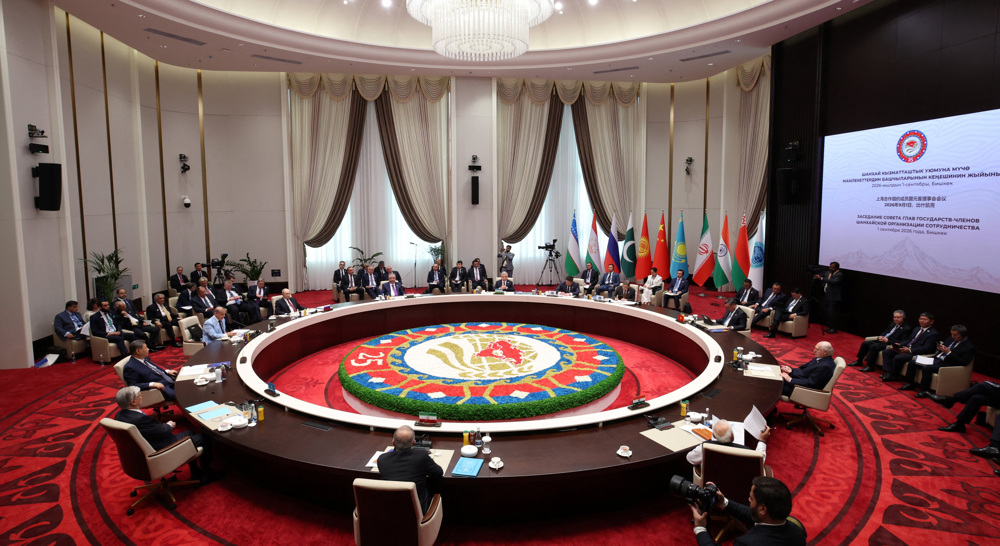
He called for restoring the authority and vitality of the United Nations and improving coordination among multilateral mechanisms at both the global and regional levels.
Xi also urged countries to reject protectionism, decoupling and supply-chain disruption, saying nations should instead focus on development, openness and cooperation.
He said the SCO, which brings together countries accounting for about half of the world’s population and a quarter of the global economy, could make a greater contribution to building an equal and orderly multipolar world.
Following a two-day summit in Bishkek, leaders of the organization signed a joint statement condemning the US and Israeli war of aggression against Iran and opposing Western sanctions imposed on some of the bloc’s members.
The Bishkek Declaration, signed by Xi, Iranian President Masoud Pezeshkian, Russian President Vladimir Putin, Indian Prime Minister Narendra Modi, Pakistani Prime Minister Shehbaz Sharif and other SCO leaders, also rejected “unilateral coercive measures” that violate UN and World Trade Organization rules and could have a negative impact on the global economy.
The SCO comprises China, Russia, Iran, India, Pakistan, Belarus, Uzbekistan, Kazakhstan, Tajikistan and Kyrgyzstan.
The Iranian president also called for a multipolar world order based on multilateralism, sovereign equality and the rule of law during an address to the Shanghai Plus summit.
He said the growing willingness of countries to play a greater role in international decision-making should not result in replacing one center of power with another or transferring hegemony from one power to another.
Pezeshkian also urged stronger and more effective action by the United Nations and its Security Council in addressing global developments, warning that continued violations of international law could undermine countries’ confidence in international mechanisms and diplomacy.
 This makes it easy to access the Press TV website