
By Press TV Website Staff
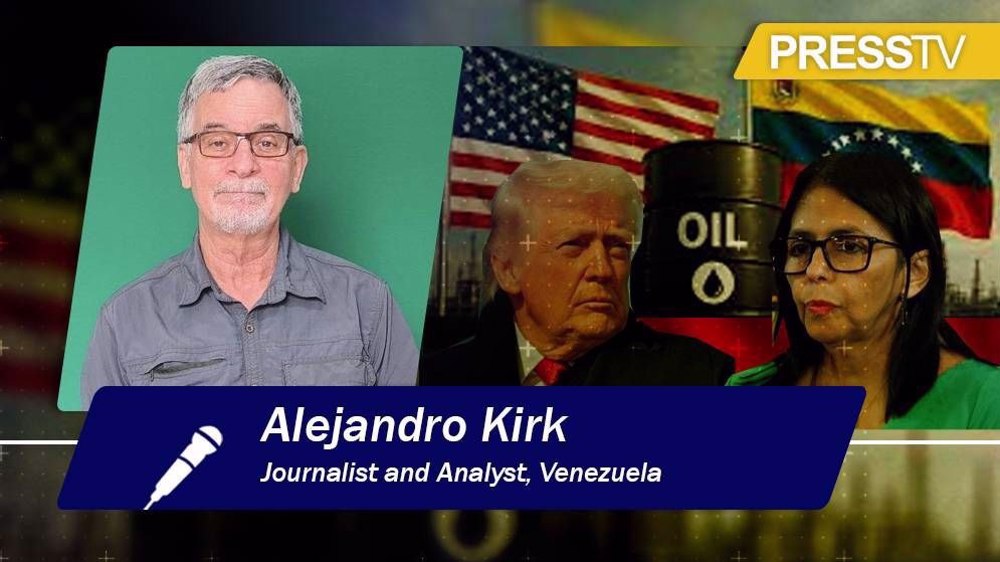
The United States’ agreement with Venezuela over the Latin American country’s vast oil resources should not be viewed merely as a commercial arrangement, but as part of a much longer history of US intervention in Latin America and the Caribbean, according to journalist and political analyst Alejandro Kirk.
US President Donald Trump described the agreement as the “biggest oil deal in world history,” with the United States gaining majority control over more than 65 billion barrels of Venezuela’s proven oil reserves.
Kirk, who is based in Venezuela, where he has reported for international media outlets for decades, said the agreement reflects a broader geopolitical strategy aimed at consolidating US influence in Latin America at a time when Washington’s global dominance is increasingly being challenged.
He, however, questioned the deal’s political durability, explaining that it was partly timed to appease US voters ahead of the November midterm elections.
The senior journalist and analyst noted that despite Washington’s control, on paper, of 22 percent of Venezuela’s proven oil reserves, it could take years for production to begin.
A new form of an old interventionism
In a freewheeling interview with the Press TV Website, Kirk said the resource-driven US interventionism in Latin America has never really disappeared. Rather, it has adapted to changing geopolitical circumstances.
“In the early 19th century, before becoming a global power, the US rejected the influence of European colonial states in the American continent,” he said, noting that most Spanish colonies were then fighting for independence and that the newly established North American state supported those struggles.
But Kirk emphasized that this support was selective. The independence movements were largely led by colonial elites who were themselves white settlers and were motivated in significant part by economic interests.
By contrast, he noted, Washington did not support or recognize Haiti’s independence from France in 1804 because the successful slave revolt was incompatible with the interests of a new US union that was itself based on slavery.
According to Kirk, US policy soon shifted toward treating the Western Hemisphere as its own sphere of influence.
“The US leadership began to see the continent as its own,” he said, pointing to the annexation of vast territories from Mexico as an early manifestation of that policy.
“The whole 20th century was one of constant US imperialist economic expansion and intervention in Latin America and the Caribbean, sometimes by sheer force and/or blockades, destabilization, subversion and terrorism, every time they saw their domination under threat,” he said.
What has changed today, Kirk said, is not the underlying nature of that interventionism but the global balance of power.
“The difference today is that US imperialism is no longer expanding and is quickly losing its hegemony over the world,” he said.
According to Kirk, the “disastrous” US aggression against Iran has further weakened Washington’s influence and increased the need to consolidate its position in what US policymakers have historically regarded as their “backyard,” particularly in anticipation of a broader confrontation with China.
From this perspective, Kirk sees the Venezuela oil agreement as more than an energy deal.
He described it as “a fence against Chinese, Russian and Iranian participation in that country’s energy sector,” while also carrying a broader political message: “Venezuela is no longer a sovereign country and its resources belong to the United States.”
Venezuelans march against US-Venezuela energy deal and foreign interference
— Press TV 🔻 (@PressTV) August 30, 2026
Gladys Quesada reports from Caracas pic.twitter.com/F0pebbcNgo
From military intervention to economic control
The timing of the agreement, Kirk said, is particularly significant because it followed the US attack of January 3 that resulted in the abduction of Venezuelan President Nicolás Maduro.
He said the attack was “probably the decisive moment of a previously agreed outcome involving some in the Venezuelan leadership and cannot be seen otherwise.”
“In a matter of hours, after months of an aeronaval blockade, the US forces achieved a striking success, kidnapping the President, with Donald Trump immediately announcing its objective: taking control of Venezuela’s oil,” he told the Press TV website.
According to Kirk, the political and economic consequences followed rapidly. Within three weeks, he said, the Venezuelan National Assembly approved a new hydrocarbons law that effectively overrode the country’s Constitution by removing safeguards protecting national sovereignty over natural resources and transferring direct control over oil and mineral sales and profits to US authorities.
Kirk said the Venezuela operation was intended to demonstrate a new model of US interventionism, one that would be “bold, quick, cheap and easy.”
The objective, he added, was not only to secure cheap oil and billions of dollars, but also to generate political benefits for Trump and the “techno-oligarchy behind him.”
He contrasted the relative success of the Venezuela operation with the subsequent US experience in Iran, where it carried out an all-out war of aggression in late February.
“When this ‘model’ failed two months later in Iran, Trump got caught in a quagmire, threatening the very existence of his administration,” Kirk said.
He also questioned the political durability of the Venezuela agreement itself, noting that it was designed partly to serve domestic US political purposes ahead of the November midterm elections.
“My view is that this ‘agreement’ forced onto Venezuela, with new economic actors — a joint venture between the US government and an obscure Venezuelan private oil firm — was timed to appease voters ahead of November’s midterm elections, where Trump is set for a historic defeat,” he said.
Kirk further cautioned that the scale of the agreement should not be confused with immediate oil production. While the United States is, on paper, now in control of 22 percent of Venezuela’s proven oil reserves — which he noted is eight times Mexico’s total proven reserves — extracting that oil could take years.
“So, it is basically a promise,” he said, adding that the agreement is “secret, illegal, and unconstitutional,” citing expert assessments.
Ultimately, he underscored, the decisive question is how Venezuelans themselves will respond.
“We are in an odd situation in which those Venezuelan Trump allies who pushed for US sanctions and military intervention are now shouting anti-imperialist slogans, astonished by the fact that what they were set to do is being done by their adversaries,” he noted.
Kirk explained that the continued influence and nationwide organizational structure of Chavista supporters and the United Socialist Party of Venezuela (PSUV) are central to understanding why the US strategy has so far been possible.
“Had the right-wing opposition taken over after Jan 3, the country would today most likely be in flames,” he said.
Kirk said PSUV and government officials have continued to urge their supporters to remain calm, arguing that the current situation is part of a strategy to buy time, regroup and eventually launch a counteroffensive.
“Step by step, however, it is increasingly clear that it is the US and its hundreds of military and civilian advisors who are pulling the strings,” he remarked.
That process, he said, includes the “depoliticizing” of the Venezuelan Armed Forces and the gradual removal of Hugo Chávez and Maduro from the collective imaginary.
He also warned against expecting a change in Washington’s Venezuela policy simply because of a possible Democratic victory in the November midterm elections.
“Those in Venezuela hoping that a hypothetical Democratic victory in November’s midterm elections will dramatically change the US approach towards Venezuela are in for a disappointment,” he said.
✍️ Viewpoint- Why Global Majority must unite against US imperialism in Iran, Venezuela, Cuba, Gaza
— Press TV 🔻 (@PressTV) March 11, 2026
By Syed Farid Alatashttps://t.co/rRMHalKxTa
Democracy, organized crime and the real strategic priority
The US has long justified its involvement in Latin America through appeals to democracy, security and the fight against organized crime. But Kirk noted that these have historically been secondary to Washington’s broader strategic and economic interests.
“Democracy has never been a priority,” he said. “Neither has been fighting organized crime.”
As an example, he cited the 1980s, when a CIA-handled drug-trafficking operation into the United States helped finance the “dirty war” against Nicaragua.
He also pointed to Chile under Salvador Allende.
“When Chile’s democratically elected socialist government of Salvador Allende nationalized copper and other industries, the US organized and financed destabilization, sabotage, terrorism, and sedition within the Armed Forces, provoking a bloody coup in 1973.”
Kirk likewise rejected the notion that Venezuela’s political transition can be explained simply in terms of concerns about electoral legitimacy. He noted that Nicolás Maduro was democratically reelected in 2024, as US intelligence services themselves had recently acknowledged that there was no significant election-rigging in Venezuela.
“The form may change according to circumstances,” he said, “but the essence is always the same: political, cultural, financial, military and economic imperial dominance.”
Is Latin America moving right — or being pushed right?
Kirk also responded to a question about whether the recent rise of right-wing governments and political movements across Latin America represents a fundamental ideological shift in the region.
He identified two factors that complicate the idea of an overwhelming popular shift toward the right. First, he said, many of the new right-wing governments have won by narrow margins, making it difficult to describe the trend as an overwhelming ideological shift in favor of “fascist forces.”
Second, he pointed to the growing role of media manipulation and algorithmically driven mass messaging on social networks.
“Voting is heavily manipulated by a combination of media and algorithmic massive messaging content spreading fake ‘information’ through social networks, in which generating fear is the main feature,” he said.
Kirk specifically linked operators of such networks and Israel, citing Fernando Cerimedo, an Argentine national recently arrested in Bolivia for attempted murder, and Brad Pascale, Cerimedo’s mentor, a former head of Trump’s digital campaigns and now the head of a multimillion-dollar Israeli effort to influence social networks.
The result, Kirk said, is a population being mobilized through fear, including fears about losing property that many people do not actually possess.
“The result is millions of dispossessed people panicking on the prospect of losing property they don’t have to a purportedly future communist government,” he said.
He further noted that the political majorities produced through such mechanisms are inherently fragile, particularly when governments subsequently implement policies that disappoint the very voters who elected them.
As an example, he cited Chile, where he said the government of José Kast, pro-Trump and pro-Israel, is “extorting money from workers to further enrich billionaires through huge tax cuts.”
“Furthermore, Kast is pushing legislation to acquire constitutional power to rule by decree at will for up to 240 days without asking for Congressional approval,” he added.
According to Kirk, the adoption of such preventive and repressive legislation is itself evidence of political and social fragility.
“This adoption of harsh preventive repressive legislation tells us a tale of political and social fragility which the cognitive war cannot sustain endlessly,” he said.
Trump calls plunder of Venezuelan oil a ‘gift’ as Washington tries to refill war-drained reserveshttps://t.co/GRuQwtsc2u
— Press TV 🔻 (@PressTV) August 31, 2026
A new Monroe Doctrine and the struggle with China
Kirk sees the current US approach to Latin America as an attempt to revive the Monroe Doctrine under substantially different conditions.
He said that the changing global balance has made Washington increasingly focused on containing China and preventing competing powers from expanding their economic and political presence in the Western Hemisphere.
In his assessment, Iran has played a significant role in accelerating that shift.
“One can say that it has been Iran that was forced to take responsibility for the new global order, by defeating the United States and becoming the rule-making power in the Persian Gulf,” Kirk said.
He pointed out that Iran’s resilience amid the ongoing war against the country has demonstrated that the US is a declining power increasingly unable to impose its hegemony, which is potentially “the most dangerous phase of any empire.”
At the center of Washington’s strategy, he said, is China.
“Washington sees China as its main global adversary,” Kirk said, describing the confrontation as economic as well as cultural, involving “two opposing concepts of economic relations, society and development,” he noted.
Against this backdrop, he said that Washington has effectively added the “Trump Corollary” to the Monroe Doctrine’s traditional principle of “America for the Americans.”
Under this interpretation, Kirk said, Latin America and the Caribbean are no longer merely Washington’s backyard but are increasingly being treated as US property.
“In this corollary, the so-called ‘Greater North America’ includes all countries north of the Equator with the entire Western Hemisphere as its zone of exclusive influence.”
Kirk also pointed to the creation of the “Shield of the Americas,” involving around 16 countries in a military alliance under direct US command.
Officially presented as a mechanism for combating organized crime and terrorism, Kirk said it is more likely intended to create large intervention forces capable of containing popular movements across the region.
He noted that the Chilean Army has openly expressed reservations about participating in such a scheme.
At the same time, Kirk said, Washington is attempting to pressure Latin American countries into reducing their economic ties with China.
“Washington is actively pushing countries to break economic ties with China, the region’s main trade partner, in a rather helpless last attempt to regain the position it had in the past.”
Such a reversal, he added, is not merely unlikely but impossible because the United States is already unable to replace China’s manufacturing and technological capacities.
The pressure is also creating divisions among Washington’s own allies, according to Kirk, because local economic elites have different interests depending on whom they trade with.
“The odd recent times in which governments could simultaneously remain ideologically, politically and militarily linked to the United States while enjoying a profitable trade partnership with China seem to be over,” he said.
Kirk also highlighted the language used by Venezuela’s acting president, Delcy Rodríguez, when announcing the oil agreement. Rodríguez, he noted, emphasized the deal’s contribution to “energy security for the hemisphere.”
Kirk said that formulation is significant because of its similarity to the traditional language of the Monroe Doctrine.
Who could be next?
The Venezuela operation, Kirk said, could have implications far beyond Latin America because it demonstrates a potentially exportable model of intervention.
According to Kirk, governments across the Global South and elsewhere may be watching the outcome with relief following the negative result, from the perspective of the United States and Israel, of the aggression against Iran.
He stressed that this reaction does not necessarily reflect sympathy for Tehran. Rather, he said, Iran’s resistance may have prevented Washington from applying the “Venezuela Experiment” elsewhere.
“Otherwise, Trump would have felt emboldened enough to take Cuba, Greenland and even Canada,” Kirk said.
Kirk sees Cuba as the most obvious potential next target. However, he believes several factors could restrain Washington from launching a full-scale invasion, including the prospect of a bloody ground campaign, the likely loss of hundreds or even thousands of US lives and a lack of sufficient ordnance for such an effort.
“Brazil and Mexico, Latin America´s largest economies, are two natural targets for Trump, for they have powerful economies, plenty of natural resources and large territories. On top, their governments uphold sovereign policies and do not take orders from Washington,” he noted.
“It comes then as no surprise,” Kirk said, “that the Zionist-led cognitive social-network war against [Brazilian President Luiz Inácio] Lula da Silva and [Mexican President Claudia] Sheinbaum is in full swing as we speak.”
He pointed in particular to growing discussion in Brazil about relaunching the country’s nuclear weapons development, which was abandoned in 1990 following the end of the military dictatorship.
Kirk said President Lula himself has suggested that, if reelected, Brazil’s nuclear doctrine should be reviewed to prevent a potential attack by the United States.
According to Kirk, Brazil already possesses the technology and means required to produce a nuclear weapon relatively quickly.
 This makes it easy to access the Press TV website