
By Maryam Bashirpour
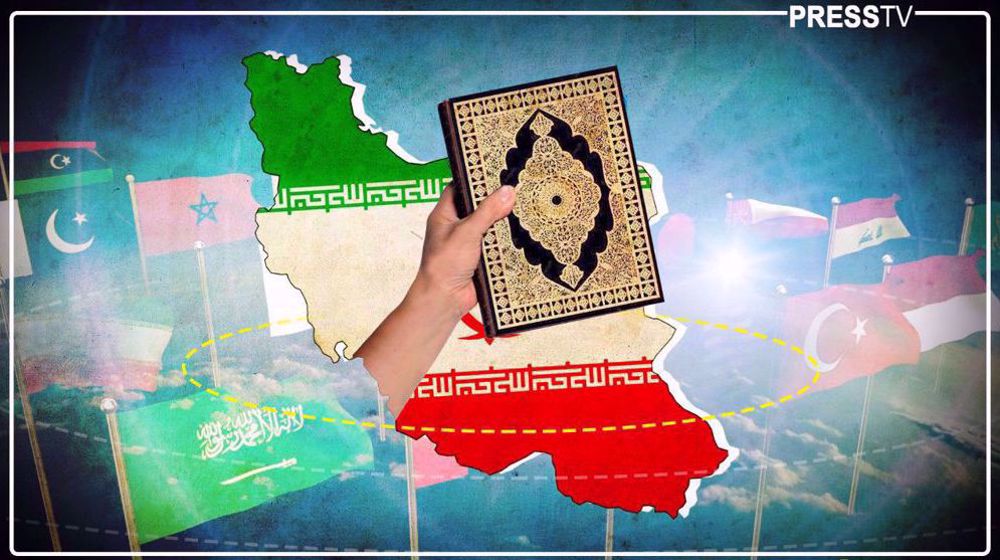
The cities across Iran take on a different color during Islamic Unity Week every year, coming alive with a powerful sense of unity and solidarity as Iranians from different walks of life commemorate the birth anniversary of Prophet Mohammad (peace be upon him).
Across the country, banners and placards adorn the entrances to streets and squares, carrying messages of devotion to the Noble Prophet of Islam (PBUH) and calling for Sunni-Shia unity.
Passersby often pause to take in the displays and capture them in photographs, as though the entire country has been transformed into a vast canvas proclaiming the timeless message of brotherhood that the Islamic Republic of Iran has consistently championed.
These powerful expressions of unity serve as a living reminder of a vision first articulated decades ago by the founder of the Islamic Revolution, Imam Khomeini (RA), and later carried forward by the martyred Leader of the Islamic Revolution, Ayatollah Seyyed Ali Khamenei.
Tracing the roots of Unity Week: Imam Khomeini’s (RA) vision
One of Imam Khomeini’s most important initiatives for strengthening unity was the designation of “Unity Week” on the occasion of the birth of the Noble Prophet (PBUH).
Traditionally, Sunnis celebrate his birth on the twelfth of Rabi’ al-Awwal, while Shiites celebrate it on the seventeenth of the same month. Rather than fueling these differences, Imam Khomeini proposed that the entire interval between these two dates be commemorated as the Week of Unity and Brotherhood.
His dream was for Muslims to shift their focus away from what separates them and toward what unites them: their shared love and devotion to the Prophet (PBUH).
Since then, Unity Week has become a platform for dialogue and exchange among followers of the two denominations, allowing them once again to emphasize the fundamental principles of Islam.
Imam Khomeini’s efforts to establish this tradition have left a lasting impact, and Unity Week is now, in Iran and many parts of the Islamic world, a reminder of the importance of cooperation and mutual respect between Shiites and Sunnis.
Imam Khomeini repeatedly emphasized the urgency of unity, citing verses from the Qur’an. He said: “We must be awake and know that the divine command is this: ‘Indeed, the believers are brothers’; believers are brothers to one another. There is nothing between them except brotherhood, and they are obliged to behave as brothers.
This is a political matter: that all Muslim nations, nearly one billion people, be brothers to one another. In that case, no harm can befall them, and none of the superpowers can attack them.”
He also said: “Sunni and Shiite are brothers and must avoid every kind of disagreement... Muslims must be united and stand as one against all oppressors. If Muslims were a single fist, no one could stand against them.”
Leader of Iran’s Islamic Revolution says the triumph of Islam and Muslims playing an epochal role have never been nearer at hand, reiterating his call to Islamic heads of state, especially those in the Persian Gulf region, to know their real enemy and its plots. pic.twitter.com/QCdl1iZWuT
— Press TV 🔻 (@PressTV) August 30, 2026
The enemy’s strategy: The old project of sowing discord
For years, the US and the Zionist regime have designed a coordinated program to sow division and discord among Muslims. From supporting Takfiri and terrorist groups to investing billions in media outlets that pit Shiites against Sunnis, the strategy has been systematic.
The martyred Leader of the Islamic Revolution, Ayatollah Seyyed Ali Khamenei, repeatedly stressed that these enemies are hostile not only to Iran, but to the entire Islamic world.
These enemies know well that a divided Islamic world is a weak Islamic world. Therefore, they fuel religious differences, ignite ethnic tensions, and support extremist ideologies in order to keep the Islamic Ummah fragmented. They spend billions of dollars on media propaganda campaigns designed to portray Shiites and Sunnis as irreconcilable enemies.
The objective of this project is clear: a divided Ummah is a weak Ummah whose resources can easily be plundered, whose destiny can be controlled, and which can be trapped in endless proxy wars.
A prominent example of this strategy can be seen in West Asian Arab countries, where, by exacerbating religious divisions, the enemy has been able for years to oppress people who, had they been united, would never have tolerated such injustice.
Iran’s response: Not merely a slogan, but a lived model
In response to this project, Iran has not limited itself to slogans and statements. The Islamic Republic hosts the “International Islamic Unity Conference” in Tehran every year, bringing together Muslim scholars and thinkers from dozens of countries.
The 39th edition of this conference last year was held under the slogan “The Prophet of Mercy and the Unity of the Islamic Ummah” and emphasized the issue of Palestine as the principal axis of convergence. This year, the focus was on “Islamic Unity in the Thought of the Martyred Imam (Leader of the Islamic Revolution).”
Beyond these events, however, Iran presents a “lived model” of Sunni-Shia coexistence.
Mohammad-Bagher Ghalibaf, Speaker of the Iranian parliament, in his message this year, said the unity among Muslims led to the defeat of their enemies, stressing that extra-regional powers cannot bring security to the region.
“Today, Sunni-Shia unity in Iran is not merely a ceremonial slogan, but one of the pillars of national power and one of the country’s great assets for security and development,” he said.
In Iran, Shiites and Sunnis pray alongside one another, commemorate each other’s celebrations and mourning ceremonies, and stand united in defense of the country. This coexistence was thoroughly tested during the recent imposed wars, when Iranians of every ethnicity and religious denomination stood side by side in defense of the borders and frustrated the enemy.
Throughout the two imposed wars, this unity was put to a severe test and proved its resilience. Iranians from every social and religious background – Shiite and Sunni, Persian and Kurdish, Arab and Baluch – united in defense of their country’s soil. This solidarity, forged in the midst of hardship, has today become one of the pillars of national power.
✍🏻Feature - United we stand: Ayatollah Khamenei’s lifelong mission to unite Muslims against enemies’ hostile plots
— Press TV 🔻 (@PressTV) August 30, 2026
By @HumairaAhad_83 https://t.co/rvB1frBkHO
Palestine: The great test of Islamic unity
If there is a common issue capable of bringing the hearts of Muslims closer together, it is undoubtedly Palestine. The ongoing Israeli-American genocide in Gaza has revealed the true face of the Zionist regime to the world and demonstrated that this regime is not merely the enemy of Shiites, but the enemy of all Muslims.
Palestine has consistently featured in the unity conferences in Iran, with women researchers, activists, and experts addressing the immediate challenges facing the Islamic world. The endless suffering of the Palestinians is a bitter reminder of the fate of divided societies and demonstrates what great achievements Muslims can accomplish if they unite.
As one Sunni scholar said at last year’s conference, Gaza is a deep wound on the body of the Islamic Ummah, and unity has never been as necessary as it is today. The enemies of Islam know well that a united Muslim Ummah would become a tremendous force that could no longer be easily manipulated or exploited.
A new horizon: From unity week to a regional union
But the matter does not end there. Qalibaf spoke of “new regional pacts” that could mark “the beginning of a new chapter” in the convergence of Muslim neighbors.
His reference is to the growing economic, security, and political cooperation between Iran and the Arab countries of the region, including Saudi Arabia, the United Arab Emirates, Egypt, and others, which has accelerated under the active diplomacy of the new government.
This vision goes beyond a symbolic week and moves toward “lasting regional unions,” where shared economic interests, collective security, and confronting external threats bind Muslims together more closely than ever.
Leader of the Islamic Revolution Ayatollah Seyyed Mojtaba Khamenei has also repeatedly emphasized that the future of the region belongs to the region itself and that Islamic countries, without the need for outsiders, can shape the order they desire.
Pezeshkian congratulates Muslim states on Prophet's birth anniversaryhttps://t.co/Gc73ih6hXQ
— Press TV 🔻 (@PressTV) August 30, 2026
Iran’s role: Not a country, but an idea
In this context, Iran is not merely a country; it is “an idea.” The idea of independence, the idea of resistance, and the idea of the unity of the Ummah.
From the very first day of the Islamic Revolution, the slogan “Neither East nor West, Islamic Republic” demonstrated that Iran was not going to join the camp of either superpower, but sought to become a new pole in the Islamic world. This pole is founded upon justice, freedom, and Islamic brotherhood.
A tangible example of this outlook is Iran’s unwavering support for the resistance in Palestine and the rest of the region, and support that is based not on sect, but on “right” and “resistance to oppression.” President Masoud Pezeshkian rightly said: “We seek neither conflict nor division, but we will not remain silent in the face of oppression.”
This is the essence of Iran’s foreign policy, a policy that places the unity of Muslims at the forefront. It has been like this since the 1979 Islamic Revolution.
A single fist against the storm
The birth of the Noble Prophet (PBUH) and Unity Week are not merely a religious celebration; rather, they are an opportunity to reflect upon his message of mercy, justice, and brotherhood.
Islamic Unity Week, born from the far-sighted vision of Imam Khomeini, is a powerful symbol of the achievements Muslims can attain by moving beyond sectarian differences and focusing on their shared faith and common challenges.
Decades ago, Imam Khomeini envisioned this dream, and today the Islamic Republic of Iran, through its lived model of Sunni-Shia coexistence, with Palestine as a focal point, through a strategy of unity in the face of imposed wars, and through its vision of regional unions, has demonstrated that this dream is achievable.
The United States and the Zionist regime will continue their extensive investment in division. They will equip Takfiri groups, spread false propaganda, and exploit every fissure. As the martyred Leader of the Islamic Revolution repeatedly emphasized, the United States and the Zionist regime are not merely enemies of Iran, but enemies of the entire Islamic world.
Maryam Bashirpour is a university researcher and writer based in Tehran.
(The views expressed in this article do not necessarily reflect those of Press TV)
 This makes it easy to access the Press TV website