Islamic Unity Conference in Tehran urges Muslim resistance against Israel, US

Calls for Muslim unity and resistance to Israel and the US have dominated an Islamic Unity Conference in Tehran, with speakers warning that failure to confront Israeli aggression could see the threat spread from Lebanon and Syria to other countries across the region.
The remarks came as Muslim scholars and intellectuals gathered at the mausoleum of the founder of the Islamic Republic, Imam Khomeini, for the 40th International Conference on Islamic Unity, which opened in Tehran on Thursday.
The conference has brought together hundreds of Muslim scholars and thinkers from around 40 countries under the theme of Islamic unity in the thought of the martyred Leader Ayatollah Seyyed Ali Khamenei.
Speakers at the conference stressed the need to overcome sectarian differences, strengthen solidarity among Muslims and support the peoples of Palestine and Lebanon, while stressing that unity is essential to confronting US and Israeli efforts to dominate the region.
Lebanese scholar Sheikh Hassan Baghdadi said Imam Khomeini elevated Islamic unity from a general principle to a strategic project, linking it to the Palestinian cause and the establishment of International Quds Day.
He said Palestine remains a central issue for the Muslim world because it has been used by Western colonial powers as a strategic foothold for intervention in the region and the separation of Arab and Muslim countries.
“Today as well, the same expansionist plan of America and Israel against Iran and the resistance front is being pursued, but with patience, endurance and doing what we can, God willing, we will prevail over this plan,” Baghdadi said.
He said Imam Khomeini also outlined a broader approach to confronting threats, encompassing economic resistance, work and production, military strength, domestic unity and unity among Muslims.
Baghdadi said the need for such unity has become more urgent amid the current regional situation.
“Today, more than ever, we need to adhere to this method and choose Islamic unity to stand against aggression and oppression,” he said.
‘Unity’ as a way out of sectarian division
Baghdadi also emphasized the role of rapprochement among Islamic schools of thought in reducing sectarian hostility and preventing Muslims from falling into a cycle of mutual accusations and takfir.
He said scholars who understand the jurisprudential foundations of different Islamic schools are better positioned to assess religious questions and understand the points of agreement among Muslims.
Rapprochement also allows Islamic scholars to better understand developments across the Muslim world and examine them through evidence accepted by Muslims from the Quran and Sunnah, he said.
“Muslims must be made aware of what the enemies and hypocrites want, and religious differences must not be allowed to prevent Muslim unity,” Baghdadi said.
He said even when governments prevent rapprochement between religious schools, popular sentiment among Muslims can continue to drive unity.
Baghdadi cited Israel’s withdrawal from southern Lebanon in 2000 and the 2006 Lebanon war, saying Muslims across the Arab and Islamic worlds celebrated victories for the resistance.
“Governments could not stop the feelings of Muslims,” he said.
He said that Palestine could similarly serve as a unifying issue capable of bringing Muslims together despite sectarian differences.
“Palestine can be a comprehensive title that brings Muslims together,” Baghdadi said.

US-Israeli hostility, wider regional threat
Seyyed Hassan Khomeini, custodian of Imam Khomeini’s mausoleum, similarly warned that Israel’s threats should not be viewed as confined to the current front lines.
He said Muslim rulers should not assume that US President Donald Trump and Israeli prime minister Benjamin Netanyahu are acting in their interests.
“The rulers of the Islamic world think that Trump and Netanyahu are their well-wishers?!” he said.
“If we do not stand against the Zionists, tomorrow Lebanon and Syria will not be the only fields of threat, and Saudi Arabia and Türkiye will also be under their bayonets,” Khomeini said.
He urged Muslims to combine resistance toward external enemies with greater solidarity among themselves.
“Muslims must stand against the enemies, but among themselves they must act with affection and kindness and take the initiative to resolve each other’s problems,” he said.
Khomeini said unity is not merely a tactical slogan associated with Imam Khomeini but a lasting principle.
“Imam did not present unity as a tactical statement,” he said. “Unity has been our slogan, it must be and it will be.”
He also pointed to the experience of Palestine and Lebanon, saying those who stood with their peoples will be vindicated, while those who failed to do so will eventually face a moral reckoning.
Khomeini also directly appealed to Muslim scholars over the assassination of Imam Khamenei, questioning their response to the terrorist attack.
“Where are the scholars of the Muslim world?” he asked.
“Six months ago, one of the sons of the Messenger of God, a pious human being, a symbol of confronting hegemony and a voice for the freedom of Muslims in Palestine and Lebanon and everywhere, was martyred by the vilest of people,” Khomeini said.
He recalled Imam Khomeini’s warning during the Iran-Iraq War that regional rulers should not assume that supporting an attack on Iran would leave them safe from its consequences.
He said that when Iraq attacked Iran, Imam Khomeini had warned some rulers in the southern Persian Gulf that if Iraq succeeded in overcoming Iran, it would eventually turn against them as well.
“Less than a year after the end of the war, it attacked Kuwait,” Khomeini said.
Khomeini praised the Iranian people for standing on their own feet and resisting pressure, saying those who supported Iran have fulfilled their duty to the Prophet, while those who did not will eventually face him with shame.
Quranic teachings and responsibility
American Islamic thinker and Quran commentator Mohammad al-Asi focused on the relationship between divine will and human responsibility, stating that Quranic teachings on struggle and defense require Muslims to understand both their duty to act and their reliance on God for the ultimate outcome.
Referring to the Quranic verse “Kutiba ‘alaykumu al-qital” — “Fighting has been prescribed for you” — al-Asi highlighted the grammatical construction of the verse and its implications for understanding the relationship between divine will and human responsibility.
He said Muslims are witnessing killings, massacres, ethnic cleansing, war crimes and crimes against humanity and that scholars and Islamic movements have to determine their responsibilities in response.
“If scholars, thinkers and Islamic movements understand this reality, they must determine their position toward the duty they have in such circumstances,” al-Asi said.
He also cited the Quranic verse “And victory is only from Allah,” stating that human beings must fulfill their responsibilities while recognizing that ultimate victory comes from God.
“We must ask ourselves whether we are performing our duty with this spirit and this outlook,” he said.
Al-Asi also referred to verses at the beginning of the Quran’s Surah al-Isra concerning the Al-Aqsa Mosque and urged Muslims to reflect on their significance for the Palestinian cause.
Unity presented as regional strategy
The conference’s discussions linked religious unity with broader political and security questions facing Muslim countries, with speakers stating that sectarian divisions weaken the ability of Muslim societies to respond to external pressure.
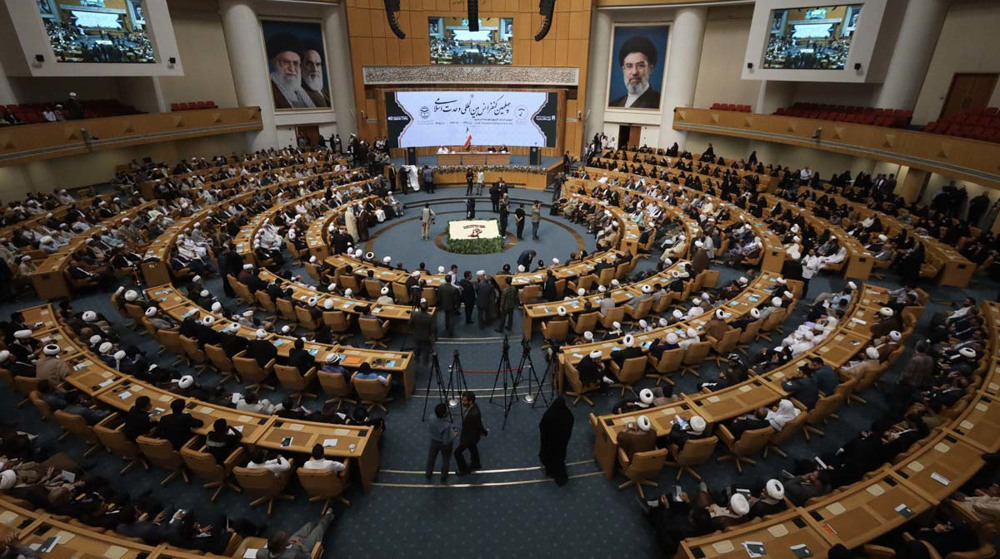
The conference organizers have described Islamic unity as a means of strengthening cohesion among Muslims, promoting cooperation among religious scholars and thinkers and addressing challenges facing Muslim countries.
The event is being held during Islamic Unity Week, the period between the dates observed by Sunni and Shia Muslims for the birth anniversary of Prophet Muhammad (peace be upon Him). The observance was established in Iran following Imam Khomeini’s call for Muslims to use the occasion to promote unity.
Across the conference, the speakers' arguments converged on the view that Muslim unity should go beyond ceremonial calls for solidarity and serve as a practical response to regional conflicts, sectarian divisions and foreign intervention.

Basij chief: US turns to economic war after failing to destroy Iran

Iran warns states not to become complicit in US ‘economic terrorism’

No one will sell oil in region if Iran cannot: Parliament speaker



Islamic Unity Conference in Tehran urges Muslim resistance against Israel, US
Islamabad MoU: US signature, hollow from the start
Iran warns states not to become complicit in US ‘economic terrorism’
No one will sell oil in region if Iran cannot: Parliament speaker
Basij chief: US turns to economic war after failing to destroy Iran
Iran prepares ‘surprises’ in weapons, tactics for any future war
'Ideological cover for war': Anti-imperialist scholars condemn Guardian open letter over Iran
Iran says changed balance of power, proved era of hit-and-run over


 PressTV NEWSLETTER now
  This makes it easy to access the Press TV website