
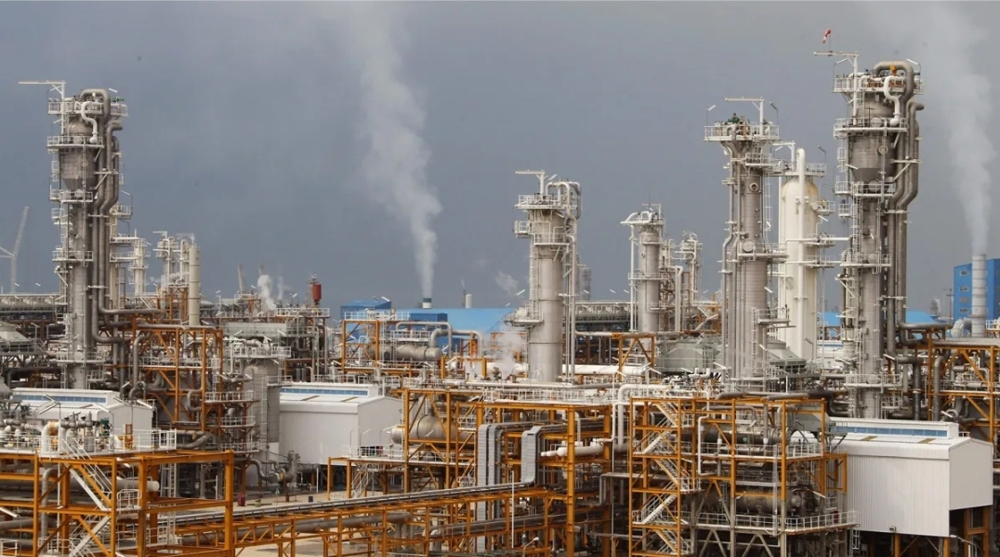
Iran has restored about 40% of production capacity damaged at the giant South Pars gas field following repeated US-Israeli attacks, Deputy Oil Minister for Planning Ahmad Zeraatkar says, as Tehran accelerates reconstruction and expands domestic refining capacity.
“About 40% of the damaged capacity has now returned to service, and production in this part has resumed,” Zeraatkar said on Thursday.
Iranian energy workers have brought several damaged units back online ahead of schedule, Zeraatkar said, demonstrating the rapid progress being made in restoring the affected facilities.
He said full reconstruction will take at least two years given the scale of the damage, but stressed that the work is advancing steadily by relying on Iran’s domestic capabilities.
“The complete reconstruction of the damaged sites is time-consuming and will require at least about two years,” he said.
Iranian financial institutions have also joined the reconstruction effort, with four domestic financing projects established as part of one of the country’s largest financing packages, he said.
Debris removal at the damaged facilities has been completed and reconstruction is now proceeding in an organized and planned manner, Zeraatkar said.
Gholamabbas Hosseini, managing director of the South Pars Gas Complex, also said that debris removal operations at four damaged refineries had been completed through round-the-clock efforts by specialized personnel.
Reconstruction of the units is now being pursued through a program-based approach relying on domestic capabilities, Hosseini said, adding that major maintenance, equipment upkeep and operational process upgrades have increased the readiness of the complex’s refineries to sustain stable and reliable gas production.
“All specialized and operational capacities are being deployed to maintain production stability, particularly during the cold months of the year,” he said.
On Wednesday, an agreement was signed for the reconstruction of the refineries serving phases 9 and 10 of the joint South Pars field between Pars Oil and Gas Company and a consortium led by Shahr Bank.
Ebrahim Soleimani, acting project manager for the reconstruction of the Phase 9 and 10 refineries, said debris removal and safety operations in the damaged sections had been completed in less than two months.
Reconstruction activities entered the implementation stage after safe conditions were established, Soleimani said.
The latest recovery is part of a broader effort to restore South Pars after the strategic energy hub came under repeated terrorist attacks during the US-Israeli wars on Iran.
South Pars, located in Iran’s Persian Gulf waters and sharing the giant gas reservoir with Qatar’s North Field, is central to Iran’s domestic energy supply and petrochemical industry.
On April 6, during the 40-day Ramadan war, US-Israeli strikes hit facilities in the South Pars industrial complex in Asaluyeh, including the Jam and Damavand petrochemical facilities. The attacks disrupted electricity and other essential utilities serving surrounding petrochemical plants.
South Pars had already been targeted during the 12-day war in June 2025, making the subsequent reconstruction a repeated test of Iran’s ability to keep its energy infrastructure operating under sustained military pressure.
Iranian engineers moved rapidly to restore some damaged facilities. At the Phase 14 refinery, three gas-sweetening trains that suffered less severe damage were repaired and returned to production in less than 10 days, according to Iranian officials.
The attacks targeted infrastructure directly linked to the daily lives of ordinary Iranians, Zeraatkar said.
“The main objective of the attacks was to target vital infrastructure and ultimately put pressure on the Iranian people,” he said, noting that natural gas is essential for households and commercial facilities as well as factories and industries.
Iran has managed to get through the summer without damage to its vital energy networks and is preparing to maintain the stability of the gas network through the coming winter, Zeraatkar added.
Alongside the reconstruction of its gas infrastructure, Iran is preparing to increase domestic gasoline production through the launch of two new refineries.
Mohammad-Sadegh Azimifar, managing director of the National Iranian Oil Products Refining and Distribution Company, said the Adish Southern and Mehr Persian Gulf refineries will be launched by the end of the year, raising national gasoline production by about 12 million liters per day.
Iran will add 12 million liters to its daily gasoline production capacity with the launch of two refineries—Adish South and Mehr Persian Gulf—before the Persian year’s end, according to the state oil distributor. The increase equals about 9% of current daily gasoline demand. pic.twitter.com/X3zgsOAAuE
— Press TV 🔻 (@PressTV) August 26, 2026
The increase will equal about 9% of the country’s gasoline consumption and could strengthen domestic production and supply capacity for the strategic fuel, Azimifar said.
The Adish Southern refinery is currently receiving feedstock and its commissioning process is underway, while the Mehr Persian Gulf refinery is scheduled to become operational by the end of the year, he said.
The reconstruction and expansion efforts come as Washington has intensified economic pressure on Tehran through sanctions and a naval blockade aimed at restricting Iran’s energy revenues and international trade.
Despite the pressure, Iran has continued exporting crude oil, with China remaining a major buyer. Chinese purchases of Iranian crude have remained close to the previous year’s levels despite U.S. efforts to restrict Tehran’s oil revenues through sanctions and enforcement measures.
China has also denounced the threat of U.S. sanctions over trade with Iran, saying such measures would be illegal.
Iran has also sought to adapt its wider energy system to pressures created by the war and sanctions, including through greater emphasis on energy efficiency and demand management, while pursuing additional solar and nuclear generation and alternative routes for energy exports.
 This makes it easy to access the Press TV website